

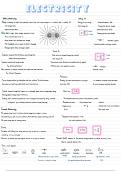
Static
electricity :
Voltage : (V)
Charge : a
property of matter that experiences a force when next to other
charges or in an electric field-coulomb ( C ) Energy per unit charge
·
Potential difference (pd)
-
Like charges repel Unit Voltage (V)
:
Cenergy lost by each charge
Opposite charges attract Electromotive force (emf)
·
-
Eletric field : a
region where charges experience a force - energyerge Cenergy gained by each charge
Drawn with lines from to-ve
-
the
---
Space between lines represents field strength voltmeter Symbol
-
The straightest is where the field strongest Connected parallel
-
is
·
curve to what measure
you
Charged objects attract
uncharged objects
-
Current (1)
:
Conductors materials that let electrons pass Rate of flow of charges
Chargea
through them (charges second
·
:
per
-
metals a re the best conductors
·
Unit Ampere (A)
:
=
Insulators : materials that hardly conduct Conventional current (direction of current) :
positive to
negative
E plastics glass dry Electrons flow negative to positive
·
.
.
g ,
air from A
Ammeter
,
Semi-conductors : 'In between' materials that conduct much better when more
·
Connected in Series
E g. Silicon
.
& Germanium
Resistance :
You insulators. The friction
charge insulators by rubbing them Property charges. If
·
with other between current decreases
of matter that resists flow of resistance
can ·
increases
,
them causes one object to
gain electrons & one to loose electrons ·
Unit : Ohm (2) ·
If current increases
,
resistance decreases
Induced charges charges : that
appear on an uncharged object due to a charged object nearby Ohm's law : V =
IR
Inducing objects :
charged object + earth wire
Earthing The temperature has
·
It
: when unwanted
charge buits up, it can be
dangerous .
is earthed
by being connected to be constant to keep resistance constant
to the
ground by a
conducting material ,
so unwanted
charge flows away Resistance of wires : Cross sectional a re a
: material :
Length of wire : Ra1 nichrome wires have m o re resistance
A
Current Electricity :
RCL than copper wires
The to deliver electrical
·
purpose of circuit
any is
energy from a
supply to a device
·
The
electricity in a cable is a flow of electrons . Most cables have copper conducting wires with Temperature : metal conductors : TV R↑
PVC plastic non-metal conductors : TTRX
around them as
insulating material
Circuits
·
An electric cell (battery) can make electrons m ove
if there is a conductor
P =
VI P =
RR p
=
connecting its two terminals
·
Electrons are pushed from the negative terminal to the positive terminal
Kilowatt (kWh) :
measure of the electrical
energy consumed by 1000W of power in 1 hour
Used to calculate electrical
·
bills
Some circuit Symbols :
(t) &
Single cell Connectinga Switch
lamp diode variable resistor thermistor fixed resistor LDR
(length)
Allows current to flow in
only one direction (changes due to temperature Ligth dependent resistor
Can convert to d the higher the temperature the lower the resistance LTRt
a c
. .
voltage . c .
voltage ,
electricity :
Voltage : (V)
Charge : a
property of matter that experiences a force when next to other
charges or in an electric field-coulomb ( C ) Energy per unit charge
·
Potential difference (pd)
-
Like charges repel Unit Voltage (V)
:
Cenergy lost by each charge
Opposite charges attract Electromotive force (emf)
·
-
Eletric field : a
region where charges experience a force - energyerge Cenergy gained by each charge
Drawn with lines from to-ve
-
the
---
Space between lines represents field strength voltmeter Symbol
-
The straightest is where the field strongest Connected parallel
-
is
·
curve to what measure
you
Charged objects attract
uncharged objects
-
Current (1)
:
Conductors materials that let electrons pass Rate of flow of charges
Chargea
through them (charges second
·
:
per
-
metals a re the best conductors
·
Unit Ampere (A)
:
=
Insulators : materials that hardly conduct Conventional current (direction of current) :
positive to
negative
E plastics glass dry Electrons flow negative to positive
·
.
.
g ,
air from A
Ammeter
,
Semi-conductors : 'In between' materials that conduct much better when more
·
Connected in Series
E g. Silicon
.
& Germanium
Resistance :
You insulators. The friction
charge insulators by rubbing them Property charges. If
·
with other between current decreases
of matter that resists flow of resistance
can ·
increases
,
them causes one object to
gain electrons & one to loose electrons ·
Unit : Ohm (2) ·
If current increases
,
resistance decreases
Induced charges charges : that
appear on an uncharged object due to a charged object nearby Ohm's law : V =
IR
Inducing objects :
charged object + earth wire
Earthing The temperature has
·
It
: when unwanted
charge buits up, it can be
dangerous .
is earthed
by being connected to be constant to keep resistance constant
to the
ground by a
conducting material ,
so unwanted
charge flows away Resistance of wires : Cross sectional a re a
: material :
Length of wire : Ra1 nichrome wires have m o re resistance
A
Current Electricity :
RCL than copper wires
The to deliver electrical
·
purpose of circuit
any is
energy from a
supply to a device
·
The
electricity in a cable is a flow of electrons . Most cables have copper conducting wires with Temperature : metal conductors : TV R↑
PVC plastic non-metal conductors : TTRX
around them as
insulating material
Circuits
·
An electric cell (battery) can make electrons m ove
if there is a conductor
P =
VI P =
RR p
=
connecting its two terminals
·
Electrons are pushed from the negative terminal to the positive terminal
Kilowatt (kWh) :
measure of the electrical
energy consumed by 1000W of power in 1 hour
Used to calculate electrical
·
bills
Some circuit Symbols :
(t) &
Single cell Connectinga Switch
lamp diode variable resistor thermistor fixed resistor LDR
(length)
Allows current to flow in
only one direction (changes due to temperature Ligth dependent resistor
Can convert to d the higher the temperature the lower the resistance LTRt
a c
. .
voltage . c .
voltage ,


