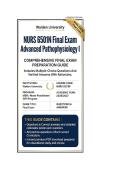
,NURS 6501N Final Exam Advanced Pathophysiology I Questions And
Answers 2026/2027 Walden University
Course:
NURS 6501N Advanced Pathophysiology
University:
Walden University
Assessment:
Final Exam
Area:
Advanced Pathophysiology
1. A patient develops skeletal muscle enlargement after months of
resistance training. Which cellular adaptation best explains the finding?
A) Atrophy
B) Hypertrophy
C) Metaplasia
D) Dysplasia
Correct Answer: Hypertrophy
Rationale: Hypertrophy is an increase in the size of existing cells rather than
an increase in cell number. Skeletal muscle fibers enlarge in response to
increased workload, particularly with resistance training, allowing the tissue
to generate greater force.
2. A patient has prolonged immobilization of the lower extremity after a
fracture. Which cellular adaptation is most likely to occur in the
affected skeletal muscle?
A) Hyperplasia
B) Metaplasia
C) Atrophy
D) Dysplasia
Correct Answer: Atrophy
Rationale: Reduced workload causes cells to decrease in size and functional
capacity, producing atrophy. Disuse atrophy is common when skeletal
muscles are not routinely stimulated by normal physical activity.
, 3. A chronic irritant causes respiratory epithelial cells to be replaced by a
different mature cell type that better tolerates the stress. Which
adaptation has occurred?
A) Metaplasia
B) Hypertrophy
C) Necrosis
D) Apoptosis
Correct Answer: Metaplasia
Rationale: Metaplasia is a reversible substitution of one differentiated cell
type for another better suited to tolerate chronic stress. Although protective
initially, persistent irritation can contribute to abnormal cellular changes and
increased disease risk.
4. Which cellular process involves regulated destruction of a cell through
an organized process with minimal surrounding inflammation?
A) Necrosis
B) Apoptosis
C) Ischemia
D) Autophagy
Correct Answer: Apoptosis
Rationale: Apoptosis is programmed cell death that removes damaged,
unnecessary, or aging cells in a controlled manner. Cell contents are
packaged and removed without the extensive inflammatory response
typically associated with necrosis.
5. A patient experiences prolonged ischemia of the myocardium. Which
event indicates that cellular injury has progressed toward irreversible
damage?
A) Mild cellular swelling
B) Temporary reduction in ATP production
C) Severe membrane and mitochondrial damage
D) Reversible fatty change
Correct Answer: Severe membrane and mitochondrial damage
Rationale: Mild cellular swelling and some biochemical abnormalities may be
reversible. Severe damage to cell membranes and mitochondria indicates
, loss of the ability to maintain cellular homeostasis and strongly suggests
irreversible injury.
6. A cell deprived of oxygen develops reduced ATP production. Which
cellular function is most directly impaired?
A) Sodium-potassium pump activity
B) DNA transcription only
C) Collagen storage
D) Antibody specificity
Correct Answer: Sodium-potassium pump activity
Rationale: The sodium-potassium ATPase requires ATP to maintain normal
intracellular sodium and potassium concentrations. ATP depletion reduces
pump activity, causing sodium and water to enter the cell and producing
cellular swelling.
7. A patient experiences reperfusion after prolonged ischemia. Why can
tissue damage worsen after blood flow returns?
A) Reperfusion always lowers oxygen concentration
B) Reactive oxygen species can increase cellular injury
C) Reperfusion prevents inflammatory activity
D) Mitochondria permanently stop functioning
Correct Answer: Reactive oxygen species can increase cellular injury
Rationale: Reoxygenation can generate reactive oxygen species that damage
lipids, proteins, and DNA. Reperfusion can therefore produce additional
oxidative and inflammatory injury in previously ischemic tissue.
8. A patient has decreased plasma albumin because of severe liver
disease. Which consequence is most likely?
A) Increased plasma oncotic pressure
B) Decreased movement of fluid into tissues
C) Decreased plasma oncotic pressure and edema
D) Increased intracellular sodium
Correct Answer: Decreased plasma oncotic pressure and edema
Rationale: Albumin is a major contributor to plasma oncotic pressure.
Reduced albumin decreases the force retaining fluid within blood vessels,
allowing more fluid to move into the interstitial space and contributing to
edema.
Answers 2026/2027 Walden University
Course:
NURS 6501N Advanced Pathophysiology
University:
Walden University
Assessment:
Final Exam
Area:
Advanced Pathophysiology
1. A patient develops skeletal muscle enlargement after months of
resistance training. Which cellular adaptation best explains the finding?
A) Atrophy
B) Hypertrophy
C) Metaplasia
D) Dysplasia
Correct Answer: Hypertrophy
Rationale: Hypertrophy is an increase in the size of existing cells rather than
an increase in cell number. Skeletal muscle fibers enlarge in response to
increased workload, particularly with resistance training, allowing the tissue
to generate greater force.
2. A patient has prolonged immobilization of the lower extremity after a
fracture. Which cellular adaptation is most likely to occur in the
affected skeletal muscle?
A) Hyperplasia
B) Metaplasia
C) Atrophy
D) Dysplasia
Correct Answer: Atrophy
Rationale: Reduced workload causes cells to decrease in size and functional
capacity, producing atrophy. Disuse atrophy is common when skeletal
muscles are not routinely stimulated by normal physical activity.
, 3. A chronic irritant causes respiratory epithelial cells to be replaced by a
different mature cell type that better tolerates the stress. Which
adaptation has occurred?
A) Metaplasia
B) Hypertrophy
C) Necrosis
D) Apoptosis
Correct Answer: Metaplasia
Rationale: Metaplasia is a reversible substitution of one differentiated cell
type for another better suited to tolerate chronic stress. Although protective
initially, persistent irritation can contribute to abnormal cellular changes and
increased disease risk.
4. Which cellular process involves regulated destruction of a cell through
an organized process with minimal surrounding inflammation?
A) Necrosis
B) Apoptosis
C) Ischemia
D) Autophagy
Correct Answer: Apoptosis
Rationale: Apoptosis is programmed cell death that removes damaged,
unnecessary, or aging cells in a controlled manner. Cell contents are
packaged and removed without the extensive inflammatory response
typically associated with necrosis.
5. A patient experiences prolonged ischemia of the myocardium. Which
event indicates that cellular injury has progressed toward irreversible
damage?
A) Mild cellular swelling
B) Temporary reduction in ATP production
C) Severe membrane and mitochondrial damage
D) Reversible fatty change
Correct Answer: Severe membrane and mitochondrial damage
Rationale: Mild cellular swelling and some biochemical abnormalities may be
reversible. Severe damage to cell membranes and mitochondria indicates
, loss of the ability to maintain cellular homeostasis and strongly suggests
irreversible injury.
6. A cell deprived of oxygen develops reduced ATP production. Which
cellular function is most directly impaired?
A) Sodium-potassium pump activity
B) DNA transcription only
C) Collagen storage
D) Antibody specificity
Correct Answer: Sodium-potassium pump activity
Rationale: The sodium-potassium ATPase requires ATP to maintain normal
intracellular sodium and potassium concentrations. ATP depletion reduces
pump activity, causing sodium and water to enter the cell and producing
cellular swelling.
7. A patient experiences reperfusion after prolonged ischemia. Why can
tissue damage worsen after blood flow returns?
A) Reperfusion always lowers oxygen concentration
B) Reactive oxygen species can increase cellular injury
C) Reperfusion prevents inflammatory activity
D) Mitochondria permanently stop functioning
Correct Answer: Reactive oxygen species can increase cellular injury
Rationale: Reoxygenation can generate reactive oxygen species that damage
lipids, proteins, and DNA. Reperfusion can therefore produce additional
oxidative and inflammatory injury in previously ischemic tissue.
8. A patient has decreased plasma albumin because of severe liver
disease. Which consequence is most likely?
A) Increased plasma oncotic pressure
B) Decreased movement of fluid into tissues
C) Decreased plasma oncotic pressure and edema
D) Increased intracellular sodium
Correct Answer: Decreased plasma oncotic pressure and edema
Rationale: Albumin is a major contributor to plasma oncotic pressure.
Reduced albumin decreases the force retaining fluid within blood vessels,
allowing more fluid to move into the interstitial space and contributing to
edema.