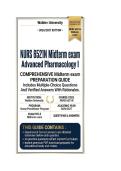
,NURS 6521N Midterm exam Advanced Pharmacology I Questions
And Answers 2026/2027 Walden University
Course:
NURS 6521N Advanced Pharmacology
University:
Walden University
Assessment:
Midterm Exam
1. Which sequence correctly represents the four major processes of
pharmacokinetics?
A) Receptor binding, efficacy, potency, toxicity
B) Diagnosis, treatment, monitoring, evaluation
C) Absorption, receptor binding, response, elimination
D) Absorption, distribution, metabolism, excretion
Correct Answer: Absorption, distribution, metabolism, excretion
Rationale: Pharmacokinetics describes what the body does to a drug through
absorption, distribution, metabolism, and excretion. These processes
determine how quickly a medication reaches systemic circulation, where it
distributes, how it is transformed, and how it is eliminated. (NCBI)
2. Which statement best describes pharmacodynamics?
A) It describes how the liver metabolizes medications.
B) It describes the effects of a drug on the body and its mechanisms of
action.
C) It describes the fraction of an oral dose reaching systemic circulation.
D) It describes renal elimination of a medication.
Correct Answer: It describes the effects of a drug on the body and its
mechanisms of action.
Rationale: Pharmacodynamics concerns drug effects and mechanisms,
including receptor interactions and downstream physiological responses.
Pharmacokinetics, in contrast, focuses on absorption, distribution,
metabolism, and excretion of medications. (NCBI)
3. A medication with extensive hepatic first-pass metabolism is
prescribed orally. Which change would most directly increase the
amount of unchanged drug reaching systemic circulation?
,A) Administering the medication intravenously
B) Giving the medication with a high-fat meal
C) Increasing plasma protein binding
D) Increasing the interval between doses
Correct Answer: Administering the medication intravenously
Rationale: Intravenous administration delivers medication directly into
systemic circulation and bypasses gastrointestinal absorption and hepatic
first-pass metabolism. Oral administration can result in substantial
presystemic metabolism, reducing bioavailability. (NCBI)
4. A patient with marked hypoalbuminemia begins a highly protein-bound
medication. What change is most likely?
A) Reduced free drug concentration
B) Increased free drug concentration
C) Complete loss of drug absorption
D) Increased first-pass metabolism
Correct Answer: Increased free drug concentration
Rationale: Albumin binds many medications in plasma. When albumin
concentration falls, less drug is protein-bound, increasing the unbound
fraction available for distribution and pharmacologic activity. This can
increase toxicity risk with highly protein-bound drugs. (NCBI)
5. A medication has a half-life of 8 hours. Approximately how much drug
remains after 24 hours, assuming first-order elimination and no
additional doses?
A) 12.5%
B) 25%
C) 50%
D) 75%
Correct Answer: 12.5%
Rationale: With first-order elimination, one half-life leaves 50%, two half-lives
leave 25%, and three half-lives leave 12.5%. Twenty-four hours represents
three 8-hour half-lives, so 12.5% remains. (NCBI)
6. A drug binds to a receptor and produces a biological response similar
to the endogenous ligand. How should this drug be classified?
, A) Competitive antagonist
B) Agonist
C) Inverse agonist
D) Enzyme inhibitor
Correct Answer: Agonist
Rationale: An agonist binds to a receptor and activates it to produce a
biological response. Antagonists bind without activating the receptor,
thereby blocking or reducing the effect of an agonist. (NCBI)
7. Which statement best describes a partial agonist?
A) It cannot bind to the receptor.
B) It activates the receptor but produces a lower maximal response than a
full agonist.
C) It permanently blocks the receptor.
D) It only acts when another agonist is absent.
Correct Answer: It activates the receptor but produces a lower maximal
response than a full agonist.
Rationale: Partial agonists have receptor activity but lower efficacy than full
agonists. In the presence of a full agonist, a partial agonist can also reduce
the overall response because it occupies receptors without producing the
same maximal effect. (PubMed)
8. A competitive antagonist is present at a receptor site. Which effect
would be expected?
A) Permanent receptor destruction
B) Increased intrinsic activity
C) Reduced agonist binding and response through receptor competition
D) Increased agonist potency
Correct Answer: Reduced agonist binding and response through receptor
competition
Rationale: Competitive antagonists occupy the same receptor site as an
agonist and interfere with agonist binding. Their effect can often be
overcome by increasing agonist concentration, distinguishing competitive
antagonism from irreversible blockade. (PubMed)
9. What is the primary purpose of pharmacogenomics in medication
therapy?
And Answers 2026/2027 Walden University
Course:
NURS 6521N Advanced Pharmacology
University:
Walden University
Assessment:
Midterm Exam
1. Which sequence correctly represents the four major processes of
pharmacokinetics?
A) Receptor binding, efficacy, potency, toxicity
B) Diagnosis, treatment, monitoring, evaluation
C) Absorption, receptor binding, response, elimination
D) Absorption, distribution, metabolism, excretion
Correct Answer: Absorption, distribution, metabolism, excretion
Rationale: Pharmacokinetics describes what the body does to a drug through
absorption, distribution, metabolism, and excretion. These processes
determine how quickly a medication reaches systemic circulation, where it
distributes, how it is transformed, and how it is eliminated. (NCBI)
2. Which statement best describes pharmacodynamics?
A) It describes how the liver metabolizes medications.
B) It describes the effects of a drug on the body and its mechanisms of
action.
C) It describes the fraction of an oral dose reaching systemic circulation.
D) It describes renal elimination of a medication.
Correct Answer: It describes the effects of a drug on the body and its
mechanisms of action.
Rationale: Pharmacodynamics concerns drug effects and mechanisms,
including receptor interactions and downstream physiological responses.
Pharmacokinetics, in contrast, focuses on absorption, distribution,
metabolism, and excretion of medications. (NCBI)
3. A medication with extensive hepatic first-pass metabolism is
prescribed orally. Which change would most directly increase the
amount of unchanged drug reaching systemic circulation?
,A) Administering the medication intravenously
B) Giving the medication with a high-fat meal
C) Increasing plasma protein binding
D) Increasing the interval between doses
Correct Answer: Administering the medication intravenously
Rationale: Intravenous administration delivers medication directly into
systemic circulation and bypasses gastrointestinal absorption and hepatic
first-pass metabolism. Oral administration can result in substantial
presystemic metabolism, reducing bioavailability. (NCBI)
4. A patient with marked hypoalbuminemia begins a highly protein-bound
medication. What change is most likely?
A) Reduced free drug concentration
B) Increased free drug concentration
C) Complete loss of drug absorption
D) Increased first-pass metabolism
Correct Answer: Increased free drug concentration
Rationale: Albumin binds many medications in plasma. When albumin
concentration falls, less drug is protein-bound, increasing the unbound
fraction available for distribution and pharmacologic activity. This can
increase toxicity risk with highly protein-bound drugs. (NCBI)
5. A medication has a half-life of 8 hours. Approximately how much drug
remains after 24 hours, assuming first-order elimination and no
additional doses?
A) 12.5%
B) 25%
C) 50%
D) 75%
Correct Answer: 12.5%
Rationale: With first-order elimination, one half-life leaves 50%, two half-lives
leave 25%, and three half-lives leave 12.5%. Twenty-four hours represents
three 8-hour half-lives, so 12.5% remains. (NCBI)
6. A drug binds to a receptor and produces a biological response similar
to the endogenous ligand. How should this drug be classified?
, A) Competitive antagonist
B) Agonist
C) Inverse agonist
D) Enzyme inhibitor
Correct Answer: Agonist
Rationale: An agonist binds to a receptor and activates it to produce a
biological response. Antagonists bind without activating the receptor,
thereby blocking or reducing the effect of an agonist. (NCBI)
7. Which statement best describes a partial agonist?
A) It cannot bind to the receptor.
B) It activates the receptor but produces a lower maximal response than a
full agonist.
C) It permanently blocks the receptor.
D) It only acts when another agonist is absent.
Correct Answer: It activates the receptor but produces a lower maximal
response than a full agonist.
Rationale: Partial agonists have receptor activity but lower efficacy than full
agonists. In the presence of a full agonist, a partial agonist can also reduce
the overall response because it occupies receptors without producing the
same maximal effect. (PubMed)
8. A competitive antagonist is present at a receptor site. Which effect
would be expected?
A) Permanent receptor destruction
B) Increased intrinsic activity
C) Reduced agonist binding and response through receptor competition
D) Increased agonist potency
Correct Answer: Reduced agonist binding and response through receptor
competition
Rationale: Competitive antagonists occupy the same receptor site as an
agonist and interfere with agonist binding. Their effect can often be
overcome by increasing agonist concentration, distinguishing competitive
antagonism from irreversible blockade. (PubMed)
9. What is the primary purpose of pharmacogenomics in medication
therapy?