

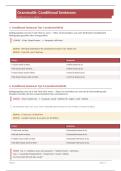
Grammatik: Conditional Sentences
If-Sätze Typ 1 & 2 • Klasse 7
1. Conditional Sentences Typ 1 (wahrscheinlich)
Bedingungssätze vom Typ 1 sind "Was ist, wenn…"-Sätze. Sie beschreiben, was unter bestimmten (realistischen)
Bedingungen geschieht oder nicht geschieht.
FORMEL if-Satz: Simple Present → Hauptsatz: will-future
BEISPIEL We'll play basketball in the schoolyard if it doesn't rain. Watch out!
BEISPIEL If you fall, I won't hold you.
If-Satz Hauptsatz
If I leave work on time, I will be home at six.
If he leaves work on time, I will be home at six.
If I don't leave work on time, I won't be home at six.
If he doesn't leave work on time, I won't be home at six.
2. Conditional Sentences Typ 2 (unwahrscheinlich)
Bedingungssätze vom Typ 2 sind "Was wäre, wenn…"-Sätze. Du verwendest sie, wenn du dir eine Handlung oder
Situation vorstellst, die eher unwahrscheinlich oder unrealistisch ist.
FORMEL if-Satz: Simple Past → Hauptsatz: would + Infinitiv ('d) / might / could + Infinitiv
Im if-Satz kann statt "was" auch "were" stehen (für alle Personen): If I were in Africa. If I weren't in Africa.
BEISPIEL If I were you, I'd block him.
BEISPIEL I wouldn't eat any, if you gave me 100 dollars.
If-Satz Hauptsatz
If I left work on time, I'd/would be home at six.
If he left work on time, I'd/would be home at six.
If I didn't leave work on time, I'd/wouldn't be home at six.
If he didn't leave work on time, I'd/wouldn't be home at six.
MERKE Typ 1 = realistisch, kann noch passieren → Simple Present + will-future.
Typ 2 = unrealistisch/hypothetisch → Simple Past + would + Infinitiv.
Im if-Satz steht NIE will oder would!
Englisch Seite
If-Sätze Typ 1 & 2 • Klasse 7
1. Conditional Sentences Typ 1 (wahrscheinlich)
Bedingungssätze vom Typ 1 sind "Was ist, wenn…"-Sätze. Sie beschreiben, was unter bestimmten (realistischen)
Bedingungen geschieht oder nicht geschieht.
FORMEL if-Satz: Simple Present → Hauptsatz: will-future
BEISPIEL We'll play basketball in the schoolyard if it doesn't rain. Watch out!
BEISPIEL If you fall, I won't hold you.
If-Satz Hauptsatz
If I leave work on time, I will be home at six.
If he leaves work on time, I will be home at six.
If I don't leave work on time, I won't be home at six.
If he doesn't leave work on time, I won't be home at six.
2. Conditional Sentences Typ 2 (unwahrscheinlich)
Bedingungssätze vom Typ 2 sind "Was wäre, wenn…"-Sätze. Du verwendest sie, wenn du dir eine Handlung oder
Situation vorstellst, die eher unwahrscheinlich oder unrealistisch ist.
FORMEL if-Satz: Simple Past → Hauptsatz: would + Infinitiv ('d) / might / could + Infinitiv
Im if-Satz kann statt "was" auch "were" stehen (für alle Personen): If I were in Africa. If I weren't in Africa.
BEISPIEL If I were you, I'd block him.
BEISPIEL I wouldn't eat any, if you gave me 100 dollars.
If-Satz Hauptsatz
If I left work on time, I'd/would be home at six.
If he left work on time, I'd/would be home at six.
If I didn't leave work on time, I'd/wouldn't be home at six.
If he didn't leave work on time, I'd/wouldn't be home at six.
MERKE Typ 1 = realistisch, kann noch passieren → Simple Present + will-future.
Typ 2 = unrealistisch/hypothetisch → Simple Past + would + Infinitiv.
Im if-Satz steht NIE will oder would!
Englisch Seite


