
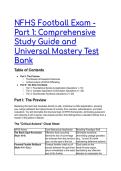
NFHS Football Exam -
Part 1: Comprehensive
Study Guide and
Universal Mastery Test
Bank
Table of Contents
● Part I: The Preview
○ The Mission & Expected Outcomes
○ Critical Axioms of NFHS Officiating
● Part II: The Elite Test Bank
○ Tier 1: Foundational Syntax & Application (Questions 1–10)
○ Tier 2: Complex Application & Simulation (Questions 11–20)
○ Tier 3: Grandmaster Synthesis (Questions 21–30)
Part I: The Preview
Mastering this test bank translates directly to elite, instinctual on-field adjudication, ensuring
your rulings withstand the highest levels of scrutiny from coaches, administrators, and state
evaluators. You will internalize the structural logic of NFHS frameworks, eliminating guesswork
and replacing it with surgical, rules-based precision that distinguishes a standard referee from a
master of the gridiron rulebook.
The "Critical Axioms" Cheat Sheet
NFHS Axiom Core Mechanical Application Resulting Paradigm Shift
The Basic Spot Revolution Offensive fouls occurring Eliminates excessive,
(Rule 10-4) behind the line of scrimmage drive-killing yardage penalties
are enforced from the previous (e.g., 1st and 30) while
spot, not the spot of the foul. maintaining defensive balance.
Forward Fumble Rollback Forward fumbles ruled out of Clock starts on the
(Rule 4-3-1 Exc.) bounds between the goal lines ready-for-play signal,
return immediately to the exact neutralizing any offensive
spot of the fumble. attempts to manipulate the
,NFHS Axiom Core Mechanical Application Resulting Paradigm Shift
clock or gain unearned
yardage.
Post-Scrimmage Kick (PSK) PSK strictly applies if Team R Team R retains possession of
Matrix fouls beyond the expanded the ball; penalty enforcement is
neutral zone during a anchored to the spot where the
scrimmage kick that crosses kick ends rather than the
the zone, provided K does not previous spot.
possess the ball when the
down ends.
Illegal Participation All illegal participation Removes the geometric
Standardization infractions (Rule 9-6) are advantage of spotting the foul
exclusively 15-yard, live-ball where the substitute entered
fouls enforced from the basic the field, ensuring uniform
spot. punitive severity.
Defenseless Player A player receiving a blindside Re-anchors risk minimization
Enhancements block with forceful contact not priorities; illegal helmet contact
initiated with open hands, or a or closed-hand blindside blocks
runner whose forward progress trigger severe personal fouls.
is stopped, is entirely protected.
Part II: The Elite Test Bank
Tier 1: Foundational Syntax & Application
Q1: During a pre-game equipment inspection, the Umpire notices multiple players on Team A
wearing uniform pants that are pulled up, exposing the top of the kneecaps, while wearing
properly fitted knee pads underneath. Based on the principles of NFHS Player Equipment Rules
(Rule 1-5), which action/conclusion is the MOST ACCURATE? A) The equipment is legal
provided the knee pads underneath are unaltered and manufactured appropriately to minimize
risk. B) The equipment is illegal, and the Head Coach must immediately be penalized 15 yards
for unsportsmanlike conduct prior to kickoff. C) The equipment is illegal, and the players must
be removed from the game until the pants completely cover the knees, thigh guards, and knee
pads. D) The equipment is legal only if both teams agree to waive the knee coverage mandate
during the pre-game conference to allow for uniform variation.
● Answer: C (The equipment is illegal, and the players must be removed from the game
until the pants completely cover the knees, thigh guards, and knee pads.)
● Distractor Analysis:
○ A is incorrect: Properly manufactured pads do not negate the stringent, aesthetic,
and protective requirement that the pants themselves must cover the knees entirely.
○ B is incorrect: The initial action is to employ preventative officiating and remove the
players to fix the equipment, not to immediately penalize the coach with a 15-yard
foul before the game begins.
○ D is incorrect: Safety and uniform equipment rules are non-negotiable statutes and
cannot be waived by the mutual consent of the head coaches.
The Mentor's Analysis: Equipment rules exist as absolute safety baselines. When pants do not
cover the knees, the player is wearing improperly worn equipment and must be removed until
compliant. By utilizing preventative officiating during pre-game, you bypass the common trap of
, allowing uniform violations onto the field which compromise the structural integrity of the game.
Professional/Academic Intuition: Safety equipment compliance is strict liability;
non-compliant players simply do not cross the sideline boundary.
Q2: Team B's defensive line enters the field with eye shade (grease) applied. The Umpire notes
that B55 has the area under his eyes painted with a solid stroke of black grease containing a
white cross symbol, while B56 has a solid stroke containing the number "56". Based on the
principles of NFHS Equipment Adornment, which action/conclusion is the MOST ACCURATE?
A) B55 is illegal due to the symbol, but B56 is legal because a player's own number is explicitly
permitted within the shade. B) Both players are legal as long as the eye shade is applied in a
single solid stroke, regardless of internal graphics. C) Both players are wearing illegal
equipment and must remove the symbols and numbers before participating in the contest. D)
Both players are legal because eye shade restrictions apply only to offensive players to prevent
snap deception and signal masking.
● Answer: C (Both players are wearing illegal equipment and must remove the symbols
and numbers before participating in the contest.)
● Distractor Analysis:
○ A is incorrect: Numbers are explicitly prohibited alongside words, logos, and
symbols; wearing one's own number provides no immunity.
○ B is incorrect: While the application must indeed be a solid stroke, the inclusion of
any secondary graphic within it instantly renders the adornment illegal.
○ D is incorrect: Equipment rules are universally applied across all 22 players on the
field regardless of possession or phase of the game.
The Mentor's Analysis: Eye shade is strictly regulated to prevent intimidation tactics and
unsanctioned uniform modifications. The rule dictates a solid stroke with absolute purity—no
words, logos, numbers, or symbols of any kind. By recognizing illegal uniform adornments, you
bypass the novice error of assuming a player's own number or a team logo is a permissible
exception. Professional/Academic Intuition: Eye shade must be a solid, unadulterated
stroke; any embedded graphic constitutes an immediate, correctable equipment
violation.
Q3: Team A lines up for a scrimmage play. A3, a wide receiver, is wearing a solid blue towel
with a small manufacturer's logo (2 square inches). A4, a running back, is wearing a solid white
towel with the school's logo (2 square inches). Based on the principles of NFHS Player Towel
Guidelines, which action/conclusion is the MOST ACCURATE? A) Both towels are legal, as
players are no longer required to wear towels of the same solid color as their teammates. B)
A3's towel is legal, but A4's is illegal because all towels worn by the same team must match in
color to avoid deception. C) Both towels are illegal because only one logo of any type is allowed
on the field per team during a live ball. D) Both towels are illegal because towels must be a solid
color matching the primary dominant color of the jersey.
● Answer: A (Both towels are legal, as players are no longer required to wear towels of the
same solid color as their teammates.)
● Distractor Analysis:
○ B is incorrect: This is an outdated legacy rule. Recent changes dictate that while
towels must be a solid color, they do not have to be the same solid color for each
player on a team.
○ C is incorrect: The restriction is a maximum of one manufacturer's logo and/or one
school logo (neither exceeding 2¼ sq inches) per towel, not per team.
○ D is incorrect: There is no rule stipulating the towel must match the primary jersey
color; it just cannot be ball- or penalty-flag colored.
Part 1: Comprehensive
Study Guide and
Universal Mastery Test
Bank
Table of Contents
● Part I: The Preview
○ The Mission & Expected Outcomes
○ Critical Axioms of NFHS Officiating
● Part II: The Elite Test Bank
○ Tier 1: Foundational Syntax & Application (Questions 1–10)
○ Tier 2: Complex Application & Simulation (Questions 11–20)
○ Tier 3: Grandmaster Synthesis (Questions 21–30)
Part I: The Preview
Mastering this test bank translates directly to elite, instinctual on-field adjudication, ensuring
your rulings withstand the highest levels of scrutiny from coaches, administrators, and state
evaluators. You will internalize the structural logic of NFHS frameworks, eliminating guesswork
and replacing it with surgical, rules-based precision that distinguishes a standard referee from a
master of the gridiron rulebook.
The "Critical Axioms" Cheat Sheet
NFHS Axiom Core Mechanical Application Resulting Paradigm Shift
The Basic Spot Revolution Offensive fouls occurring Eliminates excessive,
(Rule 10-4) behind the line of scrimmage drive-killing yardage penalties
are enforced from the previous (e.g., 1st and 30) while
spot, not the spot of the foul. maintaining defensive balance.
Forward Fumble Rollback Forward fumbles ruled out of Clock starts on the
(Rule 4-3-1 Exc.) bounds between the goal lines ready-for-play signal,
return immediately to the exact neutralizing any offensive
spot of the fumble. attempts to manipulate the
,NFHS Axiom Core Mechanical Application Resulting Paradigm Shift
clock or gain unearned
yardage.
Post-Scrimmage Kick (PSK) PSK strictly applies if Team R Team R retains possession of
Matrix fouls beyond the expanded the ball; penalty enforcement is
neutral zone during a anchored to the spot where the
scrimmage kick that crosses kick ends rather than the
the zone, provided K does not previous spot.
possess the ball when the
down ends.
Illegal Participation All illegal participation Removes the geometric
Standardization infractions (Rule 9-6) are advantage of spotting the foul
exclusively 15-yard, live-ball where the substitute entered
fouls enforced from the basic the field, ensuring uniform
spot. punitive severity.
Defenseless Player A player receiving a blindside Re-anchors risk minimization
Enhancements block with forceful contact not priorities; illegal helmet contact
initiated with open hands, or a or closed-hand blindside blocks
runner whose forward progress trigger severe personal fouls.
is stopped, is entirely protected.
Part II: The Elite Test Bank
Tier 1: Foundational Syntax & Application
Q1: During a pre-game equipment inspection, the Umpire notices multiple players on Team A
wearing uniform pants that are pulled up, exposing the top of the kneecaps, while wearing
properly fitted knee pads underneath. Based on the principles of NFHS Player Equipment Rules
(Rule 1-5), which action/conclusion is the MOST ACCURATE? A) The equipment is legal
provided the knee pads underneath are unaltered and manufactured appropriately to minimize
risk. B) The equipment is illegal, and the Head Coach must immediately be penalized 15 yards
for unsportsmanlike conduct prior to kickoff. C) The equipment is illegal, and the players must
be removed from the game until the pants completely cover the knees, thigh guards, and knee
pads. D) The equipment is legal only if both teams agree to waive the knee coverage mandate
during the pre-game conference to allow for uniform variation.
● Answer: C (The equipment is illegal, and the players must be removed from the game
until the pants completely cover the knees, thigh guards, and knee pads.)
● Distractor Analysis:
○ A is incorrect: Properly manufactured pads do not negate the stringent, aesthetic,
and protective requirement that the pants themselves must cover the knees entirely.
○ B is incorrect: The initial action is to employ preventative officiating and remove the
players to fix the equipment, not to immediately penalize the coach with a 15-yard
foul before the game begins.
○ D is incorrect: Safety and uniform equipment rules are non-negotiable statutes and
cannot be waived by the mutual consent of the head coaches.
The Mentor's Analysis: Equipment rules exist as absolute safety baselines. When pants do not
cover the knees, the player is wearing improperly worn equipment and must be removed until
compliant. By utilizing preventative officiating during pre-game, you bypass the common trap of
, allowing uniform violations onto the field which compromise the structural integrity of the game.
Professional/Academic Intuition: Safety equipment compliance is strict liability;
non-compliant players simply do not cross the sideline boundary.
Q2: Team B's defensive line enters the field with eye shade (grease) applied. The Umpire notes
that B55 has the area under his eyes painted with a solid stroke of black grease containing a
white cross symbol, while B56 has a solid stroke containing the number "56". Based on the
principles of NFHS Equipment Adornment, which action/conclusion is the MOST ACCURATE?
A) B55 is illegal due to the symbol, but B56 is legal because a player's own number is explicitly
permitted within the shade. B) Both players are legal as long as the eye shade is applied in a
single solid stroke, regardless of internal graphics. C) Both players are wearing illegal
equipment and must remove the symbols and numbers before participating in the contest. D)
Both players are legal because eye shade restrictions apply only to offensive players to prevent
snap deception and signal masking.
● Answer: C (Both players are wearing illegal equipment and must remove the symbols
and numbers before participating in the contest.)
● Distractor Analysis:
○ A is incorrect: Numbers are explicitly prohibited alongside words, logos, and
symbols; wearing one's own number provides no immunity.
○ B is incorrect: While the application must indeed be a solid stroke, the inclusion of
any secondary graphic within it instantly renders the adornment illegal.
○ D is incorrect: Equipment rules are universally applied across all 22 players on the
field regardless of possession or phase of the game.
The Mentor's Analysis: Eye shade is strictly regulated to prevent intimidation tactics and
unsanctioned uniform modifications. The rule dictates a solid stroke with absolute purity—no
words, logos, numbers, or symbols of any kind. By recognizing illegal uniform adornments, you
bypass the novice error of assuming a player's own number or a team logo is a permissible
exception. Professional/Academic Intuition: Eye shade must be a solid, unadulterated
stroke; any embedded graphic constitutes an immediate, correctable equipment
violation.
Q3: Team A lines up for a scrimmage play. A3, a wide receiver, is wearing a solid blue towel
with a small manufacturer's logo (2 square inches). A4, a running back, is wearing a solid white
towel with the school's logo (2 square inches). Based on the principles of NFHS Player Towel
Guidelines, which action/conclusion is the MOST ACCURATE? A) Both towels are legal, as
players are no longer required to wear towels of the same solid color as their teammates. B)
A3's towel is legal, but A4's is illegal because all towels worn by the same team must match in
color to avoid deception. C) Both towels are illegal because only one logo of any type is allowed
on the field per team during a live ball. D) Both towels are illegal because towels must be a solid
color matching the primary dominant color of the jersey.
● Answer: A (Both towels are legal, as players are no longer required to wear towels of the
same solid color as their teammates.)
● Distractor Analysis:
○ B is incorrect: This is an outdated legacy rule. Recent changes dictate that while
towels must be a solid color, they do not have to be the same solid color for each
player on a team.
○ C is incorrect: The restriction is a maximum of one manufacturer's logo and/or one
school logo (neither exceeding 2¼ sq inches) per towel, not per team.
○ D is incorrect: There is no rule stipulating the towel must match the primary jersey
color; it just cannot be ball- or penalty-flag colored.


