
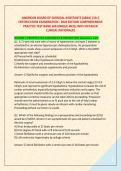
AMERICAN BOARD OF SURGICAL ASSISTANTS (ABSA) |SA-C
CERTIFICATION EXAMINATION - 2026 EDITION COMPREHENSIVE
PRACTICE TEST BANK 500 UNIQUE MCQs WITH DETAILED
CLINICAL RATIONALES
SECTION 1: PREOPERATIVE ASSESSMENT & PREPARATION (Questions 1-40)
Q1. A 72-year-old male with a history of hypertension and type 2 diabetes is
scheduled for an elective laparoscopic cholecystectomy. His preoperative
laboratory results show a serum potassium of 3.2 mEq/L. What is the MOST
appropriate next step?
A) Proceed with surgery as scheduled
B) Administer 40 mEq of potassium chloride IV push
C) Notify the surgeon and anesthesia provider of the hypokalemia
D) Administer oral potassium supplements and proceed
Answer: C) Notify the surgeon and anesthesia provider of the hypokalemia
Rationale: A serum potassium of 3.2 mEq/L is below the normal range (3.5-5.0
mEq/L) and represents significant hypokalemia. Hypokalemia increases the risk of
cardiac arrhythmias, especially during anesthesia induction and surgery. The
surgical assistant should notify the surgeon and anesthesia provider so that
appropriate corrective measures can be taken before proceeding. Potassium
should never be administered as an IV push due to the risk of fatal cardiac
arrhythmias; it must be given slowly via infusion with cardiac monitoring.
Proceeding without correction is unsafe.
Q2. Which of the following findings on a preoperative electrocardiogram (ECG)
would be of MOST concern in an asymptomatic 65-year-old patient scheduled for
elective surgery?
A) Sinus bradycardia at 52 beats per minute
B) First-degree AV block with a PR interval of 0.24 seconds
C) Atrial fibrillation with a ventricular rate of 110 beats per minute
D) Left ventricular hypertrophy by voltage criteria
Answer: C) Atrial fibrillation with a ventricular rate of 110 beats per minute
1
,Rationale: Uncontrolled atrial fibrillation with a rapid ventricular response (rate >
100 bpm) significantly increases the risk of intraoperative hemodynamic
instability, myocardial ischemia, and thromboembolic events. This finding
requires immediate preoperative evaluation and rate control. Sinus bradycardia in
a physically active patient is often benign. First-degree AV block (PR interval >
0.20 seconds) is usually benign and does not require intervention. Left ventricular
hypertrophy by voltage criteria alone, without other ECG changes or symptoms, is
a chronic finding that does not typically delay surgery.
Q3. The surgical assistant is preparing a patient for a total knee arthroplasty.
Which preoperative assessment finding would be an absolute contraindication to
proceeding with the surgery?
A) Serum hemoglobin of 10.5 g/dL
B) Blood glucose of 180 mg/dL
C) Active infection at the surgical site
D) History of deep vein thrombosis 5 years ago
Answer: C) Active infection at the surgical site
Rationale: Active infection at or near the surgical site is an absolute
contraindication to elective orthopedic surgery due to the high risk of prosthetic
joint infection, which is a devastating complication. The surgery should be
postponed until the infection is completely resolved. A hemoglobin of 10.5 g/dL is
below normal but may be acceptable with preoperative optimization. A blood
glucose of 180 mg/dL indicates poor glycemic control but is not an absolute
contraindication; it should be managed perioperatively. A history of DVT 5 years
ago requires prophylactic measures but does not contraindicate surgery.
Q4. During the preoperative verification process (time-out), which of the
following elements is NOT required according to standard surgical safety
protocols?
A) Patient identity verification using two identifiers
B) Confirmation of the surgical site and procedure
C) Verification of the patient's insurance coverage
D) Confirmation of appropriate antibiotic prophylaxis administration
Answer: C) Verification of the patient's insurance coverage
2
,Rationale: The surgical time-out is a patient safety protocol designed to prevent
wrong-site, wrong-procedure, and wrong-patient errors. Required elements
include: patient identity verification (using at least two identifiers), confirmation
of the correct surgical site and procedure, verification of appropriate antibiotic
prophylaxis, confirmation of availability of necessary implants and equipment,
and team member introductions. Insurance verification is an administrative
function that occurs before the day of surgery and is not part of the
intraoperative time-out.
Q5. A 45-year-old female is scheduled for an abdominal hysterectomy. During the
preoperative assessment, she reports taking St. John's wort for mild depression.
What is the primary concern regarding this herbal supplement in the
perioperative period?
A) It increases the risk of bleeding
B) It induces hepatic cytochrome P450 enzymes, altering anesthetic metabolism
C) It causes hypertension during anesthesia
D) It increases the risk of postoperative infection
Answer: B) It induces hepatic cytochrome P450 enzymes, altering anesthetic
metabolism
Rationale: St. John's wort is a potent inducer of the cytochrome P450 enzyme
system, particularly CYP3A4. This can significantly alter the metabolism of many
anesthetic agents, opioids, and other perioperative medications, potentially
leading to inadequate anesthesia or unexpected drug interactions. While St.
John's wort can affect serotonin levels, the primary perioperative concern is its
effect on drug metabolism. It is generally recommended to discontinue St. John's
wort at least 5 days before surgery.
Q6. Which of the following laboratory values is MOST indicative of adequate
nutritional status for wound healing in a preoperative patient?
A) Serum albumin of 2.8 g/dL
B) Serum prealbumin of 22 mg/dL
C) Total lymphocyte count of 800 cells/µL
D) Serum transferrin of 150 mg/dL
3
, Answer: B) Serum prealbumin of 22 mg/dL
Rationale: Prealbumin is the most sensitive indicator of acute nutritional status
because it has a short half-life (2-3 days) and reflects recent protein intake. A
normal prealbumin level is 15-36 mg/dL; 22 mg/dL is within the normal range and
indicates adequate nutritional status for wound healing. Serum albumin (normal
3.5-5.0 g/dL) has a longer half-life (20 days) and is less sensitive to acute changes.
Total lymphocyte count below 1,500 cells/µL indicates malnutrition, and 800 is
severely low. Transferrin (normal 200-360 mg/dL) reflects iron status and chronic
protein status.
Q7. A 58-year-old male with a history of obstructive sleep apnea is scheduled for
bariatric surgery. What is the MOST important preoperative consideration?
A) Ensuring the patient has a continuous positive airway pressure (CPAP) machine
available postoperatively
B) Checking the patient's serum electrolytes
C) Confirming the patient has a living will
D) Obtaining a preoperative psychiatric evaluation
Answer: A) Ensuring the patient has a continuous positive airway pressure (CPAP)
machine available postoperatively
Rationale: Patients with obstructive sleep apnea are at significantly increased risk
of postoperative respiratory complications, including hypoxemia, hypercapnia,
and airway obstruction, especially after receiving opioids and sedatives. Ensuring
the availability of the patient's CPAP machine for immediate postoperative use is
critical for patient safety. While electrolyte checks, advance directives, and
psychiatric evaluations may be relevant in specific contexts, airway management
is the immediate priority.
Q8. The surgical assistant is reviewing a patient's medication list before surgery.
Which medication should be continued through the perioperative period to
prevent withdrawal syndrome?
A) Metformin
B) Warfarin
C) Clonidine
D) Lisinopril
4
CERTIFICATION EXAMINATION - 2026 EDITION COMPREHENSIVE
PRACTICE TEST BANK 500 UNIQUE MCQs WITH DETAILED
CLINICAL RATIONALES
SECTION 1: PREOPERATIVE ASSESSMENT & PREPARATION (Questions 1-40)
Q1. A 72-year-old male with a history of hypertension and type 2 diabetes is
scheduled for an elective laparoscopic cholecystectomy. His preoperative
laboratory results show a serum potassium of 3.2 mEq/L. What is the MOST
appropriate next step?
A) Proceed with surgery as scheduled
B) Administer 40 mEq of potassium chloride IV push
C) Notify the surgeon and anesthesia provider of the hypokalemia
D) Administer oral potassium supplements and proceed
Answer: C) Notify the surgeon and anesthesia provider of the hypokalemia
Rationale: A serum potassium of 3.2 mEq/L is below the normal range (3.5-5.0
mEq/L) and represents significant hypokalemia. Hypokalemia increases the risk of
cardiac arrhythmias, especially during anesthesia induction and surgery. The
surgical assistant should notify the surgeon and anesthesia provider so that
appropriate corrective measures can be taken before proceeding. Potassium
should never be administered as an IV push due to the risk of fatal cardiac
arrhythmias; it must be given slowly via infusion with cardiac monitoring.
Proceeding without correction is unsafe.
Q2. Which of the following findings on a preoperative electrocardiogram (ECG)
would be of MOST concern in an asymptomatic 65-year-old patient scheduled for
elective surgery?
A) Sinus bradycardia at 52 beats per minute
B) First-degree AV block with a PR interval of 0.24 seconds
C) Atrial fibrillation with a ventricular rate of 110 beats per minute
D) Left ventricular hypertrophy by voltage criteria
Answer: C) Atrial fibrillation with a ventricular rate of 110 beats per minute
1
,Rationale: Uncontrolled atrial fibrillation with a rapid ventricular response (rate >
100 bpm) significantly increases the risk of intraoperative hemodynamic
instability, myocardial ischemia, and thromboembolic events. This finding
requires immediate preoperative evaluation and rate control. Sinus bradycardia in
a physically active patient is often benign. First-degree AV block (PR interval >
0.20 seconds) is usually benign and does not require intervention. Left ventricular
hypertrophy by voltage criteria alone, without other ECG changes or symptoms, is
a chronic finding that does not typically delay surgery.
Q3. The surgical assistant is preparing a patient for a total knee arthroplasty.
Which preoperative assessment finding would be an absolute contraindication to
proceeding with the surgery?
A) Serum hemoglobin of 10.5 g/dL
B) Blood glucose of 180 mg/dL
C) Active infection at the surgical site
D) History of deep vein thrombosis 5 years ago
Answer: C) Active infection at the surgical site
Rationale: Active infection at or near the surgical site is an absolute
contraindication to elective orthopedic surgery due to the high risk of prosthetic
joint infection, which is a devastating complication. The surgery should be
postponed until the infection is completely resolved. A hemoglobin of 10.5 g/dL is
below normal but may be acceptable with preoperative optimization. A blood
glucose of 180 mg/dL indicates poor glycemic control but is not an absolute
contraindication; it should be managed perioperatively. A history of DVT 5 years
ago requires prophylactic measures but does not contraindicate surgery.
Q4. During the preoperative verification process (time-out), which of the
following elements is NOT required according to standard surgical safety
protocols?
A) Patient identity verification using two identifiers
B) Confirmation of the surgical site and procedure
C) Verification of the patient's insurance coverage
D) Confirmation of appropriate antibiotic prophylaxis administration
Answer: C) Verification of the patient's insurance coverage
2
,Rationale: The surgical time-out is a patient safety protocol designed to prevent
wrong-site, wrong-procedure, and wrong-patient errors. Required elements
include: patient identity verification (using at least two identifiers), confirmation
of the correct surgical site and procedure, verification of appropriate antibiotic
prophylaxis, confirmation of availability of necessary implants and equipment,
and team member introductions. Insurance verification is an administrative
function that occurs before the day of surgery and is not part of the
intraoperative time-out.
Q5. A 45-year-old female is scheduled for an abdominal hysterectomy. During the
preoperative assessment, she reports taking St. John's wort for mild depression.
What is the primary concern regarding this herbal supplement in the
perioperative period?
A) It increases the risk of bleeding
B) It induces hepatic cytochrome P450 enzymes, altering anesthetic metabolism
C) It causes hypertension during anesthesia
D) It increases the risk of postoperative infection
Answer: B) It induces hepatic cytochrome P450 enzymes, altering anesthetic
metabolism
Rationale: St. John's wort is a potent inducer of the cytochrome P450 enzyme
system, particularly CYP3A4. This can significantly alter the metabolism of many
anesthetic agents, opioids, and other perioperative medications, potentially
leading to inadequate anesthesia or unexpected drug interactions. While St.
John's wort can affect serotonin levels, the primary perioperative concern is its
effect on drug metabolism. It is generally recommended to discontinue St. John's
wort at least 5 days before surgery.
Q6. Which of the following laboratory values is MOST indicative of adequate
nutritional status for wound healing in a preoperative patient?
A) Serum albumin of 2.8 g/dL
B) Serum prealbumin of 22 mg/dL
C) Total lymphocyte count of 800 cells/µL
D) Serum transferrin of 150 mg/dL
3
, Answer: B) Serum prealbumin of 22 mg/dL
Rationale: Prealbumin is the most sensitive indicator of acute nutritional status
because it has a short half-life (2-3 days) and reflects recent protein intake. A
normal prealbumin level is 15-36 mg/dL; 22 mg/dL is within the normal range and
indicates adequate nutritional status for wound healing. Serum albumin (normal
3.5-5.0 g/dL) has a longer half-life (20 days) and is less sensitive to acute changes.
Total lymphocyte count below 1,500 cells/µL indicates malnutrition, and 800 is
severely low. Transferrin (normal 200-360 mg/dL) reflects iron status and chronic
protein status.
Q7. A 58-year-old male with a history of obstructive sleep apnea is scheduled for
bariatric surgery. What is the MOST important preoperative consideration?
A) Ensuring the patient has a continuous positive airway pressure (CPAP) machine
available postoperatively
B) Checking the patient's serum electrolytes
C) Confirming the patient has a living will
D) Obtaining a preoperative psychiatric evaluation
Answer: A) Ensuring the patient has a continuous positive airway pressure (CPAP)
machine available postoperatively
Rationale: Patients with obstructive sleep apnea are at significantly increased risk
of postoperative respiratory complications, including hypoxemia, hypercapnia,
and airway obstruction, especially after receiving opioids and sedatives. Ensuring
the availability of the patient's CPAP machine for immediate postoperative use is
critical for patient safety. While electrolyte checks, advance directives, and
psychiatric evaluations may be relevant in specific contexts, airway management
is the immediate priority.
Q8. The surgical assistant is reviewing a patient's medication list before surgery.
Which medication should be continued through the perioperative period to
prevent withdrawal syndrome?
A) Metformin
B) Warfarin
C) Clonidine
D) Lisinopril
4


