

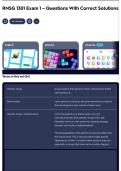
RNSG 1301 Exam 1 – Questions With Correct Solutions
Groups
Play your way to mastery with fun games
Match Blocks Charms NEW
Terms in this set (54)
Generic drugs drugs sold by their generic name; not brand (or trade)
name products
Brand name name given to a drug by the pharmaceutical company
that developed it; also called a trade name
Genetic drugs vs Brand name Once the patent on a brand name runs out
manufactures develop genetic drugs which are
intended work on in the same way (quality, dosage,
strength, and route of administration).
The bioavailability of the generic drugs may differ from
the brand name. This is why providers might specify
"dispense as written" so brand name product may use
especially in drugs that have narrow safety margins.
, Control substance - (C-I) Schedule I High abuse potential and no accepted medical use
(heroin, marijuana, LSD)
Control substance - (C-II) Schedule II High abuse potential with severe dependence liability
(narcotics, amphetamines, and barbiturates)
Example: Cocaine, methamphetamines, methadone,
Dilaudid, Demerol, Oxycodone, Fentanyl, Morphine,
Adderall, Ritalin, Dexedrine.
Written prescription only, no refills
Control substance - (C-III) Schedule III Less abuse potential than schedule II drugs and
moderate dependence liability (nonbarbiturate
sedatives, nonamphetamine stimulants, limited amounts
of certain narcotics)
< 15 mg hydrocodone per dosage unit (Vicodin) ; < 90 mg
of codeine p3er dosage unit (Tylenol w/ codeine);
ketamine; anabolic steroids; testosterone
Written/Oral Rx that expired w/n 6mos. No more than 5
refills.
Control substance - (C-IV) Schedule IV Less abuse potential than schedule III and limited
dependence liability (some sedatives, antianxiety
agents, and nonnarcotic analgesics)
Examples: Xanax, Soma, Valium, Ativan, Talwin, Ambien
Written/Oral Rx that expires w/n 6 mons. No more than 5
refills.
Groups
Play your way to mastery with fun games
Match Blocks Charms NEW
Terms in this set (54)
Generic drugs drugs sold by their generic name; not brand (or trade)
name products
Brand name name given to a drug by the pharmaceutical company
that developed it; also called a trade name
Genetic drugs vs Brand name Once the patent on a brand name runs out
manufactures develop genetic drugs which are
intended work on in the same way (quality, dosage,
strength, and route of administration).
The bioavailability of the generic drugs may differ from
the brand name. This is why providers might specify
"dispense as written" so brand name product may use
especially in drugs that have narrow safety margins.
, Control substance - (C-I) Schedule I High abuse potential and no accepted medical use
(heroin, marijuana, LSD)
Control substance - (C-II) Schedule II High abuse potential with severe dependence liability
(narcotics, amphetamines, and barbiturates)
Example: Cocaine, methamphetamines, methadone,
Dilaudid, Demerol, Oxycodone, Fentanyl, Morphine,
Adderall, Ritalin, Dexedrine.
Written prescription only, no refills
Control substance - (C-III) Schedule III Less abuse potential than schedule II drugs and
moderate dependence liability (nonbarbiturate
sedatives, nonamphetamine stimulants, limited amounts
of certain narcotics)
< 15 mg hydrocodone per dosage unit (Vicodin) ; < 90 mg
of codeine p3er dosage unit (Tylenol w/ codeine);
ketamine; anabolic steroids; testosterone
Written/Oral Rx that expired w/n 6mos. No more than 5
refills.
Control substance - (C-IV) Schedule IV Less abuse potential than schedule III and limited
dependence liability (some sedatives, antianxiety
agents, and nonnarcotic analgesics)
Examples: Xanax, Soma, Valium, Ativan, Talwin, Ambien
Written/Oral Rx that expires w/n 6 mons. No more than 5
refills.


