D522 V2 | Python for IT Automation | Master Study Guide | 2026
WGU D522 V2
Python for IT Automation
Master Study Guide | 2026 Updated
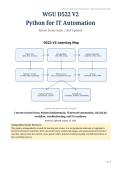
Original study map created for this guide.
Current-version focus: Python fundamentals, IT/network automation, Git/GitLab
workflow, troubleshooting, and PA readiness
Research updated: August 29, 2026
Independent Study Resource
This guide is independently created for learning and review. It is not produced, endorsed, or supplied by
Western Governors University. WGU can revise course content, lab images, and assessment instructions at
any time. Always treat the current course portal, rubric, instructor reference guide, and lab instructions as
the controlling sources.
Page 1
, D522 V2 | Python for IT Automation | Master Study Guide | 2026
1. Current 2026 Alignment and How to Use This Guide
The August 2026 WGU Institutional Catalog lists D522 as Python for IT Automation and describes the
course as covering Python fundamentals, program-flow control, decision-making, and automation of
IT tasks and processes, with an emphasis on systematic problem solving and administering secure,
scalable, resilient networks and systems. The same current catalog lists D522 as a 3-CU School of
Technology course in multiple technology programs. [1]
The public catalog does not publish the internal task rubric. For assessment-format alignment, this
guide cross-checks recent June-August 2026 learner reports and a posted instructor update. Those
sources consistently describe a V2 transition from the older objective-assessment format to a hands-
on performance-assessment workflow with two tasks, a GitLab repository, a virtual lab, and network
automation activities. Because these are community reports rather than the official rubric, this guide
labels task-specific details as "current learner-reported" and avoids presenting them as guaranteed
rubric text. [2][3][4][5]
Alignment item Status What this guide does
Course title and high-level scope Officially confirmed Uses the August 2026 WGU catalog
as the anchor.
Python + IT/network automation Officially confirmed Prioritizes flow control, problem
emphasis solving, automation, and resilient
network/system administration.
V2 PA transition Current learner/instructor-report Treats the course as PA-oriented and
corroborated explains the reported two-task
workflow.
GitLab, GNS3/VM, DNS, tickets, Current learner-report corroborated Teaches the underlying skills
email, CSV, SSH/Telnet without claiming the exact private
rubric wording.
Exact screenshots, file names, Portal-controlled Provides evidence strategy; students
branch names, evaluator wording must follow the live rubric and
instructor guide.
What changed from older D522 materials
Older 2025/early-2026 resources often describe an OA with multiple-choice and coding items. Current V2
reports from late June through August 2026 describe a project-style PA instead. Do not use an old OA question
bank as your primary preparation for the V2 workflow. [2][3][4]
1.1 Core capability map
Write readable Python that transforms requirements into deterministic logic.
Choose appropriate data structures for device inventory, status, and affected-device tracking.
Read structured input such as CSV and JSON safely and validate malformed or missing fields.
Run operating-system commands in a controlled way and interpret return codes and output.
Understand reachability, DHCP, DNS, IP addressing, remote access, and service dependencies.
Interact with remote systems and services through SSH-style libraries, console connections, HTTP
APIs, and SMTP.
Page 2
, D522 V2 | Python for IT Automation | Master Study Guide | 2026
Build modular functions, capture exceptions, use timeouts, and design scripts that can be run
repeatedly.
Use Git/GitLab branches and meaningful commits to preserve evidence of development.
Collect evidence that proves what the script did, not merely that code exists.
1.2 Recommended order of study
1. Python syntax, types, expressions, strings, collections, flow control, and functions.
2. File handling, CSV/JSON parsing, exception handling, and input validation.
3. Subprocess execution and system automation patterns.
4. Networking fundamentals: IP, reachability, DHCP, DNS, ports, SSH, and console access.
5. HTTP/REST APIs, JSON payloads, authentication headers, status codes, and timeouts.
6. Email/SMTP notifications and robust error handling.
7. Git/GitLab workflow, branches, commits, and evidence collection.
8. Integrate everything into an idempotent automation pipeline that can be monitored and
repeated.
2. Python Foundations for IT Automation
D522 is not about memorizing Python trivia. The useful mental model is: input -> transform ->
decision -> action -> verification. Every syntax topic matters because it supports that pipeline.
2.1 Variables, data types, and assignment
Python is dynamically typed: a name refers to an object, and the object has a type. In automation,
type mistakes often appear when CSV fields arrive as strings even though the values look numeric.
Convert only when a numeric operation is actually required.
Type Automation use Common mistake
str hostnames, IP text, command Assuming a numeric-looking string
output, ticket titles is an int
int ports, counters, timeouts, retry Concatenating directly with strings
counts without conversion
bool reachable/unreachable, Confusing a non-empty string such
compliant/noncompliant as "False" with False
list ordered device records, command Mutating while iterating without
results understanding effects
tuple fixed grouped values Trying to modify an immutable
object
dict device attributes keyed by names Accessing a missing key without a
default or guard
set unique affected devices or unique Expecting stable ordering
IPs
device_name = "router-a"
console_port = 5001
reachable = True
Page 3
WGU D522 V2
Python for IT Automation
Master Study Guide | 2026 Updated
Original study map created for this guide.
Current-version focus: Python fundamentals, IT/network automation, Git/GitLab
workflow, troubleshooting, and PA readiness
Research updated: August 29, 2026
Independent Study Resource
This guide is independently created for learning and review. It is not produced, endorsed, or supplied by
Western Governors University. WGU can revise course content, lab images, and assessment instructions at
any time. Always treat the current course portal, rubric, instructor reference guide, and lab instructions as
the controlling sources.
Page 1
, D522 V2 | Python for IT Automation | Master Study Guide | 2026
1. Current 2026 Alignment and How to Use This Guide
The August 2026 WGU Institutional Catalog lists D522 as Python for IT Automation and describes the
course as covering Python fundamentals, program-flow control, decision-making, and automation of
IT tasks and processes, with an emphasis on systematic problem solving and administering secure,
scalable, resilient networks and systems. The same current catalog lists D522 as a 3-CU School of
Technology course in multiple technology programs. [1]
The public catalog does not publish the internal task rubric. For assessment-format alignment, this
guide cross-checks recent June-August 2026 learner reports and a posted instructor update. Those
sources consistently describe a V2 transition from the older objective-assessment format to a hands-
on performance-assessment workflow with two tasks, a GitLab repository, a virtual lab, and network
automation activities. Because these are community reports rather than the official rubric, this guide
labels task-specific details as "current learner-reported" and avoids presenting them as guaranteed
rubric text. [2][3][4][5]
Alignment item Status What this guide does
Course title and high-level scope Officially confirmed Uses the August 2026 WGU catalog
as the anchor.
Python + IT/network automation Officially confirmed Prioritizes flow control, problem
emphasis solving, automation, and resilient
network/system administration.
V2 PA transition Current learner/instructor-report Treats the course as PA-oriented and
corroborated explains the reported two-task
workflow.
GitLab, GNS3/VM, DNS, tickets, Current learner-report corroborated Teaches the underlying skills
email, CSV, SSH/Telnet without claiming the exact private
rubric wording.
Exact screenshots, file names, Portal-controlled Provides evidence strategy; students
branch names, evaluator wording must follow the live rubric and
instructor guide.
What changed from older D522 materials
Older 2025/early-2026 resources often describe an OA with multiple-choice and coding items. Current V2
reports from late June through August 2026 describe a project-style PA instead. Do not use an old OA question
bank as your primary preparation for the V2 workflow. [2][3][4]
1.1 Core capability map
Write readable Python that transforms requirements into deterministic logic.
Choose appropriate data structures for device inventory, status, and affected-device tracking.
Read structured input such as CSV and JSON safely and validate malformed or missing fields.
Run operating-system commands in a controlled way and interpret return codes and output.
Understand reachability, DHCP, DNS, IP addressing, remote access, and service dependencies.
Interact with remote systems and services through SSH-style libraries, console connections, HTTP
APIs, and SMTP.
Page 2
, D522 V2 | Python for IT Automation | Master Study Guide | 2026
Build modular functions, capture exceptions, use timeouts, and design scripts that can be run
repeatedly.
Use Git/GitLab branches and meaningful commits to preserve evidence of development.
Collect evidence that proves what the script did, not merely that code exists.
1.2 Recommended order of study
1. Python syntax, types, expressions, strings, collections, flow control, and functions.
2. File handling, CSV/JSON parsing, exception handling, and input validation.
3. Subprocess execution and system automation patterns.
4. Networking fundamentals: IP, reachability, DHCP, DNS, ports, SSH, and console access.
5. HTTP/REST APIs, JSON payloads, authentication headers, status codes, and timeouts.
6. Email/SMTP notifications and robust error handling.
7. Git/GitLab workflow, branches, commits, and evidence collection.
8. Integrate everything into an idempotent automation pipeline that can be monitored and
repeated.
2. Python Foundations for IT Automation
D522 is not about memorizing Python trivia. The useful mental model is: input -> transform ->
decision -> action -> verification. Every syntax topic matters because it supports that pipeline.
2.1 Variables, data types, and assignment
Python is dynamically typed: a name refers to an object, and the object has a type. In automation,
type mistakes often appear when CSV fields arrive as strings even though the values look numeric.
Convert only when a numeric operation is actually required.
Type Automation use Common mistake
str hostnames, IP text, command Assuming a numeric-looking string
output, ticket titles is an int
int ports, counters, timeouts, retry Concatenating directly with strings
counts without conversion
bool reachable/unreachable, Confusing a non-empty string such
compliant/noncompliant as "False" with False
list ordered device records, command Mutating while iterating without
results understanding effects
tuple fixed grouped values Trying to modify an immutable
object
dict device attributes keyed by names Accessing a missing key without a
default or guard
set unique affected devices or unique Expecting stable ordering
IPs
device_name = "router-a"
console_port = 5001
reachable = True
Page 3