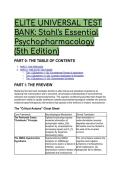
ELITE UNIVERSAL TEST
BANK: Stahl's Essential
Psychopharmacology
(5th Edition)
PART 0: THE TABLE OF CONTENTS
1. PART I: THE PREVIEW
2. PART II: THE ELITE TEST BANK
○ Tier 1 (Questions 1–10): Foundational Syntax & Application
○ Tier 2 (Questions 11–20): Complex Application & Simulation
○ Tier 3 (Questions 21–30): Grandmaster Synthesis
PART I: THE PREVIEW
Mastering this test bank translates directly to elite clinical and analytical competence by
replacing rote memorization with a structural, circuit-based understanding of neurochemical
networks and receptor pharmacodynamics. The cognitive conditioning provided here forges the
practitioner's ability to rapidly synthesize complex psychopharmacological variables into precise,
evidence-based therapeutic interventions that operate at the forefront of modern neuroscience.
The "Critical Axioms" Cheat Sheet
Core Framework Neurobiological Mechanism Clinical Translation
The Prefrontal Cortex Optimal functioning requires Over-stimulation or
"Goldilocks" Principle moderate stimulation of under-stimulation severely
postsynaptic \alpha_{2A} degrades executive function.
receptors by norepinephrine Stimulants must be titrated to
(increasing signal) and D_{1} the peak of the inverted
receptors by dopamine U-curve.
(decreasing noise).
The NMDA Hypofunction Hypofunctioning NMDA This circuit failure explains the
Hypothesis receptors on GABAergic cognitive and negative
interneurons lead to a failure of symptoms of schizophrenia,
inhibition, causing a which traditional D_{2}
downstream massive release of antagonists fail to address.
glutamate and excitotoxicity.
,Core Framework Neurobiological Mechanism Clinical Translation
Rapid Neuroplasticity via Esketamine antagonizes NMDA Bypasses traditional
mTOR/BDNF receptors, initiating a glutamate monoaminergic delays, forming
burst that stimulates AMPA new dendritic spines in hours
receptors, activates the mTOR rather than weeks, making it
pathway, and rapidly releases critical for acute suicidality.
BDNF.
Synergistic Melatonergic Agomelatine provides circadian Treats anhedonia and
Antidepressant Action resynchronization phase-delayed sleep without
(MT_{1}/MT_{2} agonism) and causing the sexual dysfunction
frontal cortex or emotional blunting typical of
dopamine/norepinephrine SSRIs.
disinhibition (5-HT_{2C} neutral
antagonism).
Lithium's Endocrine & Renal Lithium uncouples vasopressin Mandates rigorous baseline
Trajectory at the V_{2} receptor and alters and ongoing monitoring of
calcium-sensing receptors on eGFR, TSH, and serum
the parathyroid. calcium to prevent nephrogenic
diabetes insipidus and
hyperparathyroidism.
PART II: THE ELITE TEST BANK
Clinical & Theoretical Briefing: Tier 1
Before engaging the foundational syntax, the elite practitioner must understand that modern
psychopharmacology has entirely abandoned the archaic "chemical imbalance" model. We now
operate within the paradigm of signal transduction, epigenetics, and neural circuits.
Neurotransmitters are no longer viewed merely as floating soup; they are precise keys operating
within highly localized regional networks. For instance, the dopamine hypothesis of
schizophrenia is anatomically bisected: hyperactive mesolimbic pathways drive psychosis, while
hypoactive mesocortical pathways drive cognitive deficits. Concurrently,
attention-deficit/hyperactivity disorder (ADHD) is fundamentally a disorder of "tuning" in the
prefrontal cortex (PFC), where the signal-to-noise ratio is misaligned due to deficient
catecholamine tone at dendritic spines. Grasping these structural truths is the absolute
prerequisite for answering Tier 1 accurately.
Tier 1 (Questions 1–10): Foundational Syntax & Application
Q1: The neurobiological model of attention-deficit/hyperactivity disorder (ADHD) emphasizes
inefficient information processing in the prefrontal cortex (PFC). Based on the principles of
catecholamine functioning in the PFC, which receptor mechanism is MOST ACCURATE
regarding the optimization of the signal-to-noise ratio? A) High levels of dopamine stimulating
D_{2} receptors to increase cortical noise. B) High levels of norepinephrine stimulating
\alpha_{1} receptors to strengthen network connectivity. C) Moderate levels of norepinephrine
stimulating postsynaptic \alpha_{2A} receptors to strengthen the incoming signal. D) Moderate
levels of dopamine stimulating D_{4} receptors to weaken the incoming signal.
● Answer: C (Moderate levels of norepinephrine stimulating postsynaptic \alpha_{2A}
, receptors to strengthen the incoming signal.)
● Distractor Analysis:
○ A is incorrect: Moderate dopamine stimulates D_{1} (not D_{2}) receptors to
decrease noise by pruning inappropriate connections, not increase it.
○ B is incorrect: High levels of norepinephrine stimulate \alpha_{1} receptors, which
actually impairs PFC function and is associated with acute stress, rather than
strengthening cognitive connectivity.
○ D is incorrect: Dopamine primarily acts on D_{1} receptors (the most abundant in
the PFC) to decrease noise, not via D_{4} to weaken the primary signal.
The Mentor's Analysis: The prefrontal cortex operates on an arousal spectrum dictated by the
"Goldilocks" principle. When facing inefficient information processing in ADHD, the immediate
priority is restoring optimal catecholamine balance. By utilizing \alpha_{2A} agonism, the
practitioner bypasses the common trap of assuming all catecholamine increases are universally
beneficial, recognizing that only moderate stimulation yields cognitive enhancement.
Professional/Academic Intuition: Norepinephrine increases the signal (\alpha_{2A}), while
dopamine decreases the noise (D_{1}); both require moderate, not excessive,
stimulation.
Q2: A patient with treatment-resistant depression is administered intranasal esketamine.
According to the glutamatergic hypothesis of rapid antidepressant action, which downstream
event IMMEDIATELY follows the blockade of the NMDA receptor on GABAergic interneurons?
A) Direct agonism of the AMPA receptor by the esketamine molecule. B) A burst of glutamate
release leading to the stimulation of AMPA receptors. C) Downregulation of the mTOR signaling
pathway. D) Immediate suppression of Brain-Derived Neurotrophic Factor (BDNF) transcription.
● Answer: B (A burst of glutamate release leading to the stimulation of AMPA receptors.)
● Distractor Analysis:
○ A is incorrect: Esketamine does not directly agonize AMPA receptors; it acts
indirectly through upstream disinhibition.
○ C is incorrect: The mTOR pathway is rapidly activated, not downregulated, leading
to acute protein synthesis and dendritic spine formation.
○ D is incorrect: BDNF release is increased, which is critical for rapid synaptogenesis,
rather than being suppressed.
The Mentor's Analysis: Esketamine fundamentally shifts the paradigm of depression treatment
from delayed monoaminergic modulation to rapid structural neuroplasticity. By utilizing AMPA
receptor stimulation via a glutamate burst, the mechanism bypasses the common trap of waiting
weeks for genomic changes seen in traditional SSRIs. Professional/Academic Intuition:
NMDA antagonism disinhibits glutamate release, which subsequently drives AMPA
activation, triggering mTOR and BDNF-mediated dendritic spine formation.
Q3: The novel antidepressant agomelatine demonstrates a unique pharmacological profile
devoid of traditional monoamine reuptake inhibition. Which receptor binding profile is
UNEQUIVOCALLY attributed to agomelatine? A) MT_{1}/MT_{2} receptor antagonist and
5-HT_{2C} receptor agonist. B) MT_{1}/MT_{2} receptor agonist and 5-HT_{2C} receptor neutral
antagonist. C) MT_{1} receptor agonist and 5-HT_{2A} receptor antagonist. D) 5-HT_{1A}
receptor partial agonist and MT_{2} receptor antagonist.
● Answer: B (MT_{1}/MT_{2} receptor agonist and 5-HT_{2C} receptor neutral antagonist.)
● Distractor Analysis:
○ A is incorrect: Agomelatine agonizes (does not antagonize) melatonergic receptors
and antagonizes (does not agonize) the 5-HT_{2C} receptor.
○ C is incorrect: While it may have negligible affinity for 5-HT_{2A}, its primary
BANK: Stahl's Essential
Psychopharmacology
(5th Edition)
PART 0: THE TABLE OF CONTENTS
1. PART I: THE PREVIEW
2. PART II: THE ELITE TEST BANK
○ Tier 1 (Questions 1–10): Foundational Syntax & Application
○ Tier 2 (Questions 11–20): Complex Application & Simulation
○ Tier 3 (Questions 21–30): Grandmaster Synthesis
PART I: THE PREVIEW
Mastering this test bank translates directly to elite clinical and analytical competence by
replacing rote memorization with a structural, circuit-based understanding of neurochemical
networks and receptor pharmacodynamics. The cognitive conditioning provided here forges the
practitioner's ability to rapidly synthesize complex psychopharmacological variables into precise,
evidence-based therapeutic interventions that operate at the forefront of modern neuroscience.
The "Critical Axioms" Cheat Sheet
Core Framework Neurobiological Mechanism Clinical Translation
The Prefrontal Cortex Optimal functioning requires Over-stimulation or
"Goldilocks" Principle moderate stimulation of under-stimulation severely
postsynaptic \alpha_{2A} degrades executive function.
receptors by norepinephrine Stimulants must be titrated to
(increasing signal) and D_{1} the peak of the inverted
receptors by dopamine U-curve.
(decreasing noise).
The NMDA Hypofunction Hypofunctioning NMDA This circuit failure explains the
Hypothesis receptors on GABAergic cognitive and negative
interneurons lead to a failure of symptoms of schizophrenia,
inhibition, causing a which traditional D_{2}
downstream massive release of antagonists fail to address.
glutamate and excitotoxicity.
,Core Framework Neurobiological Mechanism Clinical Translation
Rapid Neuroplasticity via Esketamine antagonizes NMDA Bypasses traditional
mTOR/BDNF receptors, initiating a glutamate monoaminergic delays, forming
burst that stimulates AMPA new dendritic spines in hours
receptors, activates the mTOR rather than weeks, making it
pathway, and rapidly releases critical for acute suicidality.
BDNF.
Synergistic Melatonergic Agomelatine provides circadian Treats anhedonia and
Antidepressant Action resynchronization phase-delayed sleep without
(MT_{1}/MT_{2} agonism) and causing the sexual dysfunction
frontal cortex or emotional blunting typical of
dopamine/norepinephrine SSRIs.
disinhibition (5-HT_{2C} neutral
antagonism).
Lithium's Endocrine & Renal Lithium uncouples vasopressin Mandates rigorous baseline
Trajectory at the V_{2} receptor and alters and ongoing monitoring of
calcium-sensing receptors on eGFR, TSH, and serum
the parathyroid. calcium to prevent nephrogenic
diabetes insipidus and
hyperparathyroidism.
PART II: THE ELITE TEST BANK
Clinical & Theoretical Briefing: Tier 1
Before engaging the foundational syntax, the elite practitioner must understand that modern
psychopharmacology has entirely abandoned the archaic "chemical imbalance" model. We now
operate within the paradigm of signal transduction, epigenetics, and neural circuits.
Neurotransmitters are no longer viewed merely as floating soup; they are precise keys operating
within highly localized regional networks. For instance, the dopamine hypothesis of
schizophrenia is anatomically bisected: hyperactive mesolimbic pathways drive psychosis, while
hypoactive mesocortical pathways drive cognitive deficits. Concurrently,
attention-deficit/hyperactivity disorder (ADHD) is fundamentally a disorder of "tuning" in the
prefrontal cortex (PFC), where the signal-to-noise ratio is misaligned due to deficient
catecholamine tone at dendritic spines. Grasping these structural truths is the absolute
prerequisite for answering Tier 1 accurately.
Tier 1 (Questions 1–10): Foundational Syntax & Application
Q1: The neurobiological model of attention-deficit/hyperactivity disorder (ADHD) emphasizes
inefficient information processing in the prefrontal cortex (PFC). Based on the principles of
catecholamine functioning in the PFC, which receptor mechanism is MOST ACCURATE
regarding the optimization of the signal-to-noise ratio? A) High levels of dopamine stimulating
D_{2} receptors to increase cortical noise. B) High levels of norepinephrine stimulating
\alpha_{1} receptors to strengthen network connectivity. C) Moderate levels of norepinephrine
stimulating postsynaptic \alpha_{2A} receptors to strengthen the incoming signal. D) Moderate
levels of dopamine stimulating D_{4} receptors to weaken the incoming signal.
● Answer: C (Moderate levels of norepinephrine stimulating postsynaptic \alpha_{2A}
, receptors to strengthen the incoming signal.)
● Distractor Analysis:
○ A is incorrect: Moderate dopamine stimulates D_{1} (not D_{2}) receptors to
decrease noise by pruning inappropriate connections, not increase it.
○ B is incorrect: High levels of norepinephrine stimulate \alpha_{1} receptors, which
actually impairs PFC function and is associated with acute stress, rather than
strengthening cognitive connectivity.
○ D is incorrect: Dopamine primarily acts on D_{1} receptors (the most abundant in
the PFC) to decrease noise, not via D_{4} to weaken the primary signal.
The Mentor's Analysis: The prefrontal cortex operates on an arousal spectrum dictated by the
"Goldilocks" principle. When facing inefficient information processing in ADHD, the immediate
priority is restoring optimal catecholamine balance. By utilizing \alpha_{2A} agonism, the
practitioner bypasses the common trap of assuming all catecholamine increases are universally
beneficial, recognizing that only moderate stimulation yields cognitive enhancement.
Professional/Academic Intuition: Norepinephrine increases the signal (\alpha_{2A}), while
dopamine decreases the noise (D_{1}); both require moderate, not excessive,
stimulation.
Q2: A patient with treatment-resistant depression is administered intranasal esketamine.
According to the glutamatergic hypothesis of rapid antidepressant action, which downstream
event IMMEDIATELY follows the blockade of the NMDA receptor on GABAergic interneurons?
A) Direct agonism of the AMPA receptor by the esketamine molecule. B) A burst of glutamate
release leading to the stimulation of AMPA receptors. C) Downregulation of the mTOR signaling
pathway. D) Immediate suppression of Brain-Derived Neurotrophic Factor (BDNF) transcription.
● Answer: B (A burst of glutamate release leading to the stimulation of AMPA receptors.)
● Distractor Analysis:
○ A is incorrect: Esketamine does not directly agonize AMPA receptors; it acts
indirectly through upstream disinhibition.
○ C is incorrect: The mTOR pathway is rapidly activated, not downregulated, leading
to acute protein synthesis and dendritic spine formation.
○ D is incorrect: BDNF release is increased, which is critical for rapid synaptogenesis,
rather than being suppressed.
The Mentor's Analysis: Esketamine fundamentally shifts the paradigm of depression treatment
from delayed monoaminergic modulation to rapid structural neuroplasticity. By utilizing AMPA
receptor stimulation via a glutamate burst, the mechanism bypasses the common trap of waiting
weeks for genomic changes seen in traditional SSRIs. Professional/Academic Intuition:
NMDA antagonism disinhibits glutamate release, which subsequently drives AMPA
activation, triggering mTOR and BDNF-mediated dendritic spine formation.
Q3: The novel antidepressant agomelatine demonstrates a unique pharmacological profile
devoid of traditional monoamine reuptake inhibition. Which receptor binding profile is
UNEQUIVOCALLY attributed to agomelatine? A) MT_{1}/MT_{2} receptor antagonist and
5-HT_{2C} receptor agonist. B) MT_{1}/MT_{2} receptor agonist and 5-HT_{2C} receptor neutral
antagonist. C) MT_{1} receptor agonist and 5-HT_{2A} receptor antagonist. D) 5-HT_{1A}
receptor partial agonist and MT_{2} receptor antagonist.
● Answer: B (MT_{1}/MT_{2} receptor agonist and 5-HT_{2C} receptor neutral antagonist.)
● Distractor Analysis:
○ A is incorrect: Agomelatine agonizes (does not antagonize) melatonergic receptors
and antagonizes (does not agonize) the 5-HT_{2C} receptor.
○ C is incorrect: While it may have negligible affinity for 5-HT_{2A}, its primary