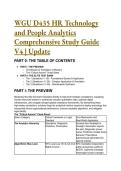
WGU D435 HR Technology
and People Analytics
Comprehensive Study Guide
V4 | Update
PART 0: THE TABLE OF CONTENTS
● PART I: THE PREVIEW
○ The Mission & Translation of Mastery
○ The "Critical Axioms" Cheat Sheet
● PART II: THE ELITE TEST BANK
○ Tier 1 (Questions 1–10) - Foundational Syntax & Application
○ Tier 2 (Questions 11–20) - Complex Application & Simulation
○ Tier 3 (Questions 21–30) - Grandmaster Synthesis
PART I: THE PREVIEW
Mastering this elite test bank translates directly to high-level strategic competence, equipping
human resources leaders to synthesize complex quantitative data, optimize digital
infrastructure, and navigate stringent global compliance frameworks. By dismantling these
high-stakes simulations, scholars forge the analytical intuition required to deploy technology that
measurably drives organizational performance, ensures equitable algorithms, and mitigates
legal liability.
The "Critical Axioms" Cheat Sheet:
Axiom Category Critical Framework or Legal Core Mechanism and
Standard Real-World Application
The Analytics Hierarchy Descriptive, Diagnostic, Ascends from hindsight to
Predictive, Prescriptive foresight. Descriptive reports
the past; Diagnostic proves
cause; Predictive models future
behavior; Prescriptive
autonomously generates the
optimal solution.
Algorithmic Bias Laws NYC Local Law 144 & CA Civil NYC mandates independent,
Rights Council public annual bias audits for
AEDTs. California mandates
meaningful human oversight
,Axiom Category Critical Framework or Legal Core Mechanism and
Standard Real-World Application
and expands liability to
software vendors.
Disparate Impact Math The Four-Fifths Rule (0.8 The selection rate for any
Impact Ratio) protected group must be at
least 80% (0.8) of the
highest-selected group.
Anything lower constitutes
statistical disparate impact.
Compensation Metrics Compa-Ratio vs. Range Compa-ratio divides actual
Penetration salary by the market midpoint.
Range penetration calculates
how deeply an employee has
advanced into their total
available pay band.
Preference Measurement Conjoint Analysis Self-explicated allocates points;
Methodologies MaxDiff identifies absolute
best/worst; Adaptive
dynamically shifts choice sets
based on real-time respondent
decisions.
Tech Architecture ERP vs. Best-of-Breed vs. ERP integrates the entire
Functional Suite business (finance, HR, supply
chain). Best-of-breed provides
isolated dominance in one
niche. Functional Suites cover
a single HR category.
PART II: THE ELITE TEST BANK
Tier 1 - Foundational Syntax & Application
Q1: A global logistics corporation is struggling with unexpectedly high attrition in its distribution
centers. The human resources analytics team utilizes historical turnover data, employee
engagement surveys, and external labor market trends to mathematically model which specific
employee cohorts are most likely to resign over the next six months. Based on the principles of
the HR Analytics Hierarchy, which specific level of analytics is the team CURRENTLY
employing? A) Descriptive analytics, because the raw data originates from historical
engagement surveys and past turnover reports. B) Diagnostic analytics, because the team is
attempting to establish the fundamental root cause of the unexpected attrition. C) Predictive
analytics, because historical quantitative data is being synthesized explicitly to forecast future
behavioral outcomes. D) Prescriptive analytics, because the ultimate goal of the statistical
model is to determine the absolute best course of action to retain staff.
● Answer: C (Predictive analytics, because historical quantitative data is being synthesized
explicitly to forecast future behavioral outcomes.)
● Distractor Analysis:
○ A is incorrect: While the raw input data is historical, descriptive analytics strictly
, reports what has already happened (e.g., stating that 50 people left last month)
without projecting future events.
○ B is incorrect: Diagnostic analytics looks backward to prove exactly why a past
event occurred, whereas this model specifically projects who will leave in the future.
○ D is incorrect: Prescriptive analytics requires the algorithm to independently
recommend or execute the optimal intervention, which this current model has not
yet achieved.
The Mentor's Analysis: The analytical hierarchy ascends from hindsight to foresight. When
facing workforce instability, the immediate priority is understanding future risk through rigorous
statistical modeling. By utilizing predictive analytics, you bypass the common trap of merely
reporting past losses through static dashboards. Professional/Academic Intuition: Data
maturity is defined by its orientation; predictive models look forward to forecast
operational risk, while prescriptive models calculate the exact strategic remedy.
Q2: An international finance firm seeks to overhaul its total rewards program to maximize
employee satisfaction without exceeding budget constraints. The HR strategy team deploys a
survey requiring employees to distribute exactly 100 points across various benefits (e.g., base
salary, remote work flexibility, health insurance, and stock options) to indicate their relative
value. Based on the principles of Preference Measurement Frameworks, which methodology is
the organization IMPLEMENTING? A) Adaptive conjoint analysis B) Maximum difference
(MaxDiff) conjoint analysis C) Self-explicated conjoint analysis D) Multivariate analysis of
variance
● Answer: C (Self-explicated conjoint analysis)
● Distractor Analysis:
○ A is incorrect: Adaptive conjoint analysis dynamically adjusts the questions
presented to the user based on their previous answers to narrow down preferences
efficiently, rather than using a static point allocation.
○ B is incorrect: MaxDiff analysis forces respondents to choose only the absolute
"most important" and "least important" items from a set, rather than allocating a
mathematical weight across all items.
○ D is incorrect: Multivariate analysis of variance is a statistical method for analyzing
multiple dependent variables simultaneously, not a survey design for eliciting direct
stakeholder preferences.
The Mentor's Analysis: Designing competitive compensation requires quantifiable, weighted
preference data. When facing diverse employee demographics, the immediate priority is
understanding precise value attribution. By utilizing self-explicated conjoint analysis, you bypass
the common trap of assuming universal benefit preferences across generational cohorts.
Professional/Academic Intuition: When a survey mechanism utilizes a fixed-point
allocation system (e.g., distributing exactly 100 points across variables), it is definitively
a self-explicated model.
Q3: The Chief Human Resources Officer (CHRO) of a rapidly expanding tech startup mandates
that all new software must share a unified backend infrastructure, operate on shared codebases
for all clients, and rely solely on front-end configuration rather than heavy custom coding to keep
maintenance costs low. Based on the principles of HR Technology Architecture, which
environment is the CHRO MANDATING? A) A single-tenancy public cloud environment B) A
multi-tenancy cloud environment C) A client-server mainframe architecture D) A highly
customized on-premise ERP integration
● Answer: B (A multi-tenancy cloud environment)
● Distractor Analysis:
and People Analytics
Comprehensive Study Guide
V4 | Update
PART 0: THE TABLE OF CONTENTS
● PART I: THE PREVIEW
○ The Mission & Translation of Mastery
○ The "Critical Axioms" Cheat Sheet
● PART II: THE ELITE TEST BANK
○ Tier 1 (Questions 1–10) - Foundational Syntax & Application
○ Tier 2 (Questions 11–20) - Complex Application & Simulation
○ Tier 3 (Questions 21–30) - Grandmaster Synthesis
PART I: THE PREVIEW
Mastering this elite test bank translates directly to high-level strategic competence, equipping
human resources leaders to synthesize complex quantitative data, optimize digital
infrastructure, and navigate stringent global compliance frameworks. By dismantling these
high-stakes simulations, scholars forge the analytical intuition required to deploy technology that
measurably drives organizational performance, ensures equitable algorithms, and mitigates
legal liability.
The "Critical Axioms" Cheat Sheet:
Axiom Category Critical Framework or Legal Core Mechanism and
Standard Real-World Application
The Analytics Hierarchy Descriptive, Diagnostic, Ascends from hindsight to
Predictive, Prescriptive foresight. Descriptive reports
the past; Diagnostic proves
cause; Predictive models future
behavior; Prescriptive
autonomously generates the
optimal solution.
Algorithmic Bias Laws NYC Local Law 144 & CA Civil NYC mandates independent,
Rights Council public annual bias audits for
AEDTs. California mandates
meaningful human oversight
,Axiom Category Critical Framework or Legal Core Mechanism and
Standard Real-World Application
and expands liability to
software vendors.
Disparate Impact Math The Four-Fifths Rule (0.8 The selection rate for any
Impact Ratio) protected group must be at
least 80% (0.8) of the
highest-selected group.
Anything lower constitutes
statistical disparate impact.
Compensation Metrics Compa-Ratio vs. Range Compa-ratio divides actual
Penetration salary by the market midpoint.
Range penetration calculates
how deeply an employee has
advanced into their total
available pay band.
Preference Measurement Conjoint Analysis Self-explicated allocates points;
Methodologies MaxDiff identifies absolute
best/worst; Adaptive
dynamically shifts choice sets
based on real-time respondent
decisions.
Tech Architecture ERP vs. Best-of-Breed vs. ERP integrates the entire
Functional Suite business (finance, HR, supply
chain). Best-of-breed provides
isolated dominance in one
niche. Functional Suites cover
a single HR category.
PART II: THE ELITE TEST BANK
Tier 1 - Foundational Syntax & Application
Q1: A global logistics corporation is struggling with unexpectedly high attrition in its distribution
centers. The human resources analytics team utilizes historical turnover data, employee
engagement surveys, and external labor market trends to mathematically model which specific
employee cohorts are most likely to resign over the next six months. Based on the principles of
the HR Analytics Hierarchy, which specific level of analytics is the team CURRENTLY
employing? A) Descriptive analytics, because the raw data originates from historical
engagement surveys and past turnover reports. B) Diagnostic analytics, because the team is
attempting to establish the fundamental root cause of the unexpected attrition. C) Predictive
analytics, because historical quantitative data is being synthesized explicitly to forecast future
behavioral outcomes. D) Prescriptive analytics, because the ultimate goal of the statistical
model is to determine the absolute best course of action to retain staff.
● Answer: C (Predictive analytics, because historical quantitative data is being synthesized
explicitly to forecast future behavioral outcomes.)
● Distractor Analysis:
○ A is incorrect: While the raw input data is historical, descriptive analytics strictly
, reports what has already happened (e.g., stating that 50 people left last month)
without projecting future events.
○ B is incorrect: Diagnostic analytics looks backward to prove exactly why a past
event occurred, whereas this model specifically projects who will leave in the future.
○ D is incorrect: Prescriptive analytics requires the algorithm to independently
recommend or execute the optimal intervention, which this current model has not
yet achieved.
The Mentor's Analysis: The analytical hierarchy ascends from hindsight to foresight. When
facing workforce instability, the immediate priority is understanding future risk through rigorous
statistical modeling. By utilizing predictive analytics, you bypass the common trap of merely
reporting past losses through static dashboards. Professional/Academic Intuition: Data
maturity is defined by its orientation; predictive models look forward to forecast
operational risk, while prescriptive models calculate the exact strategic remedy.
Q2: An international finance firm seeks to overhaul its total rewards program to maximize
employee satisfaction without exceeding budget constraints. The HR strategy team deploys a
survey requiring employees to distribute exactly 100 points across various benefits (e.g., base
salary, remote work flexibility, health insurance, and stock options) to indicate their relative
value. Based on the principles of Preference Measurement Frameworks, which methodology is
the organization IMPLEMENTING? A) Adaptive conjoint analysis B) Maximum difference
(MaxDiff) conjoint analysis C) Self-explicated conjoint analysis D) Multivariate analysis of
variance
● Answer: C (Self-explicated conjoint analysis)
● Distractor Analysis:
○ A is incorrect: Adaptive conjoint analysis dynamically adjusts the questions
presented to the user based on their previous answers to narrow down preferences
efficiently, rather than using a static point allocation.
○ B is incorrect: MaxDiff analysis forces respondents to choose only the absolute
"most important" and "least important" items from a set, rather than allocating a
mathematical weight across all items.
○ D is incorrect: Multivariate analysis of variance is a statistical method for analyzing
multiple dependent variables simultaneously, not a survey design for eliciting direct
stakeholder preferences.
The Mentor's Analysis: Designing competitive compensation requires quantifiable, weighted
preference data. When facing diverse employee demographics, the immediate priority is
understanding precise value attribution. By utilizing self-explicated conjoint analysis, you bypass
the common trap of assuming universal benefit preferences across generational cohorts.
Professional/Academic Intuition: When a survey mechanism utilizes a fixed-point
allocation system (e.g., distributing exactly 100 points across variables), it is definitively
a self-explicated model.
Q3: The Chief Human Resources Officer (CHRO) of a rapidly expanding tech startup mandates
that all new software must share a unified backend infrastructure, operate on shared codebases
for all clients, and rely solely on front-end configuration rather than heavy custom coding to keep
maintenance costs low. Based on the principles of HR Technology Architecture, which
environment is the CHRO MANDATING? A) A single-tenancy public cloud environment B) A
multi-tenancy cloud environment C) A client-server mainframe architecture D) A highly
customized on-premise ERP integration
● Answer: B (A multi-tenancy cloud environment)
● Distractor Analysis: