

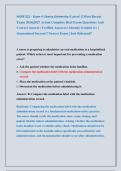
NURS 221 - Exam 4 Liberty University (Latest) || Most Recent
Exam 2026|2027 Actual Complete Real Exam Questions And
Correct Answer (Verified Answers) Already Graded A+ |
Guaranteed Success!! Newest Exam | Just Released!!
A nurse is preparing to administer an oral medication to a hospitalized
patient. Which action is most important for preventing a medication
error?
A. Ask the patient whether the medication looks familiar.
B. Compare the medication label with the medication administration
record.
C. Place the medication at the patient's bedside.
D. Document the medication before administering it.
Answer: B. Compare the medication label with the medication
administration record.
Rationale: Comparing the medication label with the medication
administration record is a fundamental medication-safety practice.
The nurse should verify the medication, dose, route, timing, and
patient identity before administration. Asking whether the medication
looks familiar is not a reliable safety check. Medications should not be
left unattended at the bedside unless specifically prescribed for self-
administration, and documentation should occur after administration.
,A patient reports severe pain 30 minutes after receiving an opioid
analgesic. What should the nurse do first?
A. Administer another dose immediately.
B. Tell the patient that the medication needs more time.
C. Reassess the patient's pain and overall clinical status.
D. Notify the health care provider without performing an assessment.
Answer: C. Reassess the patient's pain and overall clinical status.
Rationale: The nursing process begins with assessment. The nurse
should reassess pain intensity, location, quality, vital signs, respiratory
status, and response to the medication before determining the next
intervention. Administering another dose without verifying the
prescription and patient's condition could cause harm.
A nurse is teaching a patient how to use an incentive spirometer after
surgery. Which statement indicates that the patient understands the
teaching?
A. “I will use it only when I feel short of breath.”
B. “I will inhale slowly through the mouthpiece and hold my breath
briefly.”
C. “I should blow forcefully into the device.”
D. “I should use it once each day.”
Answer: B. “I will inhale slowly through the mouthpiece and hold my
breath briefly.”
Rationale: An incentive spirometer promotes lung expansion and helps
prevent postoperative atelectasis. The patient should sit upright, seal
,the lips around the mouthpiece, inhale slowly and deeply, and briefly
hold the breath before exhaling. It is generally used regularly
according to the postoperative plan rather than only when symptoms
occur.
A nurse is caring for a patient at risk for falls. Which intervention is
most appropriate?
A. Keep the bed in the highest position.
B. Place frequently used items within easy reach.
C. Encourage the patient to walk without assistance.
D. Keep all four side rails raised continuously.
Answer: B. Place frequently used items within easy reach.
Rationale: Keeping needed items within reach reduces unnecessary
attempts to get out of bed. The bed should generally be maintained in a
low position, appropriate footwear should be used, and assistance
should be provided as needed. Routine use of all four side rails may
function as a restraint and is not an appropriate universal fall-
prevention measure.
A nurse enters a patient's room and finds the patient lying on the floor.
What is the nurse's priority action?
A. Complete the incident report.
B. Move the patient immediately back to bed.
C. Assess the patient for injury and immediate threats to safety.
D. Call the patient's family.
, Answer: C. Assess the patient for injury and immediate threats to
safety.
Rationale: The nurse must first assess the patient for injury, airway,
breathing, circulation, level of consciousness, and other immediate
concerns. The patient should not be moved unnecessarily if a
significant injury is suspected. Documentation and incident reporting
occur after immediate patient needs have been addressed.
Which assessment finding requires the nurse's most immediate
attention?
A. Temperature of 37.1°C (98.8°F)
B. Respiratory rate of 8 breaths/min in a patient receiving an opioid
C. Mild incisional pain
D. Heart rate of 88 beats/min
Answer: B. Respiratory rate of 8 breaths/min in a patient receiving an
opioid.
Rationale: Opioids can cause respiratory depression. A respiratory
rate of 8 breaths/min is concerning and requires immediate assessment
and intervention. The nurse should assess respiratory effort,
oxygenation, level of consciousness, and other relevant findings and
follow the prescribed emergency protocol.
A patient is prescribed a medication by the oral route. Which
assessment is most important before administration?
Exam 2026|2027 Actual Complete Real Exam Questions And
Correct Answer (Verified Answers) Already Graded A+ |
Guaranteed Success!! Newest Exam | Just Released!!
A nurse is preparing to administer an oral medication to a hospitalized
patient. Which action is most important for preventing a medication
error?
A. Ask the patient whether the medication looks familiar.
B. Compare the medication label with the medication administration
record.
C. Place the medication at the patient's bedside.
D. Document the medication before administering it.
Answer: B. Compare the medication label with the medication
administration record.
Rationale: Comparing the medication label with the medication
administration record is a fundamental medication-safety practice.
The nurse should verify the medication, dose, route, timing, and
patient identity before administration. Asking whether the medication
looks familiar is not a reliable safety check. Medications should not be
left unattended at the bedside unless specifically prescribed for self-
administration, and documentation should occur after administration.
,A patient reports severe pain 30 minutes after receiving an opioid
analgesic. What should the nurse do first?
A. Administer another dose immediately.
B. Tell the patient that the medication needs more time.
C. Reassess the patient's pain and overall clinical status.
D. Notify the health care provider without performing an assessment.
Answer: C. Reassess the patient's pain and overall clinical status.
Rationale: The nursing process begins with assessment. The nurse
should reassess pain intensity, location, quality, vital signs, respiratory
status, and response to the medication before determining the next
intervention. Administering another dose without verifying the
prescription and patient's condition could cause harm.
A nurse is teaching a patient how to use an incentive spirometer after
surgery. Which statement indicates that the patient understands the
teaching?
A. “I will use it only when I feel short of breath.”
B. “I will inhale slowly through the mouthpiece and hold my breath
briefly.”
C. “I should blow forcefully into the device.”
D. “I should use it once each day.”
Answer: B. “I will inhale slowly through the mouthpiece and hold my
breath briefly.”
Rationale: An incentive spirometer promotes lung expansion and helps
prevent postoperative atelectasis. The patient should sit upright, seal
,the lips around the mouthpiece, inhale slowly and deeply, and briefly
hold the breath before exhaling. It is generally used regularly
according to the postoperative plan rather than only when symptoms
occur.
A nurse is caring for a patient at risk for falls. Which intervention is
most appropriate?
A. Keep the bed in the highest position.
B. Place frequently used items within easy reach.
C. Encourage the patient to walk without assistance.
D. Keep all four side rails raised continuously.
Answer: B. Place frequently used items within easy reach.
Rationale: Keeping needed items within reach reduces unnecessary
attempts to get out of bed. The bed should generally be maintained in a
low position, appropriate footwear should be used, and assistance
should be provided as needed. Routine use of all four side rails may
function as a restraint and is not an appropriate universal fall-
prevention measure.
A nurse enters a patient's room and finds the patient lying on the floor.
What is the nurse's priority action?
A. Complete the incident report.
B. Move the patient immediately back to bed.
C. Assess the patient for injury and immediate threats to safety.
D. Call the patient's family.
, Answer: C. Assess the patient for injury and immediate threats to
safety.
Rationale: The nurse must first assess the patient for injury, airway,
breathing, circulation, level of consciousness, and other immediate
concerns. The patient should not be moved unnecessarily if a
significant injury is suspected. Documentation and incident reporting
occur after immediate patient needs have been addressed.
Which assessment finding requires the nurse's most immediate
attention?
A. Temperature of 37.1°C (98.8°F)
B. Respiratory rate of 8 breaths/min in a patient receiving an opioid
C. Mild incisional pain
D. Heart rate of 88 beats/min
Answer: B. Respiratory rate of 8 breaths/min in a patient receiving an
opioid.
Rationale: Opioids can cause respiratory depression. A respiratory
rate of 8 breaths/min is concerning and requires immediate assessment
and intervention. The nurse should assess respiratory effort,
oxygenation, level of consciousness, and other relevant findings and
follow the prescribed emergency protocol.
A patient is prescribed a medication by the oral route. Which
assessment is most important before administration?


