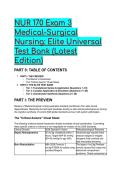
NUR 170 Exam 3
Medical-Surgical
Nursing: Elite Universal
Test Bank (Latest
Edition)
PART 0: TABLE OF CONTENTS
1. PART I: THE PREVIEW
○ The Mentor’s Introduction
○ The "Critical Axioms" Cheat Sheet
2. PART II: THE ELITE TEST BANK
○ Tier 1: Foundational Syntax & Application (Questions 1–10)
○ Tier 2: Complex Application & Simulation (Questions 11–20)
○ Tier 3: Grandmaster Synthesis (Questions 21–30)
PART I: THE PREVIEW
Mastery of Medical-Surgical nursing separates standard practitioners from elite clinical
diagnosticians. Mastering this test bank translates directly to elite clinical performance by forcing
the cognitive synthesis of current 2026 global standards across multi-system pathologies.
The "Critical Axioms" Cheat Sheet
The following evidence-based frameworks dictate immediate clinical prioritization. Committing
these specific metrics to memory is non-negotiable for mastery of the 2026 standards.
Clinical Domain 2026 Standard / Axiom Pathophysiological Rationale
Sepsis Hemodynamics 30 mL/kg crystalloids within 3 Advanced age requires lower
hours; Target MAP 65 mmHg pressure targets to mitigate
(60–65 mmHg for age ≥65). iatrogenic fluid overload and
fatal myocardial ischemia.
Burn Resuscitation ABA 2026 Formula: 2 The legacy 4 mL/kg Parkland
mL/kg/%TBSA for adults using formula causes fluid creep and
Lactated Ringer's. abdominal compartment
syndrome. Titrate exclusively to
,Clinical Domain 2026 Standard / Axiom Pathophysiological Rationale
30–50 mL/hr urine output.
Malignant Hyperthermia Dantrolene 2.5 mg/kg Hypermetabolic skeletal muscle
continuous rapid IV push; rigidity requires immediate
reconstitute with sterile water ryanodine receptor antagonism.
only. Saline causes precipitation.
Endocrine Crises Myxedema = IV Levothyroxine Myxedema requires metabolic
+ Hydrocortisone. Thyroid restart and adrenal protection.
Storm = IV Propranolol first. Thyroid storm requires
immediate beta-blockade to
prevent cardiovascular
collapse.
Acute Kidney Injury KDIGO Stage 1: Urine output Oliguria is the absolute earliest
<0.5 mL/kg/h for 6–12 hours. functional marker of acute
tubular necrosis. Serum
creatinine is a lagging indicator
of injury.
PART II: THE ELITE TEST BANK
Tier 1: Foundational Syntax & Application
Q1: A 68-year-old patient is admitted with probable septic shock secondary to severe
community-acquired pneumonia. Initial fluid resuscitation of 30 mL/kg using balanced
crystalloids has been completed. The patient's blood pressure remains 82/48 mmHg. Based on
the principles of the 2026 Surviving Sepsis Campaign (SSC) Guidelines, which action is the
MOST APPROPRIATE? A) Administer an additional 30 mL/kg bolus of 0.9% Normal Saline to
maximize preload stretch. B) Initiate a peripheral norepinephrine infusion to target a Mean
Arterial Pressure (MAP) of 75 mmHg. C) Initiate a norepinephrine infusion to target a Mean
Arterial Pressure (MAP) of 60–65 mmHg. D) Delay vasopressor initiation until central venous
access is successfully secured by the intensivist.
● Answer: C (Initiate a norepinephrine infusion to target a Mean Arterial Pressure (MAP) of
60–65 mmHg.)
● Distractor Analysis:
○ A is incorrect: Repeated unguided fluid boluses lead to fluid overload, ARDS, and
right ventricular failure. Further fluid administration must be based strictly on
dynamic measures of perfusion, not arbitrary volumes.
○ B is incorrect: Targeting a MAP of 75 mmHg increases vasopressor exposure
without improving survival, significantly elevating the risk of digital ischemia and
arrhythmias.
○ D is incorrect: The 2026 SSC guidelines explicitly recommend starting
vasopressors peripherally to immediately restore perfusion rather than delaying
life-saving therapy for central line placement.
The Mentor's Analysis: Hemodynamic collapse in sepsis requires immediate, meticulously
titrated intervention. The 2026 SSC guidelines mandate an initial MAP target of 65 mmHg
generally, but specifically recommend a lower threshold of 60–65 mmHg for adults 65 years and
older to mitigate the risks of excessive vasoconstriction and myocardial ischemia. By initiating
norepinephrine peripherally at this specific target, you bypass the common trap of delaying
, perfusion while simultaneously protecting the aging myocardium from vasopressor toxicity.
Professional/Academic Intuition: Age dictates the pressure deck; strictly target 60–65
mmHg for the geriatric septic patient.
Q2: A 45-year-old patient is admitted with deep partial-thickness thermal burns covering 35% of
their Total Body Surface Area (TBSA). Based on the principles of current American Burn
Association (ABA) Resuscitation Guidelines, which fluid calculation protocol is the MOST
ACCURATE for the first 24 hours of resuscitation? A) 4 mL/kg/%TBSA of Lactated Ringer's,
administering half in the first 8 hours. B) 2 mL/kg/%TBSA of Lactated Ringer's, administering
half in the first 8 hours. C) 4 mL/kg/%TBSA of 0.9% Normal Saline, administering half in the first
8 hours. D) 2 mL/kg/%TBSA of 5% Dextrose in Water, administering evenly over 24 hours.
● Answer: B (2 mL/kg/%TBSA of Lactated Ringer's, administering half in the first 8 hours.)
● Distractor Analysis:
○ A is incorrect: This formula represents the legacy Parkland calculation, which
extensive modern data proves is directly associated with fluid creep, pulmonary
edema, and abdominal compartment syndrome.
○ C is incorrect: Normal saline causes hyperchloremic metabolic acidosis and 4
mL/kg is an excessive starting volume.
○ D is incorrect: Dextrose is contraindicated for initial burn shock resuscitation in
adults due to ensuing hyperglycemia, and burn fluids are front-loaded, never given
evenly over 24 hours.
The Mentor's Analysis: Burn shock is driven by profound capillary leak and interstitial fluid
shifts resulting from inflammatory and vasoactive mediator release. Current global standards
mandate restrictive volume initiation at 2 mL/kg/%TBSA to mitigate iatrogenic fluid overload,
titrating fluid upward only if urine output falls below the strictly defined 30–50 mL/hr threshold.
By utilizing Lactated Ringer's at this precise volume, you bypass the common trap of
hyperchloremic acidosis and third-spacing. Professional/Academic Intuition: Start low, titrate
to flow: 2 mL/kg/%TBSA is the modern standard for thermal burns.
Q3: The nurse is caring for a client with a comminuted long bone fracture of the femur who is at
high risk for a fat embolism. Based on the principles of orthopedic trauma assessment, the
nurse specifically monitors for the earliest signs of this complication by performing a rigorous
assessment of which physiological systems? A) The cardiovascular and renal systems. B) The
integumentary and hepatic systems. C) The neurological and respiratory systems. D) The
musculoskeletal and gastrointestinal systems.
● Answer: C (The neurological and respiratory systems.)
● Distractor Analysis:
○ A is incorrect: While unexplained tachycardia often occurs, acute renal failure is not
an early hallmark of fat embolism syndrome.
○ B is incorrect: Petechiae (integumentary assessment) is a classic confirmatory sign,
but it is a late manifestation, occurring in only 50-60% of cases and often appearing
days after the initial systemic insult.
○ D is incorrect: Gastrointestinal involvement is completely unrelated to the primary
pathophysiology of intravascular lipid embolization.
The Mentor's Analysis: Fat embolism syndrome (FES) occurs when marrow fat enters the
venous circulation, primarily impacting the pulmonary and cerebral microvasculature. The
immediate priority is identifying acute hypoxemia and altered mental status before
cardiovascular collapse ensues. By assessing respiratory effort and neurological baselines
continuously, you bypass the novice error of waiting for petechiae to appear before initiating
life-saving oxygenation. Professional/Academic Intuition: Altered mentation and tachypnea
Medical-Surgical
Nursing: Elite Universal
Test Bank (Latest
Edition)
PART 0: TABLE OF CONTENTS
1. PART I: THE PREVIEW
○ The Mentor’s Introduction
○ The "Critical Axioms" Cheat Sheet
2. PART II: THE ELITE TEST BANK
○ Tier 1: Foundational Syntax & Application (Questions 1–10)
○ Tier 2: Complex Application & Simulation (Questions 11–20)
○ Tier 3: Grandmaster Synthesis (Questions 21–30)
PART I: THE PREVIEW
Mastery of Medical-Surgical nursing separates standard practitioners from elite clinical
diagnosticians. Mastering this test bank translates directly to elite clinical performance by forcing
the cognitive synthesis of current 2026 global standards across multi-system pathologies.
The "Critical Axioms" Cheat Sheet
The following evidence-based frameworks dictate immediate clinical prioritization. Committing
these specific metrics to memory is non-negotiable for mastery of the 2026 standards.
Clinical Domain 2026 Standard / Axiom Pathophysiological Rationale
Sepsis Hemodynamics 30 mL/kg crystalloids within 3 Advanced age requires lower
hours; Target MAP 65 mmHg pressure targets to mitigate
(60–65 mmHg for age ≥65). iatrogenic fluid overload and
fatal myocardial ischemia.
Burn Resuscitation ABA 2026 Formula: 2 The legacy 4 mL/kg Parkland
mL/kg/%TBSA for adults using formula causes fluid creep and
Lactated Ringer's. abdominal compartment
syndrome. Titrate exclusively to
,Clinical Domain 2026 Standard / Axiom Pathophysiological Rationale
30–50 mL/hr urine output.
Malignant Hyperthermia Dantrolene 2.5 mg/kg Hypermetabolic skeletal muscle
continuous rapid IV push; rigidity requires immediate
reconstitute with sterile water ryanodine receptor antagonism.
only. Saline causes precipitation.
Endocrine Crises Myxedema = IV Levothyroxine Myxedema requires metabolic
+ Hydrocortisone. Thyroid restart and adrenal protection.
Storm = IV Propranolol first. Thyroid storm requires
immediate beta-blockade to
prevent cardiovascular
collapse.
Acute Kidney Injury KDIGO Stage 1: Urine output Oliguria is the absolute earliest
<0.5 mL/kg/h for 6–12 hours. functional marker of acute
tubular necrosis. Serum
creatinine is a lagging indicator
of injury.
PART II: THE ELITE TEST BANK
Tier 1: Foundational Syntax & Application
Q1: A 68-year-old patient is admitted with probable septic shock secondary to severe
community-acquired pneumonia. Initial fluid resuscitation of 30 mL/kg using balanced
crystalloids has been completed. The patient's blood pressure remains 82/48 mmHg. Based on
the principles of the 2026 Surviving Sepsis Campaign (SSC) Guidelines, which action is the
MOST APPROPRIATE? A) Administer an additional 30 mL/kg bolus of 0.9% Normal Saline to
maximize preload stretch. B) Initiate a peripheral norepinephrine infusion to target a Mean
Arterial Pressure (MAP) of 75 mmHg. C) Initiate a norepinephrine infusion to target a Mean
Arterial Pressure (MAP) of 60–65 mmHg. D) Delay vasopressor initiation until central venous
access is successfully secured by the intensivist.
● Answer: C (Initiate a norepinephrine infusion to target a Mean Arterial Pressure (MAP) of
60–65 mmHg.)
● Distractor Analysis:
○ A is incorrect: Repeated unguided fluid boluses lead to fluid overload, ARDS, and
right ventricular failure. Further fluid administration must be based strictly on
dynamic measures of perfusion, not arbitrary volumes.
○ B is incorrect: Targeting a MAP of 75 mmHg increases vasopressor exposure
without improving survival, significantly elevating the risk of digital ischemia and
arrhythmias.
○ D is incorrect: The 2026 SSC guidelines explicitly recommend starting
vasopressors peripherally to immediately restore perfusion rather than delaying
life-saving therapy for central line placement.
The Mentor's Analysis: Hemodynamic collapse in sepsis requires immediate, meticulously
titrated intervention. The 2026 SSC guidelines mandate an initial MAP target of 65 mmHg
generally, but specifically recommend a lower threshold of 60–65 mmHg for adults 65 years and
older to mitigate the risks of excessive vasoconstriction and myocardial ischemia. By initiating
norepinephrine peripherally at this specific target, you bypass the common trap of delaying
, perfusion while simultaneously protecting the aging myocardium from vasopressor toxicity.
Professional/Academic Intuition: Age dictates the pressure deck; strictly target 60–65
mmHg for the geriatric septic patient.
Q2: A 45-year-old patient is admitted with deep partial-thickness thermal burns covering 35% of
their Total Body Surface Area (TBSA). Based on the principles of current American Burn
Association (ABA) Resuscitation Guidelines, which fluid calculation protocol is the MOST
ACCURATE for the first 24 hours of resuscitation? A) 4 mL/kg/%TBSA of Lactated Ringer's,
administering half in the first 8 hours. B) 2 mL/kg/%TBSA of Lactated Ringer's, administering
half in the first 8 hours. C) 4 mL/kg/%TBSA of 0.9% Normal Saline, administering half in the first
8 hours. D) 2 mL/kg/%TBSA of 5% Dextrose in Water, administering evenly over 24 hours.
● Answer: B (2 mL/kg/%TBSA of Lactated Ringer's, administering half in the first 8 hours.)
● Distractor Analysis:
○ A is incorrect: This formula represents the legacy Parkland calculation, which
extensive modern data proves is directly associated with fluid creep, pulmonary
edema, and abdominal compartment syndrome.
○ C is incorrect: Normal saline causes hyperchloremic metabolic acidosis and 4
mL/kg is an excessive starting volume.
○ D is incorrect: Dextrose is contraindicated for initial burn shock resuscitation in
adults due to ensuing hyperglycemia, and burn fluids are front-loaded, never given
evenly over 24 hours.
The Mentor's Analysis: Burn shock is driven by profound capillary leak and interstitial fluid
shifts resulting from inflammatory and vasoactive mediator release. Current global standards
mandate restrictive volume initiation at 2 mL/kg/%TBSA to mitigate iatrogenic fluid overload,
titrating fluid upward only if urine output falls below the strictly defined 30–50 mL/hr threshold.
By utilizing Lactated Ringer's at this precise volume, you bypass the common trap of
hyperchloremic acidosis and third-spacing. Professional/Academic Intuition: Start low, titrate
to flow: 2 mL/kg/%TBSA is the modern standard for thermal burns.
Q3: The nurse is caring for a client with a comminuted long bone fracture of the femur who is at
high risk for a fat embolism. Based on the principles of orthopedic trauma assessment, the
nurse specifically monitors for the earliest signs of this complication by performing a rigorous
assessment of which physiological systems? A) The cardiovascular and renal systems. B) The
integumentary and hepatic systems. C) The neurological and respiratory systems. D) The
musculoskeletal and gastrointestinal systems.
● Answer: C (The neurological and respiratory systems.)
● Distractor Analysis:
○ A is incorrect: While unexplained tachycardia often occurs, acute renal failure is not
an early hallmark of fat embolism syndrome.
○ B is incorrect: Petechiae (integumentary assessment) is a classic confirmatory sign,
but it is a late manifestation, occurring in only 50-60% of cases and often appearing
days after the initial systemic insult.
○ D is incorrect: Gastrointestinal involvement is completely unrelated to the primary
pathophysiology of intravascular lipid embolization.
The Mentor's Analysis: Fat embolism syndrome (FES) occurs when marrow fat enters the
venous circulation, primarily impacting the pulmonary and cerebral microvasculature. The
immediate priority is identifying acute hypoxemia and altered mental status before
cardiovascular collapse ensues. By assessing respiratory effort and neurological baselines
continuously, you bypass the novice error of waiting for petechiae to appear before initiating
life-saving oxygenation. Professional/Academic Intuition: Altered mentation and tachypnea