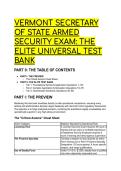
VERMONT SECRETARY
OF STATE ARMED
SECURITY EXAM: THE
ELITE UNIVERSAL TEST
BANK
PART 0: THE TABLE OF CONTENTS
● PART I: THE PREVIEW
○ The Critical Axioms Cheat Sheet
● PART II: THE ELITE TEST BANK
○ Tier 1: Foundational Syntax & Application (Questions 1–18)
○ Tier 2: Complex Application & Simulation (Questions 19–37)
○ Tier 3: Grandmaster Synthesis (Questions 38–55)
PART I: THE PREVIEW
Mastering this test bank translates directly to elite operational competence, ensuring every
tactical and administrative decision aligns flawlessly with Vermont's strict regulatory frameworks.
The objective is to forge analytical precision, rendering the practitioner legally unassailable and
operationally superior in any high-stress environment.
The "Critical Axioms" Cheat Sheet
Axiom Category Statutory Standard & Operational Rule
Licensing Tiers A Licensed Security Guard requires 40 hours of
training and two years of verifiable experience;
a Registered Security Employee requires 8
hours of training and direct agency supervision.
The Firearms Specialty Carrying a weapon on duty requires an active
Part 4 license plus a Part 5 Firearms Specialty
Designation (12 hours general, 4 hours specific
weapon, and range qualification).
Use of Deadly Force Under 13 V.S.A. § 2305, deadly force is justified
only when objectively reasonable and
,Axiom Category Statutory Standard & Operational Rule
necessary to defend human life against an
imminent threat of death or serious bodily injury.
The Chokehold Axiom Chokeholds are strictly prohibited as standard
compliance restraints; they are legally
permissible only when the statutory justification
for deadly force has already been met.
Duty to Intervene Practitioners must physically or verbally
intervene against excessive force by peers and
must adjust force calculations when a subject is
known to suffer from mental impairment.
PART II: THE ELITE TEST BANK
Tier 1: Foundational Syntax & Application
Q1: An applicant seeks to work as a registered security employee under a licensed private
security agency in Vermont. According to the Office of Professional Regulation (OPR), what is
the MINIMUM required training duration the applicant must complete to achieve permanent
credentialing in this specific role? A) 40 hours of comprehensive private security training B) 12
hours of specialized classroom instruction C) 8 hours of approved private security training D) 6
hours of emergency response theory
● Answer: C (8 hours of approved private security training)
● Distractor Analysis:
○ A is incorrect: This 40-hour requirement applies exclusively to Licensed Security
Guards seeking independent practice or higher authority.
○ B is incorrect: Twelve hours represents the general classroom requirement for the
firearms specialty designation, not the baseline registration.
○ D is incorrect: This is a fabricated timeframe that does not align with Vermont's Title
26 administrative rules.
The Mentor's Analysis: The foundational rule for entry-level access dictates a strict baseline to
ensure public safety without over-burdening subordinate staff. When facing administrative
compliance, the immediate priority is distinguishing the applicant's intended operational tier. By
utilizing the 8-hour statutory standard, you bypass the common trap of confusing entry-level
prerequisites with advanced licensure criteria. Professional Intuition: Always segregate the
8-hour registered employee standard from the 40-hour licensed guard requirement.
Q2: A licensed security guard in Vermont wishes to transition to an armed post. To legally carry
a firearm on duty, which combination of training is the MANDATORY requirement under the
Board of Private Investigative and Security Services rules? A) 8 hours of general safety and a
standard background check B) 12 hours of general firearm safety, 4 hours on the specific
weapon, and range qualification C) 40 hours of comprehensive private security training with a
firearms module D) 6 hours of recertification training and employer authorization
● Answer: B (12 hours of general firearm safety, 4 hours on the specific weapon, and range
qualification)
● Distractor Analysis:
○ A is incorrect: This represents entry-level unarmed training combined with a generic
vetting process, lacking the rigor required for lethal force authorization.
○ C is incorrect: While 40 hours is required for the baseline license, the firearms
, designation is an additional, separate specialty requirement.
○ D is incorrect: Six hours is the minimum requirement for biennial recertification, not
the initial specialty designation.
The Mentor's Analysis: The state views firearms as an escalated liability requiring specific,
multi-tiered mitigation. When facing an upgrade to armed status, the immediate priority is
fulfilling the precise mathematical breakdown of required instructional hours. By utilizing the
12+4 formula, you bypass the common trap of assuming baseline licensure covers weapon
authorization. Professional Intuition: An armed designation is a distinct mathematical
formula: 12 general hours + 4 specific hours + range qualification.
Q3: A newly hired registered security employee is dispatched to an unarmed post at a
commercial facility. Regarding emergency medical preparedness, what is the MAXIMUM
allowable timeframe for the employee to obtain CPR and AED certification? A) Prior to
assuming any active security duties B) Within 30 days of initial registration C) Within three
months of hire by an agency D) Prior to the first biennial license renewal
● Answer: C (Within three months of hire by an agency)
● Distractor Analysis:
○ A is incorrect: While logically sound for maximum safety, Vermont law provides a
grace period for new hires to complete this specific certification.
○ B is incorrect: Thirty days is an aggressive administrative timeline not supported by
current OPR mandates.
○ D is incorrect: Waiting until the two-year renewal cycle constitutes a gross violation
of the statutory deadline.
The Mentor's Analysis: Operational readiness requires basic life-saving capabilities, but
regulators provide a realistic window for logistical compliance. When facing onboarding
requirements, the immediate priority is tracking the exact statutory grace period for medical
certs. By utilizing the three-month rule, you bypass the common trap of either delaying training
indefinitely or improperly barring a compliant new hire. Professional Intuition: Medical
certification is a ticking clock: 90 days from the date of agency hire, no exceptions.
Q4: A security professional in Vermont is evaluated for their authority to use force. Under 13
V.S.A. § 2305, the use of deadly force by an armed guard is considered LAWFUL only under
which circumstance? A) When preventing the escape of any fleeing suspect who has committed
a property felony B) When it is objectively reasonable and necessary in defense of human life
C) When a subject refuses to comply with verbal commands during a lawful detention D) When
the practitioner feels subjectively threatened by an unarmed trespasser
● Answer: B (When it is objectively reasonable and necessary in defense of human life)
● Distractor Analysis:
○ A is incorrect: Deadly force cannot be used merely to prevent escape for property
crimes; the fleeing suspect must pose an imminent threat of death or serious bodily
injury.
○ C is incorrect: Non-compliance does not authorize lethal force; force must be
proportional to the threat.
○ D is incorrect: The standard is "objectively reasonable," not strictly subjective fear,
and an unarmed trespasser generally does not warrant lethal force.
The Mentor's Analysis: Lethal force is the absolute terminal point of the use-of-force continuum
and requires unimpeachable justification. When facing a potential lethal encounter, the
immediate priority is applying the objective reasonableness standard strictly to the preservation
of life. By utilizing the objective threat requirement, you bypass the common trap of applying
deadly force to property crimes or simple non-compliance. Professional Intuition: Deadly force
OF STATE ARMED
SECURITY EXAM: THE
ELITE UNIVERSAL TEST
BANK
PART 0: THE TABLE OF CONTENTS
● PART I: THE PREVIEW
○ The Critical Axioms Cheat Sheet
● PART II: THE ELITE TEST BANK
○ Tier 1: Foundational Syntax & Application (Questions 1–18)
○ Tier 2: Complex Application & Simulation (Questions 19–37)
○ Tier 3: Grandmaster Synthesis (Questions 38–55)
PART I: THE PREVIEW
Mastering this test bank translates directly to elite operational competence, ensuring every
tactical and administrative decision aligns flawlessly with Vermont's strict regulatory frameworks.
The objective is to forge analytical precision, rendering the practitioner legally unassailable and
operationally superior in any high-stress environment.
The "Critical Axioms" Cheat Sheet
Axiom Category Statutory Standard & Operational Rule
Licensing Tiers A Licensed Security Guard requires 40 hours of
training and two years of verifiable experience;
a Registered Security Employee requires 8
hours of training and direct agency supervision.
The Firearms Specialty Carrying a weapon on duty requires an active
Part 4 license plus a Part 5 Firearms Specialty
Designation (12 hours general, 4 hours specific
weapon, and range qualification).
Use of Deadly Force Under 13 V.S.A. § 2305, deadly force is justified
only when objectively reasonable and
,Axiom Category Statutory Standard & Operational Rule
necessary to defend human life against an
imminent threat of death or serious bodily injury.
The Chokehold Axiom Chokeholds are strictly prohibited as standard
compliance restraints; they are legally
permissible only when the statutory justification
for deadly force has already been met.
Duty to Intervene Practitioners must physically or verbally
intervene against excessive force by peers and
must adjust force calculations when a subject is
known to suffer from mental impairment.
PART II: THE ELITE TEST BANK
Tier 1: Foundational Syntax & Application
Q1: An applicant seeks to work as a registered security employee under a licensed private
security agency in Vermont. According to the Office of Professional Regulation (OPR), what is
the MINIMUM required training duration the applicant must complete to achieve permanent
credentialing in this specific role? A) 40 hours of comprehensive private security training B) 12
hours of specialized classroom instruction C) 8 hours of approved private security training D) 6
hours of emergency response theory
● Answer: C (8 hours of approved private security training)
● Distractor Analysis:
○ A is incorrect: This 40-hour requirement applies exclusively to Licensed Security
Guards seeking independent practice or higher authority.
○ B is incorrect: Twelve hours represents the general classroom requirement for the
firearms specialty designation, not the baseline registration.
○ D is incorrect: This is a fabricated timeframe that does not align with Vermont's Title
26 administrative rules.
The Mentor's Analysis: The foundational rule for entry-level access dictates a strict baseline to
ensure public safety without over-burdening subordinate staff. When facing administrative
compliance, the immediate priority is distinguishing the applicant's intended operational tier. By
utilizing the 8-hour statutory standard, you bypass the common trap of confusing entry-level
prerequisites with advanced licensure criteria. Professional Intuition: Always segregate the
8-hour registered employee standard from the 40-hour licensed guard requirement.
Q2: A licensed security guard in Vermont wishes to transition to an armed post. To legally carry
a firearm on duty, which combination of training is the MANDATORY requirement under the
Board of Private Investigative and Security Services rules? A) 8 hours of general safety and a
standard background check B) 12 hours of general firearm safety, 4 hours on the specific
weapon, and range qualification C) 40 hours of comprehensive private security training with a
firearms module D) 6 hours of recertification training and employer authorization
● Answer: B (12 hours of general firearm safety, 4 hours on the specific weapon, and range
qualification)
● Distractor Analysis:
○ A is incorrect: This represents entry-level unarmed training combined with a generic
vetting process, lacking the rigor required for lethal force authorization.
○ C is incorrect: While 40 hours is required for the baseline license, the firearms
, designation is an additional, separate specialty requirement.
○ D is incorrect: Six hours is the minimum requirement for biennial recertification, not
the initial specialty designation.
The Mentor's Analysis: The state views firearms as an escalated liability requiring specific,
multi-tiered mitigation. When facing an upgrade to armed status, the immediate priority is
fulfilling the precise mathematical breakdown of required instructional hours. By utilizing the
12+4 formula, you bypass the common trap of assuming baseline licensure covers weapon
authorization. Professional Intuition: An armed designation is a distinct mathematical
formula: 12 general hours + 4 specific hours + range qualification.
Q3: A newly hired registered security employee is dispatched to an unarmed post at a
commercial facility. Regarding emergency medical preparedness, what is the MAXIMUM
allowable timeframe for the employee to obtain CPR and AED certification? A) Prior to
assuming any active security duties B) Within 30 days of initial registration C) Within three
months of hire by an agency D) Prior to the first biennial license renewal
● Answer: C (Within three months of hire by an agency)
● Distractor Analysis:
○ A is incorrect: While logically sound for maximum safety, Vermont law provides a
grace period for new hires to complete this specific certification.
○ B is incorrect: Thirty days is an aggressive administrative timeline not supported by
current OPR mandates.
○ D is incorrect: Waiting until the two-year renewal cycle constitutes a gross violation
of the statutory deadline.
The Mentor's Analysis: Operational readiness requires basic life-saving capabilities, but
regulators provide a realistic window for logistical compliance. When facing onboarding
requirements, the immediate priority is tracking the exact statutory grace period for medical
certs. By utilizing the three-month rule, you bypass the common trap of either delaying training
indefinitely or improperly barring a compliant new hire. Professional Intuition: Medical
certification is a ticking clock: 90 days from the date of agency hire, no exceptions.
Q4: A security professional in Vermont is evaluated for their authority to use force. Under 13
V.S.A. § 2305, the use of deadly force by an armed guard is considered LAWFUL only under
which circumstance? A) When preventing the escape of any fleeing suspect who has committed
a property felony B) When it is objectively reasonable and necessary in defense of human life
C) When a subject refuses to comply with verbal commands during a lawful detention D) When
the practitioner feels subjectively threatened by an unarmed trespasser
● Answer: B (When it is objectively reasonable and necessary in defense of human life)
● Distractor Analysis:
○ A is incorrect: Deadly force cannot be used merely to prevent escape for property
crimes; the fleeing suspect must pose an imminent threat of death or serious bodily
injury.
○ C is incorrect: Non-compliance does not authorize lethal force; force must be
proportional to the threat.
○ D is incorrect: The standard is "objectively reasonable," not strictly subjective fear,
and an unarmed trespasser generally does not warrant lethal force.
The Mentor's Analysis: Lethal force is the absolute terminal point of the use-of-force continuum
and requires unimpeachable justification. When facing a potential lethal encounter, the
immediate priority is applying the objective reasonableness standard strictly to the preservation
of life. By utilizing the objective threat requirement, you bypass the common trap of applying
deadly force to property crimes or simple non-compliance. Professional Intuition: Deadly force