

HEALTHCARE ADMINISTRATION • EVIDENCE-BASED PRACTICE
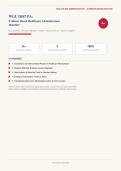
WGU D547 PA:
Evidence Based Healthcare Administration
A+
2026/2027
Data Analytics • Research Methods • AI/ML • Ethics & Privacy • Decision Support
A+ 5 100%
QUESTIONS VERIFIED EXAM DOMAINS COVERED RATIONALES INCLUDED
CATEGORIES
1. Foundations of Evidence-Based Practice in Healthcare Administration
2. Research Methods, Evidence Levels & Appraisal
3. Data Analytics & Statistical Tools for Decision-Making
4. Emerging Technologies, Privacy & Ethics
5. Translating Evidence into Administrative Action & Communication
Aligned to WGU D547 competencies: Apply data analytics • Explain how data supports decisions •
Select research paradigms and methods for evidence-based practice in healthcare administration.
STUVIAACTUALEXAM
, SECTION 1 — Foundations of Evidence-Based Practice in Healthcare Administration
Q1. A hospital administrator is deciding whether to expand a nurse residency program. She reviews published outcome studies,
consults experienced nurse leaders about local feasibility, and surveys recent graduates about their preferences. This approach
best illustrates which core principle of evidence-based practice?
A. Relying exclusively on the highest-volume vendor’s marketing claims
B. Integrating best available research evidence, practitioner expertise, and stakeholder values or preferences
C. Deferring all decisions to the most senior physician without reviewing data
D. Selecting the lowest-cost option regardless of outcomes evidence
Correct Answer: B
Rationale: Evidence-based practice in healthcare administration combines rigorous external evidence, internal expertise and organizational
context, and the values or preferences of those affected. The administrator’s process reflects all three pillars.
Q2. An ambulatory network is evaluating a new patient-flow model. Leadership insists that decisions be driven by “what the
data show” but has not defined the decision question or success metrics in advance. Which foundational step is missing?
A. Purchasing the most expensive analytics software available
B. Collecting every possible data element before any analysis
C. Framing a clear decision question and specifying the outcomes that would change the course of action
D. Excluding clinical staff from the conversation to remain objective
Correct Answer: C
Rationale: Evidence-based decision-making begins with a well-framed question and predefined criteria for success. Without them, analysis
risks becoming exploratory data mining that does not answer a real administrative problem.
Q3. A quality director cites a single observational study from one hospital as definitive proof that a new discharge checklist will
reduce readmissions system-wide. Which limitation of this reasoning is most important to raise?
A. Observational studies can never generate useful hypotheses
B. Readmission rates are unrelated to discharge processes
C. Only randomized trials conducted at the same institution may ever be used
D. Generalizability, potential confounding, and the strength of a single study’s design limit how far the finding should drive
system-wide policy
Correct Answer: D
Rationale: A single observational study may be informative but is vulnerable to confounding and may not generalize. Administrators should
weigh study design, consistency across evidence, and local context before large-scale adoption.
Q4. In the DIKW hierarchy used in healthcare analytics, the progression from raw numbers in an EHR extract to a
recommendation for staffing changes represents movement from:
A. Data to information to knowledge, and potentially to wisdom that guides action
B. Wisdom directly back to data with no intermediate steps
C. Knowledge exclusively to more data collection without interpretation
D. Information that cannot influence administrative decisions
Correct Answer: A
Rationale: DIKW describes how data become information through context, knowledge through synthesis and understanding, and wisdom
through applied judgment. Administrative recommendations sit at the knowledge/wisdom end of that continuum.
Q5. A regional health system adopts an evidence-based fall-prevention bundle after reviewing multiple studies and local pilot
results. Six months later, fall rates have not improved. Which evidence-based management response is most appropriate?
A. Abandon all fall-prevention efforts permanently
B. Re-examine implementation fidelity, local barriers, and measurement, then adapt or reinforce the intervention
C. Assume the original studies were fraudulent and ignore future research
D. Increase falls reporting thresholds so rates appear lower
Correct Answer: B
WGU D547 PA:
Evidence Based Healthcare Administration
A+
2026/2027
Data Analytics • Research Methods • AI/ML • Ethics & Privacy • Decision Support
A+ 5 100%
QUESTIONS VERIFIED EXAM DOMAINS COVERED RATIONALES INCLUDED
CATEGORIES
1. Foundations of Evidence-Based Practice in Healthcare Administration
2. Research Methods, Evidence Levels & Appraisal
3. Data Analytics & Statistical Tools for Decision-Making
4. Emerging Technologies, Privacy & Ethics
5. Translating Evidence into Administrative Action & Communication
Aligned to WGU D547 competencies: Apply data analytics • Explain how data supports decisions •
Select research paradigms and methods for evidence-based practice in healthcare administration.
STUVIAACTUALEXAM
, SECTION 1 — Foundations of Evidence-Based Practice in Healthcare Administration
Q1. A hospital administrator is deciding whether to expand a nurse residency program. She reviews published outcome studies,
consults experienced nurse leaders about local feasibility, and surveys recent graduates about their preferences. This approach
best illustrates which core principle of evidence-based practice?
A. Relying exclusively on the highest-volume vendor’s marketing claims
B. Integrating best available research evidence, practitioner expertise, and stakeholder values or preferences
C. Deferring all decisions to the most senior physician without reviewing data
D. Selecting the lowest-cost option regardless of outcomes evidence
Correct Answer: B
Rationale: Evidence-based practice in healthcare administration combines rigorous external evidence, internal expertise and organizational
context, and the values or preferences of those affected. The administrator’s process reflects all three pillars.
Q2. An ambulatory network is evaluating a new patient-flow model. Leadership insists that decisions be driven by “what the
data show” but has not defined the decision question or success metrics in advance. Which foundational step is missing?
A. Purchasing the most expensive analytics software available
B. Collecting every possible data element before any analysis
C. Framing a clear decision question and specifying the outcomes that would change the course of action
D. Excluding clinical staff from the conversation to remain objective
Correct Answer: C
Rationale: Evidence-based decision-making begins with a well-framed question and predefined criteria for success. Without them, analysis
risks becoming exploratory data mining that does not answer a real administrative problem.
Q3. A quality director cites a single observational study from one hospital as definitive proof that a new discharge checklist will
reduce readmissions system-wide. Which limitation of this reasoning is most important to raise?
A. Observational studies can never generate useful hypotheses
B. Readmission rates are unrelated to discharge processes
C. Only randomized trials conducted at the same institution may ever be used
D. Generalizability, potential confounding, and the strength of a single study’s design limit how far the finding should drive
system-wide policy
Correct Answer: D
Rationale: A single observational study may be informative but is vulnerable to confounding and may not generalize. Administrators should
weigh study design, consistency across evidence, and local context before large-scale adoption.
Q4. In the DIKW hierarchy used in healthcare analytics, the progression from raw numbers in an EHR extract to a
recommendation for staffing changes represents movement from:
A. Data to information to knowledge, and potentially to wisdom that guides action
B. Wisdom directly back to data with no intermediate steps
C. Knowledge exclusively to more data collection without interpretation
D. Information that cannot influence administrative decisions
Correct Answer: A
Rationale: DIKW describes how data become information through context, knowledge through synthesis and understanding, and wisdom
through applied judgment. Administrative recommendations sit at the knowledge/wisdom end of that continuum.
Q5. A regional health system adopts an evidence-based fall-prevention bundle after reviewing multiple studies and local pilot
results. Six months later, fall rates have not improved. Which evidence-based management response is most appropriate?
A. Abandon all fall-prevention efforts permanently
B. Re-examine implementation fidelity, local barriers, and measurement, then adapt or reinforce the intervention
C. Assume the original studies were fraudulent and ignore future research
D. Increase falls reporting thresholds so rates appear lower
Correct Answer: B


