
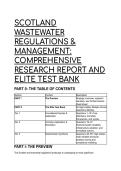
SCOTLAND
WASTEWATER
REGULATIONS &
MANAGEMENT:
COMPREHENSIVE
RESEARCH REPORT AND
ELITE TEST BANK
PART 0: THE TABLE OF CONTENTS
Section Content Description
PART I The Preview Strategic overview, research
narrative, and Critical Axioms
cheat sheet.
PART II The Elite Test Bank 55 High-Caliber Multiple-Choice
Questions (MCQs).
Tier 1 Foundational Syntax & Questions 1–18: Core
Application definitions, transition
frameworks, and syntax.
Tier 2 Complex Application & Questions 19–37:
Simulation Scenario-based variables,
infrastructure adoption, and
immediate actions.
Tier 3 Grandmaster Synthesis Questions 38–55: High-stakes,
multi-variable structural
problem solving and
compliance modeling.
PART I: THE PREVIEW
The Scottish environmental regulatory landscape is undergoing its most significant
,modernization in over a decade. Mastering the nuances of this transition is paramount for
infrastructure developers, environmental engineers, and regulatory compliance officers. This
assessment bridges the gap between theoretical planning guidelines and strict statutory
enforcement, translating directly to elite professional competence in Scottish water
management.
The Research Context: EASR Transition and Infrastructure
Modernization
The modernization of Scotland's environmental governance is defined by the shift from the
legacy Water Environment (Controlled Activities) (Scotland) Regulations 2011 (CAR) to the
comprehensive Environmental Authorisations (Scotland) Regulations 2018 (EASR), which fully
takes effect on November 1, 2025. This transition integrates water, waste, radioactive
substances, and industrial activities into a unified, risk-based framework. Historical exemptions
are being aggressively phased out, demanding new formal applications, while a reinforced "Fit &
Proper Person" test aims to eradicate organized waste crime.
Simultaneously, the physical infrastructure of Scottish wastewater is strained by historical legacy
systems. Combined Sewer Overflows (CSOs) remain a critical vulnerability, with data indicating
that 21% of Scottish Water's storm overflows spilled over 50 times in the 2023-2024 period, and
specific sites like Meadowhead discharging 365 times in 2023 alone. To mitigate this hydraulic
overloading, the Scottish Environment Protection Agency (SEPA) and Scottish Water mandate
Sustainable Drainage Systems (SuDS). Governed structurally by Sewers for Scotland 4th
Edition, SuDS intercept and attenuate surface water before it enters the public network.
Regulatory and Infrastructure Frameworks
Regulatory Tier / Framework Scope & Application Enforcement & Transition
Notes
General Binding Rules "No-application tier" for low-risk Subject to self-compliance;
(GBRs) actions (e.g., GBR 10 for septic digital portal integration allows
tanks, GBR 7 for temporary self-assessment.
bridges).
Registrations & Licences Moderate to high-risk Existing CAR licences
cumulative and individual automatically transition to
activities (e.g., complex EASR; legacy exemptions
industrial discharges). require reapplication.
SuDS & SfS4 Adoption Surface water management Scottish Water solely adopts
hierarchy prioritizing source assets meeting Sewers for
control (green roofs, swales) Scotland 4th Edition (SfS4)
over tanked systems. strict standards.
CAS-G-004 Standardized flow recording Mandates data submission in
and reporting at sewage Excel format via SEPA's online
treatment works. portal.
The "Critical Axioms" Cheat Sheet
● The EASR Exemption Guillotine: Valid CAR licences and registrations transition
automatically to EASR on November 1, 2025. However, historical exemptions do
, not—they die and require immediate re-application to maintain legality.
● The GBR Strict-Liability Protocol: General Binding Rules (GBRs) offer operational
freedom without application fees, but require absolute, strict self-compliance. SEPA
enforces breaches directly via Regulation 32 (Enforcement Notices) and Regulation 33
(State-executed works with cost recovery).
● The SuDS Hierarchy: Surface water must never discharge directly to the water
environment without treatment. The hierarchy demands source control (e.g., rainwater
harvesting, green roofs) first. Underground tanked systems are the least sustainable and
lack biological treatment.
● The Structural Adoption Gatekeeper: Scottish Water will only adopt external SuDS and
sewer infrastructure if it meticulously complies with the BSI standards and structural
parameters outlined in Sewers for Scotland 4th Edition.
● The Radioactive Thresholds: Under EASR GBRs, low-level radioactive waste requires
strict tracking: solid uranium is capped at 0.5 kg per week for normal refuse; barium
eluting sources are capped at 4 × 10^5 becquerels of Cs-137+ on premises.
PART II: THE ELITE TEST BANK
Tier 1: Foundational Syntax & Application
Q1: Under the sweeping modernization of Scottish environmental law, historical CAR
regulations are being absorbed into the unified EASR framework. Which statement MOST
ACCURATELY describes the administrative fate of existing, valid CAR licences and
registrations on November 1, 2025? A) They are instantly revoked, requiring the operator to
suspend all activities until a new Environmental Impact Assessment is approved. B) They
automatically become authorizations under the draft EASR framework without the need for the
licence holders to reapply. C) They are downgraded to General Binding Rules, requiring strict
self-compliance but removing all annual subsistence charges. D) They are transferred to the
jurisdiction of the Highway Authority Utilities Committee (HAUC) for reassessment.
● Answer: B (They automatically become authorizations under the draft EASR framework
without the need for the licence holders to reapply.)
● Distractor Analysis:
○ A is incorrect: The transition is designed for regulatory continuity; shutting down
compliant operations contradicts SEPA’s goals.
○ C is incorrect: High-risk and moderate-risk activities cannot be arbitrarily
downgraded to low-risk GBRs.
○ D is incorrect: HAUC manages road works and diversions, not environmental
pollution authorizations.
The Mentor's Analysis: Regulatory transitions strive for seamless continuity for compliant actors.
When facing the November 2025 deadline, the immediate priority is understanding status. By
automating the transition of CAR licences and registrations, SEPA minimizes bureaucratic
friction for compliant legacy operators. Professional/Academic Intuition: Valid CAR licences
and registrations transition to EASR automatically; no re-application is required.
Q2: A rural Scottish business relies on a package treatment plant for its wastewater. According
to SEPA’s risk-based tier system, which regulatory tier PRIMARILY governs small-scale,
low-risk private sewage systems to ensure they do not cumulatively pollute the water
environment? A) The SuDS Registration Tier. B) The EASR Complex Licence Tier. C) The
WASTEWATER
REGULATIONS &
MANAGEMENT:
COMPREHENSIVE
RESEARCH REPORT AND
ELITE TEST BANK
PART 0: THE TABLE OF CONTENTS
Section Content Description
PART I The Preview Strategic overview, research
narrative, and Critical Axioms
cheat sheet.
PART II The Elite Test Bank 55 High-Caliber Multiple-Choice
Questions (MCQs).
Tier 1 Foundational Syntax & Questions 1–18: Core
Application definitions, transition
frameworks, and syntax.
Tier 2 Complex Application & Questions 19–37:
Simulation Scenario-based variables,
infrastructure adoption, and
immediate actions.
Tier 3 Grandmaster Synthesis Questions 38–55: High-stakes,
multi-variable structural
problem solving and
compliance modeling.
PART I: THE PREVIEW
The Scottish environmental regulatory landscape is undergoing its most significant
,modernization in over a decade. Mastering the nuances of this transition is paramount for
infrastructure developers, environmental engineers, and regulatory compliance officers. This
assessment bridges the gap between theoretical planning guidelines and strict statutory
enforcement, translating directly to elite professional competence in Scottish water
management.
The Research Context: EASR Transition and Infrastructure
Modernization
The modernization of Scotland's environmental governance is defined by the shift from the
legacy Water Environment (Controlled Activities) (Scotland) Regulations 2011 (CAR) to the
comprehensive Environmental Authorisations (Scotland) Regulations 2018 (EASR), which fully
takes effect on November 1, 2025. This transition integrates water, waste, radioactive
substances, and industrial activities into a unified, risk-based framework. Historical exemptions
are being aggressively phased out, demanding new formal applications, while a reinforced "Fit &
Proper Person" test aims to eradicate organized waste crime.
Simultaneously, the physical infrastructure of Scottish wastewater is strained by historical legacy
systems. Combined Sewer Overflows (CSOs) remain a critical vulnerability, with data indicating
that 21% of Scottish Water's storm overflows spilled over 50 times in the 2023-2024 period, and
specific sites like Meadowhead discharging 365 times in 2023 alone. To mitigate this hydraulic
overloading, the Scottish Environment Protection Agency (SEPA) and Scottish Water mandate
Sustainable Drainage Systems (SuDS). Governed structurally by Sewers for Scotland 4th
Edition, SuDS intercept and attenuate surface water before it enters the public network.
Regulatory and Infrastructure Frameworks
Regulatory Tier / Framework Scope & Application Enforcement & Transition
Notes
General Binding Rules "No-application tier" for low-risk Subject to self-compliance;
(GBRs) actions (e.g., GBR 10 for septic digital portal integration allows
tanks, GBR 7 for temporary self-assessment.
bridges).
Registrations & Licences Moderate to high-risk Existing CAR licences
cumulative and individual automatically transition to
activities (e.g., complex EASR; legacy exemptions
industrial discharges). require reapplication.
SuDS & SfS4 Adoption Surface water management Scottish Water solely adopts
hierarchy prioritizing source assets meeting Sewers for
control (green roofs, swales) Scotland 4th Edition (SfS4)
over tanked systems. strict standards.
CAS-G-004 Standardized flow recording Mandates data submission in
and reporting at sewage Excel format via SEPA's online
treatment works. portal.
The "Critical Axioms" Cheat Sheet
● The EASR Exemption Guillotine: Valid CAR licences and registrations transition
automatically to EASR on November 1, 2025. However, historical exemptions do
, not—they die and require immediate re-application to maintain legality.
● The GBR Strict-Liability Protocol: General Binding Rules (GBRs) offer operational
freedom without application fees, but require absolute, strict self-compliance. SEPA
enforces breaches directly via Regulation 32 (Enforcement Notices) and Regulation 33
(State-executed works with cost recovery).
● The SuDS Hierarchy: Surface water must never discharge directly to the water
environment without treatment. The hierarchy demands source control (e.g., rainwater
harvesting, green roofs) first. Underground tanked systems are the least sustainable and
lack biological treatment.
● The Structural Adoption Gatekeeper: Scottish Water will only adopt external SuDS and
sewer infrastructure if it meticulously complies with the BSI standards and structural
parameters outlined in Sewers for Scotland 4th Edition.
● The Radioactive Thresholds: Under EASR GBRs, low-level radioactive waste requires
strict tracking: solid uranium is capped at 0.5 kg per week for normal refuse; barium
eluting sources are capped at 4 × 10^5 becquerels of Cs-137+ on premises.
PART II: THE ELITE TEST BANK
Tier 1: Foundational Syntax & Application
Q1: Under the sweeping modernization of Scottish environmental law, historical CAR
regulations are being absorbed into the unified EASR framework. Which statement MOST
ACCURATELY describes the administrative fate of existing, valid CAR licences and
registrations on November 1, 2025? A) They are instantly revoked, requiring the operator to
suspend all activities until a new Environmental Impact Assessment is approved. B) They
automatically become authorizations under the draft EASR framework without the need for the
licence holders to reapply. C) They are downgraded to General Binding Rules, requiring strict
self-compliance but removing all annual subsistence charges. D) They are transferred to the
jurisdiction of the Highway Authority Utilities Committee (HAUC) for reassessment.
● Answer: B (They automatically become authorizations under the draft EASR framework
without the need for the licence holders to reapply.)
● Distractor Analysis:
○ A is incorrect: The transition is designed for regulatory continuity; shutting down
compliant operations contradicts SEPA’s goals.
○ C is incorrect: High-risk and moderate-risk activities cannot be arbitrarily
downgraded to low-risk GBRs.
○ D is incorrect: HAUC manages road works and diversions, not environmental
pollution authorizations.
The Mentor's Analysis: Regulatory transitions strive for seamless continuity for compliant actors.
When facing the November 2025 deadline, the immediate priority is understanding status. By
automating the transition of CAR licences and registrations, SEPA minimizes bureaucratic
friction for compliant legacy operators. Professional/Academic Intuition: Valid CAR licences
and registrations transition to EASR automatically; no re-application is required.
Q2: A rural Scottish business relies on a package treatment plant for its wastewater. According
to SEPA’s risk-based tier system, which regulatory tier PRIMARILY governs small-scale,
low-risk private sewage systems to ensure they do not cumulatively pollute the water
environment? A) The SuDS Registration Tier. B) The EASR Complex Licence Tier. C) The


