
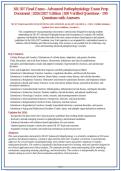
,Keywords:
Advanced Pathophysiology, NR 507 Final Exam, Nursing Exam Prep, Pathophysiology Questions, Clinical
Reasoning, Evidence-Based Practice, 2026-2027 Edition
Answer Format:
Each question is presented in a multiple-choice format, followed by the correct answer and a comprehensive
rationale. The rationale explains the pathophysiological basis, clinical significance, and why the other options are
incorrect, promoting deeper understanding and retention.
Compliance Checklist:
Aligned with the latest AACN Essentials for nursing education
Updated to reflect 2026-2027 National Council Licensure Examination (NCLEX) test plan
Includes evidence-based practice guidelines from reputable sources
Reviewed by subject matter experts in advanced pathophysiology
Verified for accuracy and clarity of content
Content Area Overview:
Content Area Questions Key Topics Weight
Cellular Biology and Genetics 1-20 Cellular adaptation, injury, death; Genetic 10%
mutations; Epigenetics
Fluid, Electrolyte, and 21-35 Fluid shifts, electrolyte imbalances, 7.5%
Acid-Base Balance acid-base disorders
Immunity and Inflammation 36-55 Innate immunity, adaptive immunity, 10%
hypersensitivity, autoimmunity
Stress and Adaptation 56-65 Neuroendocrine stress response, allostasis, 5%
maladaptation
Alterations in Hematologic 66-80 Anemias, coagulopathies, leukemias, 7.5%
Function lymphomas
Alterations in Cardiovascular 81-100 Heart failure, ischemic heart disease, 10%
Function arrhythmias, valvular disorders
Alterations in Respiratory 101-115 COPD, asthma, pneumonia, ARDS, 7.5%
Function pulmonary embolism
Alterations in Renal and Urinary 116-130 AKI, CKD, glomerulonephritis, nephrotic 7.5%
Function syndrome, UTIs
Alterations in Gastrointestinal 131-145 IBD, IBS, cirrhosis, pancreatitis, 7.5%
Function malabsorption
Alterations in Endocrine 146-160 Diabetes mellitus, thyroid disorders, adrenal 7.5%
Function insufficiency, pituitary disorders
Alterations in Neurologic 161-175 Stroke, seizures, Parkinson's, Alzheimer's, 7.5%
Function multiple sclerosis
Alterations in Musculoskeletal 176-185 Osteoporosis, fractures, osteoarthritis, 5%
Function rheumatoid arthritis
Alterations in Integumentary 186-192 Burns, infections, skin cancers, pressure 3.5%
Function injuries
Alterations in Reproductive 193-198 STIs, menstrual disorders, cancers, infertility 3%
Function
Page 2
,Alterations in Aging and 199-200 Frailty, sepsis, MODS, polypharmacy 1%
Multisystem Disorders
Page 3
, Q1. In a patient with chronic heart failure, which mechanism primarily contributes to
the transition from compensatory hypertrophy to decompensated failure?
A. Sustained activation of the -adrenergic receptor pathway leading to cardiomyocyte
apoptosis
B. Increased expression of SERCA2a enhancing calcium reuptake
C. Downregulation of the renin-angiotensin-aldosterone system
D. Enhanced nitric oxide bioavailability in the coronary microvasculature
Correct Answer: A. Sustained activation of the -adrenergic receptor pathway leading
to cardiomyocyte apoptosis
Rationale: Chronic sympathetic activation in heart failure leads to ²-receptor
desensitization and downregulation, but sustained catecholamine exposure also triggers
cardiomyocyte apoptosis and fibrosis, contributing to decompensation. SERCA2a is
typically downregulated, RAAS is upregulated, and nitric oxide is reduced, not enhanced.
Why Wrong:
B - SERCA2a is downregulated in heart failure, impairing calcium reuptake, not
increased.
C - RAAS is activated, not downregulated, in chronic heart failure.
D - Nitric oxide bioavailability is reduced, contributing to endothelial dysfunction, not
enhanced.
Reference: McCance, K.L. & Huether, S.E. (2023). Pathophysiology: The Biologic Basis
for Disease in Adults and Children, 9th Ed., Ch. 32.
Q2. Which of the following best explains the development of insulin resistance in
obesity?
A. Excess free fatty acids activate protein kinase C, impairing insulin receptor
substrate-1 signaling
B. Increased adiponectin levels enhance insulin sensitivity
C. Upregulation of GLUT4 transporters on adipocytes
D. Reduced inflammatory cytokine secretion from adipose tissue
Correct Answer: A. Excess free fatty acids activate protein kinase C, impairing
insulin receptor substrate-1 signaling
Rationale: Obesity leads to elevated free fatty acids that activate PKC-¸, which
serine-phosphorylates IRS-1, reducing insulin signaling. Adiponectin is decreased, GLUT4
is downregulated, and inflammatory cytokines are increased, all promoting resistance.
Why Wrong:
B - Adiponectin levels are decreased in obesity, not increased.
C - GLUT4 expression is reduced, not upregulated, in insulin resistance.
D - Adipose tissue secretes more pro-inflammatory cytokines, not fewer.
Page 4


