
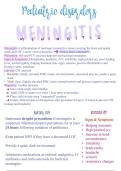
Pediatric disorders
M E N I N G I T l S
Meningitis is inflammation of meninges (connective tissue covering the brain and spinal
cord) and CSF. Can be viral or bacterial. Viral is more common!!!
Prevention: Hib and PCV vaccines help prevent bacterial meningitis.
Signs & Symptoms: Photophobia, headache, N/V, irritability, high-pitched cry, poor feeding,
fever, nuchal rigidity, bulging fontanels (late sign), seizures, positive Brudzinski’s and
Kernig’s signs, petechiae.
Lab test: CSF analysis
• Bacterial: cloudy, elevated WBC count, elevated protein, decreased glucose, positive gram
stain.
• Viral: clear, slightly elevated WBC count, normal protein and glucose, negative gram stain.
Diagnosis: Lumbar puncture
Have child empty their bladder.
Apply EMLA cream over areas 1 hour prior to procedure.
Place child in side-lying “cannonball” position.
Ensure child remains in flat position after procedure for up to 12 hours to prevent CSF
leakage and headache.
Nursing Care Increased ICP
Implement droplet precautions if meningitis is Signs & Symptoms
suspected. Maintain droplet precautions for at least
• Bulging fontanels
24 hours following initiation of antibiotics.
• High-pitched cry
• Increase in head
Keep patient NPO if they have a decreased LOC.
circumference
• irritability
Provide a quiet, dark environment.
• bradycardia
• headache
Administer medications as ordered: analgesics; IV
• seizures
antibiotics and corticosteroids for bacterial
• respiratory changes
meningitis.
, Reye syndrome
Reye syndrome: life- Risk factors:
threatening disorder causing -Recent viral infection
encephalopathy and fatty -Use of aspirin to treat fever
changes in liver. associated with a viral
Labs:
Elevated liver enzymes (ast & alt)
Signs & Symptoms:
Elevated serum ammonia level
• Irritability
• Confusion
• Excessive vomiting
• Seizures
• Loss of
consciousness Diagnosis:
Liver biopsy
CSF analysis to rule out meningitis
Jr
Nursing care:
Decrease ICP (maintain head in neutral position
Hob > = 30 degrees & administer mannitol)
Prevent hemorrhage (monitor for bleeding, administer
vitamin k)
, Seizures & Epilepsy
Seizures: Uncontrolled electrical Epilepsy: chronic, recurring seizures.
discharge of neurons in the brain. Risk Factors:
Risk Factors: • trauma
• fever • Infection
• Cerebral edema • Hemorrhage
• Infection
• Toxin exposure
• Brain tumor
• Hypoxia
Types of
• Lead poisoning
• Electrolyte imbalances seizures:
• Hypoglycemia
Tonic clonic: may be preceded by aura. 3 phases:
Tonic episode: stiffening of muscles, loss of consciousness.
Clonic episode: rhythmic jerking of extremities.
Postictal phase: confusion, sleepiness.
Absence: Loss of consciousness for 5-10 seconds.
Features: blank staring, eye fluttering, lip smacking, picking at clothes,
dropping objects. Resembles daydreaming!
Myoclonic: brief stiffening of extremities.
Atonic: loss of muscle tone, resulting in falling.
Status epilepticus: prolonged seizure activity lasting >30 minutes, or a single
seizure that does not enter postictal phase.
, Seizure diagnosis
EEG to identify origin of seizure. Have patient abstain from caffeine prior to procedure.
NPO not necessary!
Wash hair prior to procedure!
Seizure Nursing care
• Implement seizure precautions: Pad side rails, have suction and oxygen equipment
available.
• During seizure: Turn patient to the side is priority! Clear area of hazardous objects,
loosen restrictive clothing, do not insert airway or restrain patient, administer O2, not
onset/duration of seizure.
• Post seizure: Keep in lateral position, check vital signs, reorient patient, NPO until
patient is fully awake and swallow reflex has returned.
Seizure medications
Antiepileptic drugs such as phenytoin, carbamazepine & valproic acid.
Monitor serum levels!
Surgical interventions
• Removal of tumor/lesion
• Hemispherectomy or corpus callosotomy
• Vagal nerve stimulator:
Stimulator implanted in left chest wall and connected to electrode at the
vagus nerve
M E N I N G I T l S
Meningitis is inflammation of meninges (connective tissue covering the brain and spinal
cord) and CSF. Can be viral or bacterial. Viral is more common!!!
Prevention: Hib and PCV vaccines help prevent bacterial meningitis.
Signs & Symptoms: Photophobia, headache, N/V, irritability, high-pitched cry, poor feeding,
fever, nuchal rigidity, bulging fontanels (late sign), seizures, positive Brudzinski’s and
Kernig’s signs, petechiae.
Lab test: CSF analysis
• Bacterial: cloudy, elevated WBC count, elevated protein, decreased glucose, positive gram
stain.
• Viral: clear, slightly elevated WBC count, normal protein and glucose, negative gram stain.
Diagnosis: Lumbar puncture
Have child empty their bladder.
Apply EMLA cream over areas 1 hour prior to procedure.
Place child in side-lying “cannonball” position.
Ensure child remains in flat position after procedure for up to 12 hours to prevent CSF
leakage and headache.
Nursing Care Increased ICP
Implement droplet precautions if meningitis is Signs & Symptoms
suspected. Maintain droplet precautions for at least
• Bulging fontanels
24 hours following initiation of antibiotics.
• High-pitched cry
• Increase in head
Keep patient NPO if they have a decreased LOC.
circumference
• irritability
Provide a quiet, dark environment.
• bradycardia
• headache
Administer medications as ordered: analgesics; IV
• seizures
antibiotics and corticosteroids for bacterial
• respiratory changes
meningitis.
, Reye syndrome
Reye syndrome: life- Risk factors:
threatening disorder causing -Recent viral infection
encephalopathy and fatty -Use of aspirin to treat fever
changes in liver. associated with a viral
Labs:
Elevated liver enzymes (ast & alt)
Signs & Symptoms:
Elevated serum ammonia level
• Irritability
• Confusion
• Excessive vomiting
• Seizures
• Loss of
consciousness Diagnosis:
Liver biopsy
CSF analysis to rule out meningitis
Jr
Nursing care:
Decrease ICP (maintain head in neutral position
Hob > = 30 degrees & administer mannitol)
Prevent hemorrhage (monitor for bleeding, administer
vitamin k)
, Seizures & Epilepsy
Seizures: Uncontrolled electrical Epilepsy: chronic, recurring seizures.
discharge of neurons in the brain. Risk Factors:
Risk Factors: • trauma
• fever • Infection
• Cerebral edema • Hemorrhage
• Infection
• Toxin exposure
• Brain tumor
• Hypoxia
Types of
• Lead poisoning
• Electrolyte imbalances seizures:
• Hypoglycemia
Tonic clonic: may be preceded by aura. 3 phases:
Tonic episode: stiffening of muscles, loss of consciousness.
Clonic episode: rhythmic jerking of extremities.
Postictal phase: confusion, sleepiness.
Absence: Loss of consciousness for 5-10 seconds.
Features: blank staring, eye fluttering, lip smacking, picking at clothes,
dropping objects. Resembles daydreaming!
Myoclonic: brief stiffening of extremities.
Atonic: loss of muscle tone, resulting in falling.
Status epilepticus: prolonged seizure activity lasting >30 minutes, or a single
seizure that does not enter postictal phase.
, Seizure diagnosis
EEG to identify origin of seizure. Have patient abstain from caffeine prior to procedure.
NPO not necessary!
Wash hair prior to procedure!
Seizure Nursing care
• Implement seizure precautions: Pad side rails, have suction and oxygen equipment
available.
• During seizure: Turn patient to the side is priority! Clear area of hazardous objects,
loosen restrictive clothing, do not insert airway or restrain patient, administer O2, not
onset/duration of seizure.
• Post seizure: Keep in lateral position, check vital signs, reorient patient, NPO until
patient is fully awake and swallow reflex has returned.
Seizure medications
Antiepileptic drugs such as phenytoin, carbamazepine & valproic acid.
Monitor serum levels!
Surgical interventions
• Removal of tumor/lesion
• Hemispherectomy or corpus callosotomy
• Vagal nerve stimulator:
Stimulator implanted in left chest wall and connected to electrode at the
vagus nerve


