

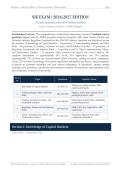
SIE Exam — 2026/2027 Edition | 75 Exam Questions | FINRA-Aligned Page 1
SIE EXAM | 2026/2027 EDITION
75 Exam Questions with 100% Verified Answers
Latest Versions | Graded A+ | FINRA-Aligned
Examination Overview: This comprehensive certification examination contains 75 multiple-choice
questions aligned with the FINRA Securities Industry Essentials (SIE) Exam Content Outline and
Securities Industry Regulatory Standards for the 2026/2027 edition. Questions are distributed across
five sections: (1) Knowledge of Capital Markets — 15 questions; (2) Understanding Products and Their
Risks — 18 questions; (3) Trading, Customer Accounts, and Prohibited Activities — 15 questions; (4)
Regulatory Framework and Industry Rules — 15 questions; and (5) Client Communication, Ethics,
and Professional Conduct — 12 questions. Each question has exactly one correct answer. The
cognitive distribution is approximately 30% recall, 50% application, and 20% analysis.
Approximately 75% of items are scenario-based (client situations, trading scenarios, compliance
cases); 25% test direct knowledge of securities regulations and product mechanics. Special emphasis
is placed on customer suitability and best interest obligations (10 questions), options trading
strategies with profit/loss calculations and breakeven analysis (10 questions), and regulatory rules
and compliance scenarios (10 questions).
Secti
Topic Questions Cognitive Focus
on
Primary/secondary markets, IPOs,
1 Knowledge of Capital Markets Q1–Q15 (15)
market participants
Understanding Products and Their Equities, debt, funds, options, DPPs,
2 Q16–Q33 (18)
Risks packaged products, risks
Trading, Customer Accounts, and Order types, margin, IRAs, settlement,
3 Q34–Q48 (15)
Prohibited Activities prohibited practices
Regulatory Framework and Industry FINRA, SEC Acts, registration, AML,
4 Q49–Q63 (15)
Rules supervision
Client Communication, Ethics, and Suitability, fiduciary duty, AML,
5 Q64–Q75 (12)
Professional Conduct complaints, arbitration
Section 1: Knowledge of Capital Markets
15 questions • Questions Q1–Q15
100% Verified Answers — Graded A+ | FINRA SIE Exam Content Outline Securities Industry Regulatory Standards 2026/2027
,SIE Exam — 2026/2027 Edition | 75 Exam Questions | FINRA-Aligned Page 2
Q1: A technology startup with 250 employees and $15 million in assets is considering its first
public offering. Under SEC regulations, the company's first sale of securities to the public is
governed primarily by which statute, and which registration exemption might be applicable
if the company qualifies?
A. Securities Exchange Act of 1934; Regulation T exemption
B. Securities Act of 1933; Regulation A+ Tier 1 or Tier 2 (an exemption permitting up to $75
million in a 12-month period, with streamlined disclosure requirements) *[CORRECT]*
C. Investment Company Act of 1940; Rule 12b-1 exemption
D. Sarbanes-Oxley Act of 2002; Regulation D Rule 506(c)
Correct Answer: B
Rationale: The Securities Act of 1933 governs the primary market (new issuance of securities to the
public) and requires registration unless an exemption applies. Regulation A+ (Tier 1 up to $20 million; Tier
2 up to $75 million in a 12-month period) provides a streamlined public offering exemption for smaller
companies. The 1934 Act regulates secondary-market trading, the 1940 Act regulates investment
companies, and Sarbanes-Oxley addresses corporate governance — none of these govern the primary
issuance itself.
Q2: In a firm commitment underwriting for an IPO, the syndicate agrees to purchase 5
million shares from the issuer at $18 per share and re-offers them to the public at $20 per
share. If 4.8 million shares are sold to the public, what is the syndicate's profit on the sold
shares (excluding unsold shares), and what is the syndicate's risk?
A. $9.6 million profit; no risk because the syndicate returns unsold shares to the issuer
B. $9.6 million profit on sold shares; the syndicate bears the risk of unsold shares (200,000
shares) because it has already purchased all 5 million shares from the issuer at $18 — the
syndicate absorbs any loss on the unsold inventory *[CORRECT]*
C. $10 million profit; the syndicate has no risk in a firm commitment
D. $0 profit; the syndicate earns only a commission
Correct Answer: B
Rationale: In a firm commitment underwriting, the syndicate purchases the entire issue from the issuer
at the wholesale price ($18) and re-offers at the public price ($20). Profit on sold shares = ($20 - $18) × 4.8
million = $9.6 million. The syndicate bears the risk of the 200,000 unsold shares (already paid for at $18
each = $3.6 million inventory exposure). In a best-efforts underwriting, by contrast, the syndicate would
not purchase unsold shares and would return them to the issuer — but in firm commitment, the syndicate
owns unsold inventory.
100% Verified Answers — Graded A+ | FINRA SIE Exam Content Outline Securities Industry Regulatory Standards 2026/2027
,SIE Exam — 2026/2027 Edition | 75 Exam Questions | FINRA-Aligned Page 3
Q3: An investor purchases shares on the New York Stock Exchange (NYSE). Which of the
following BEST describes the role of the NYSE and the trade execution model it employs?
A. The NYSE is a primary market where issuers sell new securities directly to investors
B. The NYSE is an auction-based secondary market (with elements of a hybrid market
combining electronic and specialist/designated market maker trading) where listed
securities are traded among investors, providing price discovery and liquidity through
continuous matching of buy and sell orders *[CORRECT]*
C. The NYSE is an over-the-counter (OTC) market where dealers post bid and ask quotes
D. The NYSE is a clearing corporation that settles securities transactions
Correct Answer: B
Rationale: The NYSE is a secondary market (existing securities trade among investors, distinct from the
primary market of new issuance). It is auction-based with a hybrid model: a designated market maker
(DMM) maintains fair and orderly markets at a trading post, supplemented by electronic trading. OTC
markets (e.g., Nasdaq) are dealer markets with bid/ask quotes from market makers. The NYSE is not a
clearing corporation — DTCC's NSCC handles clearing, and DTC handles settlement.
Q4: Which of the following statements correctly distinguishes a broker-dealer from an
investment adviser under SEC/FINRA regulations?
A. A broker-dealer executes securities transactions and charges commissions; an
investment adviser provides personalized advice for compensation and is regulated under
the Investment Advisers Act of 1940 *[CORRECT]*
B. A broker-dealer provides advice for compensation; an investment adviser executes
transactions
C. Both broker-dealers and investment advisers are regulated under the same statute (Securities
Exchange Act of 1934)
D. A broker-dealer is exempt from registration; an investment adviser must register with FINRA
Correct Answer: A
Rationale: A broker-dealer executes securities transactions (broker role) and trades for its own account
(dealer role), earning commissions or markups, and is regulated under the Securities Exchange Act of
1934 (and FINRA rules). An investment adviser provides personalized investment advice for compensation
and is regulated under the Investment Advisers Act of 1940 (and state law for smaller advisers). The two
roles are distinct, though a firm may register as both (subject to both regulatory regimes). Advisers
register with the SEC or states, not FINRA — FINRA regulates broker-dealers.
100% Verified Answers — Graded A+ | FINRA SIE Exam Content Outline Securities Industry Regulatory Standards 2026/2027
, SIE Exam — 2026/2027 Edition | 75 Exam Questions | FINRA-Aligned Page 4
Q5: A customer enters a market order to buy 100 shares of XYZ stock, currently trading at
$50 per share. Which of the following BEST describes the customer's order, and at what
price will the order likely execute?
A. The order executes at exactly $50 per share, guaranteed
B. The market order executes at the best available ask price at the time the order reaches the
market, which may be at, above, or below $50 due to price movement between order entry
and execution; market orders guarantee execution but not price *[CORRECT]*
C. The market order executes at the best available bid price
D. The market order is held until the price reaches $50
Correct Answer: B
Rationale: A market order guarantees execution at the best available price at the time the order reaches
the market, but does NOT guarantee a specific price. For a buy order, it executes at the best available ask
price; the last quoted price ($50) is just a snapshot and may have moved. Market orders prioritize speed of
execution over price control. Limit orders, by contrast, guarantee a maximum buy price or minimum sell
price but do not guarantee execution.
Q6: In the secondary market for U.S. Treasury securities, the primary trading venue is:
A. The New York Stock Exchange
B. The over-the-counter (OTC) market, where primary dealers and other market makers
post bid and ask quotes; Treasury securities are not listed on exchanges *[CORRECT]*
C. The Nasdaq Stock Market
D. The Chicago Board Options Exchange (CBOE)
Correct Answer: B
Rationale: U.S. Treasury securities trade in the over-the-counter (OTC) market among primary dealers
(large financial institutions designated by the Federal Reserve) and other market makers, who post bid
and ask quotes. Treasuries are not listed on stock exchanges. The NYSE and Nasdaq list corporate equities;
the CBOE lists options. The OTC market for Treasuries is one of the most liquid markets in the world, with
the Federal Reserve conducting open market operations through primary dealers.
Q7: A transfer agent performs which of the following functions for an issuer of common
stock?
A. Acts as the broker for the issuer's secondary-market trades
B. Maintains the issuer's record of stock ownership, handles the issuance and cancellation
of certificates, processes dividend payments, and manages shareholder records (often a
bank or trust company) *[CORRECT]*
C. Clears and settles the issuer's securities trades through DTCC
D. Audits the issuer's financial statements
Correct Answer: B
Rationale: A transfer agent (often a bank or trust company) maintains the issuer's record of stock
ownership, issues and cancels certificates, processes dividend payments, and manages shareholder
records and the stock ledger. The transfer agent works closely with the registrar (who independently
verifies the transfer agent's records to prevent over-issuance). DTCC's DTC handles clearing and
settlement; brokers execute secondary-market trades; independent auditors audit financial statements.
The transfer agent is essential for corporate actions and shareholder recordkeeping.
100% Verified Answers — Graded A+ | FINRA SIE Exam Content Outline Securities Industry Regulatory Standards 2026/2027
SIE EXAM | 2026/2027 EDITION
75 Exam Questions with 100% Verified Answers
Latest Versions | Graded A+ | FINRA-Aligned
Examination Overview: This comprehensive certification examination contains 75 multiple-choice
questions aligned with the FINRA Securities Industry Essentials (SIE) Exam Content Outline and
Securities Industry Regulatory Standards for the 2026/2027 edition. Questions are distributed across
five sections: (1) Knowledge of Capital Markets — 15 questions; (2) Understanding Products and Their
Risks — 18 questions; (3) Trading, Customer Accounts, and Prohibited Activities — 15 questions; (4)
Regulatory Framework and Industry Rules — 15 questions; and (5) Client Communication, Ethics,
and Professional Conduct — 12 questions. Each question has exactly one correct answer. The
cognitive distribution is approximately 30% recall, 50% application, and 20% analysis.
Approximately 75% of items are scenario-based (client situations, trading scenarios, compliance
cases); 25% test direct knowledge of securities regulations and product mechanics. Special emphasis
is placed on customer suitability and best interest obligations (10 questions), options trading
strategies with profit/loss calculations and breakeven analysis (10 questions), and regulatory rules
and compliance scenarios (10 questions).
Secti
Topic Questions Cognitive Focus
on
Primary/secondary markets, IPOs,
1 Knowledge of Capital Markets Q1–Q15 (15)
market participants
Understanding Products and Their Equities, debt, funds, options, DPPs,
2 Q16–Q33 (18)
Risks packaged products, risks
Trading, Customer Accounts, and Order types, margin, IRAs, settlement,
3 Q34–Q48 (15)
Prohibited Activities prohibited practices
Regulatory Framework and Industry FINRA, SEC Acts, registration, AML,
4 Q49–Q63 (15)
Rules supervision
Client Communication, Ethics, and Suitability, fiduciary duty, AML,
5 Q64–Q75 (12)
Professional Conduct complaints, arbitration
Section 1: Knowledge of Capital Markets
15 questions • Questions Q1–Q15
100% Verified Answers — Graded A+ | FINRA SIE Exam Content Outline Securities Industry Regulatory Standards 2026/2027
,SIE Exam — 2026/2027 Edition | 75 Exam Questions | FINRA-Aligned Page 2
Q1: A technology startup with 250 employees and $15 million in assets is considering its first
public offering. Under SEC regulations, the company's first sale of securities to the public is
governed primarily by which statute, and which registration exemption might be applicable
if the company qualifies?
A. Securities Exchange Act of 1934; Regulation T exemption
B. Securities Act of 1933; Regulation A+ Tier 1 or Tier 2 (an exemption permitting up to $75
million in a 12-month period, with streamlined disclosure requirements) *[CORRECT]*
C. Investment Company Act of 1940; Rule 12b-1 exemption
D. Sarbanes-Oxley Act of 2002; Regulation D Rule 506(c)
Correct Answer: B
Rationale: The Securities Act of 1933 governs the primary market (new issuance of securities to the
public) and requires registration unless an exemption applies. Regulation A+ (Tier 1 up to $20 million; Tier
2 up to $75 million in a 12-month period) provides a streamlined public offering exemption for smaller
companies. The 1934 Act regulates secondary-market trading, the 1940 Act regulates investment
companies, and Sarbanes-Oxley addresses corporate governance — none of these govern the primary
issuance itself.
Q2: In a firm commitment underwriting for an IPO, the syndicate agrees to purchase 5
million shares from the issuer at $18 per share and re-offers them to the public at $20 per
share. If 4.8 million shares are sold to the public, what is the syndicate's profit on the sold
shares (excluding unsold shares), and what is the syndicate's risk?
A. $9.6 million profit; no risk because the syndicate returns unsold shares to the issuer
B. $9.6 million profit on sold shares; the syndicate bears the risk of unsold shares (200,000
shares) because it has already purchased all 5 million shares from the issuer at $18 — the
syndicate absorbs any loss on the unsold inventory *[CORRECT]*
C. $10 million profit; the syndicate has no risk in a firm commitment
D. $0 profit; the syndicate earns only a commission
Correct Answer: B
Rationale: In a firm commitment underwriting, the syndicate purchases the entire issue from the issuer
at the wholesale price ($18) and re-offers at the public price ($20). Profit on sold shares = ($20 - $18) × 4.8
million = $9.6 million. The syndicate bears the risk of the 200,000 unsold shares (already paid for at $18
each = $3.6 million inventory exposure). In a best-efforts underwriting, by contrast, the syndicate would
not purchase unsold shares and would return them to the issuer — but in firm commitment, the syndicate
owns unsold inventory.
100% Verified Answers — Graded A+ | FINRA SIE Exam Content Outline Securities Industry Regulatory Standards 2026/2027
,SIE Exam — 2026/2027 Edition | 75 Exam Questions | FINRA-Aligned Page 3
Q3: An investor purchases shares on the New York Stock Exchange (NYSE). Which of the
following BEST describes the role of the NYSE and the trade execution model it employs?
A. The NYSE is a primary market where issuers sell new securities directly to investors
B. The NYSE is an auction-based secondary market (with elements of a hybrid market
combining electronic and specialist/designated market maker trading) where listed
securities are traded among investors, providing price discovery and liquidity through
continuous matching of buy and sell orders *[CORRECT]*
C. The NYSE is an over-the-counter (OTC) market where dealers post bid and ask quotes
D. The NYSE is a clearing corporation that settles securities transactions
Correct Answer: B
Rationale: The NYSE is a secondary market (existing securities trade among investors, distinct from the
primary market of new issuance). It is auction-based with a hybrid model: a designated market maker
(DMM) maintains fair and orderly markets at a trading post, supplemented by electronic trading. OTC
markets (e.g., Nasdaq) are dealer markets with bid/ask quotes from market makers. The NYSE is not a
clearing corporation — DTCC's NSCC handles clearing, and DTC handles settlement.
Q4: Which of the following statements correctly distinguishes a broker-dealer from an
investment adviser under SEC/FINRA regulations?
A. A broker-dealer executes securities transactions and charges commissions; an
investment adviser provides personalized advice for compensation and is regulated under
the Investment Advisers Act of 1940 *[CORRECT]*
B. A broker-dealer provides advice for compensation; an investment adviser executes
transactions
C. Both broker-dealers and investment advisers are regulated under the same statute (Securities
Exchange Act of 1934)
D. A broker-dealer is exempt from registration; an investment adviser must register with FINRA
Correct Answer: A
Rationale: A broker-dealer executes securities transactions (broker role) and trades for its own account
(dealer role), earning commissions or markups, and is regulated under the Securities Exchange Act of
1934 (and FINRA rules). An investment adviser provides personalized investment advice for compensation
and is regulated under the Investment Advisers Act of 1940 (and state law for smaller advisers). The two
roles are distinct, though a firm may register as both (subject to both regulatory regimes). Advisers
register with the SEC or states, not FINRA — FINRA regulates broker-dealers.
100% Verified Answers — Graded A+ | FINRA SIE Exam Content Outline Securities Industry Regulatory Standards 2026/2027
, SIE Exam — 2026/2027 Edition | 75 Exam Questions | FINRA-Aligned Page 4
Q5: A customer enters a market order to buy 100 shares of XYZ stock, currently trading at
$50 per share. Which of the following BEST describes the customer's order, and at what
price will the order likely execute?
A. The order executes at exactly $50 per share, guaranteed
B. The market order executes at the best available ask price at the time the order reaches the
market, which may be at, above, or below $50 due to price movement between order entry
and execution; market orders guarantee execution but not price *[CORRECT]*
C. The market order executes at the best available bid price
D. The market order is held until the price reaches $50
Correct Answer: B
Rationale: A market order guarantees execution at the best available price at the time the order reaches
the market, but does NOT guarantee a specific price. For a buy order, it executes at the best available ask
price; the last quoted price ($50) is just a snapshot and may have moved. Market orders prioritize speed of
execution over price control. Limit orders, by contrast, guarantee a maximum buy price or minimum sell
price but do not guarantee execution.
Q6: In the secondary market for U.S. Treasury securities, the primary trading venue is:
A. The New York Stock Exchange
B. The over-the-counter (OTC) market, where primary dealers and other market makers
post bid and ask quotes; Treasury securities are not listed on exchanges *[CORRECT]*
C. The Nasdaq Stock Market
D. The Chicago Board Options Exchange (CBOE)
Correct Answer: B
Rationale: U.S. Treasury securities trade in the over-the-counter (OTC) market among primary dealers
(large financial institutions designated by the Federal Reserve) and other market makers, who post bid
and ask quotes. Treasuries are not listed on stock exchanges. The NYSE and Nasdaq list corporate equities;
the CBOE lists options. The OTC market for Treasuries is one of the most liquid markets in the world, with
the Federal Reserve conducting open market operations through primary dealers.
Q7: A transfer agent performs which of the following functions for an issuer of common
stock?
A. Acts as the broker for the issuer's secondary-market trades
B. Maintains the issuer's record of stock ownership, handles the issuance and cancellation
of certificates, processes dividend payments, and manages shareholder records (often a
bank or trust company) *[CORRECT]*
C. Clears and settles the issuer's securities trades through DTCC
D. Audits the issuer's financial statements
Correct Answer: B
Rationale: A transfer agent (often a bank or trust company) maintains the issuer's record of stock
ownership, issues and cancels certificates, processes dividend payments, and manages shareholder
records and the stock ledger. The transfer agent works closely with the registrar (who independently
verifies the transfer agent's records to prevent over-issuance). DTCC's DTC handles clearing and
settlement; brokers execute secondary-market trades; independent auditors audit financial statements.
The transfer agent is essential for corporate actions and shareholder recordkeeping.
100% Verified Answers — Graded A+ | FINRA SIE Exam Content Outline Securities Industry Regulatory Standards 2026/2027


