
Club Pilates Written Final Exam – 2026/2027 Edition Page 1
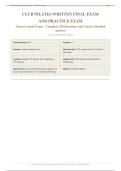
CLUB PILATES WRITTEN FINAL EXAM
AND PRACTICE EXAM
Newest Actual Exam – Complete 250 Questions and Correct Detailed
Answers
Verified | 2026/2027 Edition
Total Questions: 250 Sections: 10
Format: 4-option multiple choice Question Style: 75% scenario-based / 25% direct
knowledge
Cognitive Levels: 25% Recall / 50% Application / Aligned with: Club Pilates & Balanced Body
25% Analysis methodology
Special Focus: 25 anatomy/biomechanics applied, 20 Edition: 2026/2027 Edition
progressions/modifications, 15 teaching methodology
Aligned with Club Pilates Instructor Training Program Curriculum – 2026/2027 Edition
,Club Pilates Written Final Exam – 2026/2027 Edition Page 2
Section 1: Pilates Principles & Foundations
Q1: A new Club Pilates client asks her instructor to explain the 'Powerhouse' concept. Which response most
accurately reflects Club Pilates/Balanced Body methodology?
A. The Powerhouse refers only to the rectus abdominis muscles, the 'six-pack' visible at the front of the torso
B. The Powerhouse is the muscular corset from the bottom of the rib cage to the pelvic floor, including
the transversus abdominis, multifidus, pelvic floor, diaphragm, and deeper abdominal muscles,
working as a coordinated unit to stabilize the spine and initiate all Pilates movement *[CORRECT]*
C. The Powerhouse is a small region just below the navel that only activates during back-extension exercises
D. The Powerhouse refers exclusively to the lower back and gluteal muscles used for hip extension
Correct Answer: B
Rationale: In Club Pilates and Balanced Body methodology, the 'Powerhouse' (often called the 'core' in general
fitness) is the muscular cylinder from the bottom of the rib cage to the pelvic floor, encompassing the transversus
abdominis, multifidus, pelvic floor, diaphragm, internal and external obliques, and rectus abdominis. It functions as a
coordinated unit to provide spinal stabilization, intra-abdominal pressure regulation, and a foundation for all
movement. Defining the Powerhouse as only the rectus abdominis (A), a small sub-navel region (C), or only posterior
muscles (D) is anatomically inaccurate and contradicts the integrated, whole-torso emphasis that distinguishes Pilates
from generic core training.
Q2: Joseph Pilates originally named his method 'Contrology.' Which principle is most directly reflected in
this original name?
A. Breath, because Joseph Pilates emphasized rhythmic breathing above all else
B. Control, because every movement in the method is performed with conscious muscular control
rather than momentum or gravity-driven flailing *[CORRECT]*
C. Flow, because Contrology is named after the smooth transitions between exercises
D. Centering, because the name refers to the central region of the body
Correct Answer: B
Rationale: Joseph Pilates called his method 'Contrology,' emphasizing that the practitioner develops control over the
body through the mind—'the mind-muscle connection.' Every movement is performed with conscious muscular
engagement, precision, and intent rather than momentum. While breath (A), flow (C), and centering (D) are core
principles of Pilates, the name 'Contrology' directly refers to the principle of control. Joseph Pilates wrote in 'Return to
Life Through Contrology' that 'Contrology is complete coordination of body, mind, and spirit.'
Q3: A Club Pilates instructor cues a client to maintain 'neutral spine' during footwork on the Reformer.
Which of the following best describes the anatomical landmarks of a neutral lumbar spine in supine?
A. The lumbar spine is pressed flat against the carriage, with the ASIS and pubic bone in the same horizontal
plane
B. The ASIS (anterior superior iliac spine) and pubic symphysis are in the same vertical plane, and the
natural lumbar curve is preserved with a small space beneath the lower back *[CORRECT]*
C. The lumbar curve is exaggerated into a deep arch, with the ribs flared and the pelvis in an anterior tilt
D. The spine is in full flexion with the sacrum lifted off the carriage and only the upper back in contact
Correct Answer: B
Rationale: Neutral spine in supine is identified when the ASIS and pubic symphysis are in the same vertical plane
(neither anterior nor posterior pelvic tilt), and the natural lumbar curve is preserved—leaving a small space beneath
the lower back. This position maintains the spine's natural shock-absorbing curves and is preferred for clients with
healthy spines during load-bearing and lower-body work. Imprint (option A) flattens the lumbar spine and is used for
stabilization in certain populations. An exaggerated arch (C) or full flexion (D) would deviate from neutral and could
compromise spinal health during loaded movement.
Aligned with Club Pilates Instructor Training Program Curriculum – 2026/2027 Edition
,Club Pilates Written Final Exam – 2026/2027 Edition Page 3
Q4: Which of the following is NOT one of the six traditionally recognized Pilates principles?
A. Breath
B. Precision
C. Strength *[CORRECT]*
D. Flow
Correct Answer: C
Rationale: The six traditionally recognized Pilates principles are: Centering, Concentration, Control, Precision, Breath,
and Flow. 'Strength' is a beneficial outcome of Pilates but is not one of the six core principles. The six principles were
codified by Philip Friedman and Claudia Eisen in their 1980 book 'The Pilates Method of Physical and Mental
Conditioning' based on the writings and teachings of Joseph Pilates, and they continue to underpin Club Pilates and
Balanced Body instructor training programs.
Q5: A client is performing the Hundred and begins holding her breath during the abdominal curl. Which
principle is most directly being violated, and what is the appropriate instructor cue?
A. Precision; cue her to straighten her legs further
B. Breath; cue her to inhale for 5 counts and exhale for 5 counts, coordinating breath with the arm
pumping rhythm *[CORRECT]*
C. Flow; cue her to move her arms faster
D. Control; cue her to release the abdominal curl entirely
Correct Answer: B
Rationale: The Hundred is built on rhythmic, synchronized breathing: traditionally 5-count inhales and 5-count
exhales repeated for 10 cycles (100 beats). Holding the breath violates the principle of breath and undermines the
cardiovascular and oxygenation benefits of the exercise. The instructor should cue the client to coordinate a 5-count
inhale and 5-count exhale with the arm pumping, which also supports abdominal engagement through the breath cycle.
Adjusting leg position (A), arm speed (C), or releasing the curl (D) does not address the core issue of breath
coordination.
Q6: In Club Pilates methodology, the concept of 'stabilizing vs. mobilizing' is foundational. Which of the
following statements correctly distinguishes the two?
A. Stabilizing muscles are large prime movers like the gluteus maximus; mobilizing muscles are small
stabilizers like the multifidus
B. Stabilizing muscles (often local, deep muscles like transversus abdominis and multifidus) hold a
joint or body segment still while mobilizing muscles (often global, superficial muscles like the rectus
abdominis or hamstrings) produce movement at another joint or segment *[CORRECT]*
C. Stabilizing refers to muscle contraction only; mobilizing refers to relaxation
D. Stabilizing and mobilizing are interchangeable terms for the same muscular action
Correct Answer: B
Rationale: In Club Pilates methodology, 'stabilizing' refers to muscles (often local, deep, slow-twitch-dominant muscles
such as the transversus abdominis, multifidus, and pelvic floor) that isometrically or co-contract to hold a body
segment or joint still, while 'mobilizing' refers to muscles (often global, superficial, larger muscles such as the rectus
abdominis, hamstrings, or gluteus maximus) that concentrically or eccentrically produce movement at another segment.
Understanding this distinction is essential for cueing clients to 'move from a stable center'—the foundational Pilates
concept that all peripheral movement originates from a stabilized core.
Aligned with Club Pilates Instructor Training Program Curriculum – 2026/2027 Edition
, Club Pilates Written Final Exam – 2026/2027 Edition Page 4
Q7: Which Pilates principle is best described as 'every movement has a purpose and an end point, with no
extraneous or sloppy action'?
A. Precision *[CORRECT]*
B. Centering
C. Flow
D. Concentration
Correct Answer: A
Rationale: Precision is the principle that every movement has a specific purpose, an intended trajectory, and a clear
end point, with no extraneous motion. Joseph Pilates emphasized that 'it is not the quantity of exercise that matters but
the quality.' Precision distinguishes Pilates from generic exercise by demanding accuracy in alignment, sequencing, and
execution. Centering (B) refers to initiating movement from the Powerhouse, flow (C) refers to smooth transitions and
continuous movement, and concentration (D) refers to full mental attention on the movement.
Q8: A client asks whether Pilates is a 'mind-body' practice. Based on Joseph Pilates's writings, which
principle most directly supports this characterization?
A. Centering, because it focuses attention on the physical center of the body
B. Concentration, because the practitioner must bring full mental attention to every muscular
contraction, alignment, and breath pattern, integrating mind and body in each movement
*[CORRECT]*
C. Breath, because the lungs are connected to the brain
D. Flow, because smooth movement requires mental relaxation
Correct Answer: B
Rationale: Concentration is the principle that most directly embodies the mind-body aspect of Pilates. Joseph Pilates
wrote that 'you have to concentrate on what you are doing at all times' and 'the mind, when housed within a healthful
body, possesses a glorious sense of power.' Concentration requires the practitioner to bring full mental attention to each
muscular engagement, alignment cue, and breath, creating the integrated mind-body state Joseph Pilates called
'Contrology.' Centering, breath, and flow all require concentration but do not fully capture the explicit mind-body
integration of the principle itself.
Q9: A client is taught to inhale through the nose and exhale through the mouth during the Roll-Up. Which
of the following best describes the relationship between breath and spinal articulation in this exercise?
A. Inhale to deepen the curl forward; exhale to roll back down
B. Exhale to articulate the spine forward into flexion (deepening the curl as the air leaves the body);
inhale to articulate the spine back to the starting position, allowing the spine to unroll one vertebra at
a time *[CORRECT]*
C. Breath is unrelated to the Roll-Up and can be done in any pattern
D. Holding the breath throughout the exercise maximizes abdominal engagement
Correct Answer: B
Rationale: In Pilates breath coordination, exhalation generally supports spinal flexion—expelling air allows the
abdominals to compress the ribs and deepen the curl (as in the Roll-Up). Inhalation supports spinal extension or return
to neutral, allowing the lungs to fill and the spine to unroll vertebra by vertebra. This breath-movement synergy is a
hallmark of Club Pilates and Balanced Body methodology. Holding the breath (D) or using an arbitrary breath pattern
(C) violates the breath principle and reduces the effectiveness of the exercise.
Aligned with Club Pilates Instructor Training Program Curriculum – 2026/2027 Edition
CLUB PILATES WRITTEN FINAL EXAM
AND PRACTICE EXAM
Newest Actual Exam – Complete 250 Questions and Correct Detailed
Answers
Verified | 2026/2027 Edition
Total Questions: 250 Sections: 10
Format: 4-option multiple choice Question Style: 75% scenario-based / 25% direct
knowledge
Cognitive Levels: 25% Recall / 50% Application / Aligned with: Club Pilates & Balanced Body
25% Analysis methodology
Special Focus: 25 anatomy/biomechanics applied, 20 Edition: 2026/2027 Edition
progressions/modifications, 15 teaching methodology
Aligned with Club Pilates Instructor Training Program Curriculum – 2026/2027 Edition
,Club Pilates Written Final Exam – 2026/2027 Edition Page 2
Section 1: Pilates Principles & Foundations
Q1: A new Club Pilates client asks her instructor to explain the 'Powerhouse' concept. Which response most
accurately reflects Club Pilates/Balanced Body methodology?
A. The Powerhouse refers only to the rectus abdominis muscles, the 'six-pack' visible at the front of the torso
B. The Powerhouse is the muscular corset from the bottom of the rib cage to the pelvic floor, including
the transversus abdominis, multifidus, pelvic floor, diaphragm, and deeper abdominal muscles,
working as a coordinated unit to stabilize the spine and initiate all Pilates movement *[CORRECT]*
C. The Powerhouse is a small region just below the navel that only activates during back-extension exercises
D. The Powerhouse refers exclusively to the lower back and gluteal muscles used for hip extension
Correct Answer: B
Rationale: In Club Pilates and Balanced Body methodology, the 'Powerhouse' (often called the 'core' in general
fitness) is the muscular cylinder from the bottom of the rib cage to the pelvic floor, encompassing the transversus
abdominis, multifidus, pelvic floor, diaphragm, internal and external obliques, and rectus abdominis. It functions as a
coordinated unit to provide spinal stabilization, intra-abdominal pressure regulation, and a foundation for all
movement. Defining the Powerhouse as only the rectus abdominis (A), a small sub-navel region (C), or only posterior
muscles (D) is anatomically inaccurate and contradicts the integrated, whole-torso emphasis that distinguishes Pilates
from generic core training.
Q2: Joseph Pilates originally named his method 'Contrology.' Which principle is most directly reflected in
this original name?
A. Breath, because Joseph Pilates emphasized rhythmic breathing above all else
B. Control, because every movement in the method is performed with conscious muscular control
rather than momentum or gravity-driven flailing *[CORRECT]*
C. Flow, because Contrology is named after the smooth transitions between exercises
D. Centering, because the name refers to the central region of the body
Correct Answer: B
Rationale: Joseph Pilates called his method 'Contrology,' emphasizing that the practitioner develops control over the
body through the mind—'the mind-muscle connection.' Every movement is performed with conscious muscular
engagement, precision, and intent rather than momentum. While breath (A), flow (C), and centering (D) are core
principles of Pilates, the name 'Contrology' directly refers to the principle of control. Joseph Pilates wrote in 'Return to
Life Through Contrology' that 'Contrology is complete coordination of body, mind, and spirit.'
Q3: A Club Pilates instructor cues a client to maintain 'neutral spine' during footwork on the Reformer.
Which of the following best describes the anatomical landmarks of a neutral lumbar spine in supine?
A. The lumbar spine is pressed flat against the carriage, with the ASIS and pubic bone in the same horizontal
plane
B. The ASIS (anterior superior iliac spine) and pubic symphysis are in the same vertical plane, and the
natural lumbar curve is preserved with a small space beneath the lower back *[CORRECT]*
C. The lumbar curve is exaggerated into a deep arch, with the ribs flared and the pelvis in an anterior tilt
D. The spine is in full flexion with the sacrum lifted off the carriage and only the upper back in contact
Correct Answer: B
Rationale: Neutral spine in supine is identified when the ASIS and pubic symphysis are in the same vertical plane
(neither anterior nor posterior pelvic tilt), and the natural lumbar curve is preserved—leaving a small space beneath
the lower back. This position maintains the spine's natural shock-absorbing curves and is preferred for clients with
healthy spines during load-bearing and lower-body work. Imprint (option A) flattens the lumbar spine and is used for
stabilization in certain populations. An exaggerated arch (C) or full flexion (D) would deviate from neutral and could
compromise spinal health during loaded movement.
Aligned with Club Pilates Instructor Training Program Curriculum – 2026/2027 Edition
,Club Pilates Written Final Exam – 2026/2027 Edition Page 3
Q4: Which of the following is NOT one of the six traditionally recognized Pilates principles?
A. Breath
B. Precision
C. Strength *[CORRECT]*
D. Flow
Correct Answer: C
Rationale: The six traditionally recognized Pilates principles are: Centering, Concentration, Control, Precision, Breath,
and Flow. 'Strength' is a beneficial outcome of Pilates but is not one of the six core principles. The six principles were
codified by Philip Friedman and Claudia Eisen in their 1980 book 'The Pilates Method of Physical and Mental
Conditioning' based on the writings and teachings of Joseph Pilates, and they continue to underpin Club Pilates and
Balanced Body instructor training programs.
Q5: A client is performing the Hundred and begins holding her breath during the abdominal curl. Which
principle is most directly being violated, and what is the appropriate instructor cue?
A. Precision; cue her to straighten her legs further
B. Breath; cue her to inhale for 5 counts and exhale for 5 counts, coordinating breath with the arm
pumping rhythm *[CORRECT]*
C. Flow; cue her to move her arms faster
D. Control; cue her to release the abdominal curl entirely
Correct Answer: B
Rationale: The Hundred is built on rhythmic, synchronized breathing: traditionally 5-count inhales and 5-count
exhales repeated for 10 cycles (100 beats). Holding the breath violates the principle of breath and undermines the
cardiovascular and oxygenation benefits of the exercise. The instructor should cue the client to coordinate a 5-count
inhale and 5-count exhale with the arm pumping, which also supports abdominal engagement through the breath cycle.
Adjusting leg position (A), arm speed (C), or releasing the curl (D) does not address the core issue of breath
coordination.
Q6: In Club Pilates methodology, the concept of 'stabilizing vs. mobilizing' is foundational. Which of the
following statements correctly distinguishes the two?
A. Stabilizing muscles are large prime movers like the gluteus maximus; mobilizing muscles are small
stabilizers like the multifidus
B. Stabilizing muscles (often local, deep muscles like transversus abdominis and multifidus) hold a
joint or body segment still while mobilizing muscles (often global, superficial muscles like the rectus
abdominis or hamstrings) produce movement at another joint or segment *[CORRECT]*
C. Stabilizing refers to muscle contraction only; mobilizing refers to relaxation
D. Stabilizing and mobilizing are interchangeable terms for the same muscular action
Correct Answer: B
Rationale: In Club Pilates methodology, 'stabilizing' refers to muscles (often local, deep, slow-twitch-dominant muscles
such as the transversus abdominis, multifidus, and pelvic floor) that isometrically or co-contract to hold a body
segment or joint still, while 'mobilizing' refers to muscles (often global, superficial, larger muscles such as the rectus
abdominis, hamstrings, or gluteus maximus) that concentrically or eccentrically produce movement at another segment.
Understanding this distinction is essential for cueing clients to 'move from a stable center'—the foundational Pilates
concept that all peripheral movement originates from a stabilized core.
Aligned with Club Pilates Instructor Training Program Curriculum – 2026/2027 Edition
, Club Pilates Written Final Exam – 2026/2027 Edition Page 4
Q7: Which Pilates principle is best described as 'every movement has a purpose and an end point, with no
extraneous or sloppy action'?
A. Precision *[CORRECT]*
B. Centering
C. Flow
D. Concentration
Correct Answer: A
Rationale: Precision is the principle that every movement has a specific purpose, an intended trajectory, and a clear
end point, with no extraneous motion. Joseph Pilates emphasized that 'it is not the quantity of exercise that matters but
the quality.' Precision distinguishes Pilates from generic exercise by demanding accuracy in alignment, sequencing, and
execution. Centering (B) refers to initiating movement from the Powerhouse, flow (C) refers to smooth transitions and
continuous movement, and concentration (D) refers to full mental attention on the movement.
Q8: A client asks whether Pilates is a 'mind-body' practice. Based on Joseph Pilates's writings, which
principle most directly supports this characterization?
A. Centering, because it focuses attention on the physical center of the body
B. Concentration, because the practitioner must bring full mental attention to every muscular
contraction, alignment, and breath pattern, integrating mind and body in each movement
*[CORRECT]*
C. Breath, because the lungs are connected to the brain
D. Flow, because smooth movement requires mental relaxation
Correct Answer: B
Rationale: Concentration is the principle that most directly embodies the mind-body aspect of Pilates. Joseph Pilates
wrote that 'you have to concentrate on what you are doing at all times' and 'the mind, when housed within a healthful
body, possesses a glorious sense of power.' Concentration requires the practitioner to bring full mental attention to each
muscular engagement, alignment cue, and breath, creating the integrated mind-body state Joseph Pilates called
'Contrology.' Centering, breath, and flow all require concentration but do not fully capture the explicit mind-body
integration of the principle itself.
Q9: A client is taught to inhale through the nose and exhale through the mouth during the Roll-Up. Which
of the following best describes the relationship between breath and spinal articulation in this exercise?
A. Inhale to deepen the curl forward; exhale to roll back down
B. Exhale to articulate the spine forward into flexion (deepening the curl as the air leaves the body);
inhale to articulate the spine back to the starting position, allowing the spine to unroll one vertebra at
a time *[CORRECT]*
C. Breath is unrelated to the Roll-Up and can be done in any pattern
D. Holding the breath throughout the exercise maximizes abdominal engagement
Correct Answer: B
Rationale: In Pilates breath coordination, exhalation generally supports spinal flexion—expelling air allows the
abdominals to compress the ribs and deepen the curl (as in the Roll-Up). Inhalation supports spinal extension or return
to neutral, allowing the lungs to fill and the spine to unroll vertebra by vertebra. This breath-movement synergy is a
hallmark of Club Pilates and Balanced Body methodology. Holding the breath (D) or using an arbitrary breath pattern
(C) violates the breath principle and reduces the effectiveness of the exercise.
Aligned with Club Pilates Instructor Training Program Curriculum – 2026/2027 Edition


