
NIH Stroke Scale — All Test Groups A–F | 2026/2027 Certification Exam Page 1
NIH STROKE SCALE — ALL TEST GROUPS A–F
(PATIENTS 1–6)
Complete Answer Key | Comprehensive Certification Examination
Verified and Fully Updated for 2026/2027
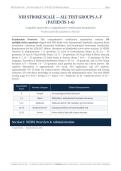
Examination Overview: This comprehensive certification examination contains 150
multiple-choice questions aligned with NIH Stroke Scale International Standards, American Heart
Association / American Stroke Association Guidelines, and Neurological Assessment Certification
Requirements for the 2026/2027 edition. Questions are distributed across seven sections: (1) NIHSS
Overview & Administration — 15 questions; (2) Level of Consciousness (Items 1a, 1b, 1c) — 20
questions; (3) Gaze & Visual Fields (Items 2 & 3) — 20 questions; (4) Facial Palsy & Motor Arm/Leg
(Items 4, 5, 6) — 25 questions; (5) Limb Ataxia & Sensory (Items 7 & 8) — 15 questions; (6) Best
Language, Dysarthria & Extinction/Inattention (Items 9, 10, 11) — 20 questions; and (7) Test Group
Scenarios A–F — Patients 1–6 — 35 questions. Each question has exactly one correct answer. The
cognitive distribution is approximately 25% recall, 50% application, and 25% analysis.
Approximately 75% of items are scenario-based, reflecting real patient presentations and scoring
scenarios; 25% test direct knowledge of scoring criteria and administration rules. The total NIHSS
scoring range is 0–42 (0 = normal; 1–4 = minor; 5–15 = moderate; 16–20 = moderate-severe; 21–42 =
severe).
Total NIHSS
Severity Category Clinical Interpretation
Score
0 Normal No neurological deficit detected
1–4 Minor Mild deficit; individualized treatment decisions
5–15 Moderate Moderate deficit; tPA candidacy per full criteria
16–20 Moderate-Severe Substantial deficit; elevated disability risk
21–42 Severe Severe deficit; high risk of poor outcome
Section 1: NIHSS Overview & Administration
15 questions • Questions Q1–Q15
Complete Answer Key — Verified and Fully Updated for 2026/2027
American Heart Association / American Stroke Association Guidelines
,NIH Stroke Scale — All Test Groups A–F | 2026/2027 Certification Exam Page 2
Q1: A 67-year-old patient arrives with suspected acute ischemic stroke. The clinical team
plans to administer the NIH Stroke Scale. Which statement BEST describes the primary
purpose of the NIHSS in this acute setting?
A. To definitively diagnose the type of stroke (ischemic vs. hemorrhagic) using clinical signs
alone
B. To provide a standardized, reproducible quantification of neurological deficit severity
that informs acute treatment decisions and prognosis *[CORRECT]*
C. To replace neuroimaging (CT/MRI) as the gold standard for confirming stroke location and
size
D. To predict with 100% certainty the long-term functional outcome at 90 days post-stroke
Correct Answer: B
Rationale: The NIHSS is a 15-item standardized instrument designed to quantify the severity of
neurological deficits in stroke patients reproducibly across raters, enabling consistent acute treatment
decisions, prognosis estimation, and longitudinal comparison. It does not diagnose stroke type, replace
neuroimaging (CT/MRI remains the gold standard for stroke type and location), nor does it predict
outcomes with absolute certainty; rather, it stratifies risk and informs evidence-based pathways such as
tPA eligibility per AHA/ASA 2026/2027 guidelines.
Q2: Which score range on the NIHSS corresponds to a 'moderate-severe' stroke
classification according to standard interpretation categories used in 2026/2027
certification materials?
A. 0 = normal; 1-4 = minor; 5-15 = moderate; 16-20 = moderate-severe; 21-42 = severe
*[CORRECT]*
B. 0 = normal; 1-10 = mild; 11-20 = moderate; 21-30 = severe; 31-42 = critical
C. 0-5 = mild; 6-15 = moderate; 16-25 = severe; 26-42 = catastrophic
D. 0 = normal; 1-15 = mild; 16-30 = moderate; 31-42 = severe
Correct Answer: A
Rationale: The standard NIHSS severity stratification used in certification training and AHA/ASA acute
stroke pathways is: 0 = normal/no deficit; 1-4 = minor stroke; 5-15 = moderate stroke; 16-20 =
moderate-severe stroke; 21-42 = severe stroke. The total score ranges from 0 (normal examination) to 42
(coma with quadriplegia). Other options use non-standard cutoffs that do not align with validated NIHSS
interpretation categories used in tPA decision protocols and outcomes research.
Complete Answer Key — Verified and Fully Updated for 2026/2027
American Heart Association / American Stroke Association Guidelines
,NIH Stroke Scale — All Test Groups A–F | 2026/2027 Certification Exam Page 3
Q3: An experienced nurse and a junior resident both administer the NIHSS on the same
patient within a 30-minute window without interim clinical change. Their scores differ by 6
points. Which statement BEST reflects NIHSS inter-rater reliability evidence and the
appropriate administrative response?
A. Such a discrepancy is expected and acceptable; the NIHSS has poor inter-rater reliability and
tolerance intervals of ±6 points are standard
B. The NIHSS demonstrates good-to-excellent inter-rater reliability (ICC approximately 0.95
in certified raters), so a 6-point discrepancy suggests administration or scoring error and
warrants review against the answer key and re-administration *[CORRECT]*
C. Discrepancies of 6 points indicate the patient is deteriorating; immediately administer tPA
without further assessment
D. Only the senior clinician's score should be recorded because experience guarantees accuracy
Correct Answer: B
Rationale: Multiple validation studies, including the original NINDS tPA trial data, demonstrate that
NIHSS has strong inter-rater reliability (ICC approximately 0.93-0.95 among certified raters). A 6-point
discrepancy in a clinically stable patient exceeds expected variance and signals an administration or
scoring error — most commonly in Items 1b, 4, 5, 6, or 11. The correct response is to review each item
against the certification answer key and re-administer. Discrepancy does not automatically justify tPA,
and seniority does not override the need for standardized scoring.
Q4: Which of the following is a REQUIRED element of proper NIHSS administration
according to standardization protocols?
A. Administering the scale in whatever order is convenient for the examiner
B. Using the standardized instructions verbatim and scoring only what the patient actually
does, not what the examiner thinks they should be able to do *[CORRECT]*
C. Coaching or cueing the patient through tasks they initially fail to encourage effort
D. Skipping items that appear difficult and substituting clinical judgment for missing items
Correct Answer: B
Rationale: Standardized NIHSS administration requires (1) use of verbatim item instructions, (2) scoring
only the actual patient performance (not presumed capacity), (3) no coaching or cueing, and (4) scoring
every item — missing items cannot be substituted with clinical judgment. Item order is fixed to facilitate
consistency across raters. Coaching inflates performance and invalidates the score. Skipping items
produces an uninterpretable total, since the score is summed across all 11 items with explicit conventions
for untestable items (e.g., amputation, intubation).
Complete Answer Key — Verified and Fully Updated for 2026/2027
American Heart Association / American Stroke Association Guidelines
, NIH Stroke Scale — All Test Groups A–F | 2026/2027 Certification Exam Page 4
Q5: A patient with a suspected right middle cerebral artery stroke is being assessed. During
administration of the NIHSS, the patient's deficits interfere with completing Item 8
(Sensory). What is the correct scoring convention for an item that cannot be tested due to a
neurological deficit?
A. Score the item as 0 (normal) because absence of evidence is not evidence of abnormality
B. Score the item as 1 (mild) by default because the patient is neurologically impaired
C. Apply the explicit scoring convention provided for that item (e.g., for Item 8, if a limb is
untestable due to motor deficit, score the untestable side as abnormal and the testable side
normally) *[CORRECT]*
D. Skip the item entirely and reduce the maximum possible total accordingly
Correct Answer: C
Rationale: The NIHSS provides explicit conventions for untestable items. For Item 8 (Sensory), if a limb
cannot be tested due to a coexisting motor deficit, the untestable side is scored as abnormal (typically 1)
and the testable side scored on its own merits. Item scoring conventions are item-specific — for example,
Item 9 (Best Language) accounts for intubation or severe aphasia with score 3; Item 10 (Dysarthria)
accounts for intubation with score 3. Scoring as 'normal' or 'mild' by default violates standardization, and
skipping items is forbidden because the total is summed across all 11 items.
Q6: Which statement regarding NIHSS certification and recertification intervals for clinical
personnel is correct under 2026/2027 standards?
A. Certification is obtained once and is valid indefinitely; no recertification is required
B. Initial certification typically requires passing a standardized module (Test Group A-F)
with a minimum passing score (commonly 80% or higher), and recertification is generally
recommended every 6 to 12 months, with annual recertification common for clinical staff
administering the scale in acute stroke pathways *[CORRECT]*
C. Certification requires a perfect score of 100% with no allowance for any errors
D. Recertification is required only after a clinician changes employers or hospitals
Correct Answer: B
Rationale: NIHSS certification is typically obtained by completing a standardized training module (one of
Test Groups A through F, each containing six patient scenarios — Patients 1-6) and passing with a
minimum score commonly set at 80% or higher. Recertification intervals vary by institution but are
generally recommended every 6-12 months, with annual recertification standard for personnel involved in
acute stroke pathways to maintain scoring fidelity. Perfect scores are not required, and recertification is
competency-based, not employment-based.
Complete Answer Key — Verified and Fully Updated for 2026/2027
American Heart Association / American Stroke Association Guidelines
NIH STROKE SCALE — ALL TEST GROUPS A–F
(PATIENTS 1–6)
Complete Answer Key | Comprehensive Certification Examination
Verified and Fully Updated for 2026/2027
Examination Overview: This comprehensive certification examination contains 150
multiple-choice questions aligned with NIH Stroke Scale International Standards, American Heart
Association / American Stroke Association Guidelines, and Neurological Assessment Certification
Requirements for the 2026/2027 edition. Questions are distributed across seven sections: (1) NIHSS
Overview & Administration — 15 questions; (2) Level of Consciousness (Items 1a, 1b, 1c) — 20
questions; (3) Gaze & Visual Fields (Items 2 & 3) — 20 questions; (4) Facial Palsy & Motor Arm/Leg
(Items 4, 5, 6) — 25 questions; (5) Limb Ataxia & Sensory (Items 7 & 8) — 15 questions; (6) Best
Language, Dysarthria & Extinction/Inattention (Items 9, 10, 11) — 20 questions; and (7) Test Group
Scenarios A–F — Patients 1–6 — 35 questions. Each question has exactly one correct answer. The
cognitive distribution is approximately 25% recall, 50% application, and 25% analysis.
Approximately 75% of items are scenario-based, reflecting real patient presentations and scoring
scenarios; 25% test direct knowledge of scoring criteria and administration rules. The total NIHSS
scoring range is 0–42 (0 = normal; 1–4 = minor; 5–15 = moderate; 16–20 = moderate-severe; 21–42 =
severe).
Total NIHSS
Severity Category Clinical Interpretation
Score
0 Normal No neurological deficit detected
1–4 Minor Mild deficit; individualized treatment decisions
5–15 Moderate Moderate deficit; tPA candidacy per full criteria
16–20 Moderate-Severe Substantial deficit; elevated disability risk
21–42 Severe Severe deficit; high risk of poor outcome
Section 1: NIHSS Overview & Administration
15 questions • Questions Q1–Q15
Complete Answer Key — Verified and Fully Updated for 2026/2027
American Heart Association / American Stroke Association Guidelines
,NIH Stroke Scale — All Test Groups A–F | 2026/2027 Certification Exam Page 2
Q1: A 67-year-old patient arrives with suspected acute ischemic stroke. The clinical team
plans to administer the NIH Stroke Scale. Which statement BEST describes the primary
purpose of the NIHSS in this acute setting?
A. To definitively diagnose the type of stroke (ischemic vs. hemorrhagic) using clinical signs
alone
B. To provide a standardized, reproducible quantification of neurological deficit severity
that informs acute treatment decisions and prognosis *[CORRECT]*
C. To replace neuroimaging (CT/MRI) as the gold standard for confirming stroke location and
size
D. To predict with 100% certainty the long-term functional outcome at 90 days post-stroke
Correct Answer: B
Rationale: The NIHSS is a 15-item standardized instrument designed to quantify the severity of
neurological deficits in stroke patients reproducibly across raters, enabling consistent acute treatment
decisions, prognosis estimation, and longitudinal comparison. It does not diagnose stroke type, replace
neuroimaging (CT/MRI remains the gold standard for stroke type and location), nor does it predict
outcomes with absolute certainty; rather, it stratifies risk and informs evidence-based pathways such as
tPA eligibility per AHA/ASA 2026/2027 guidelines.
Q2: Which score range on the NIHSS corresponds to a 'moderate-severe' stroke
classification according to standard interpretation categories used in 2026/2027
certification materials?
A. 0 = normal; 1-4 = minor; 5-15 = moderate; 16-20 = moderate-severe; 21-42 = severe
*[CORRECT]*
B. 0 = normal; 1-10 = mild; 11-20 = moderate; 21-30 = severe; 31-42 = critical
C. 0-5 = mild; 6-15 = moderate; 16-25 = severe; 26-42 = catastrophic
D. 0 = normal; 1-15 = mild; 16-30 = moderate; 31-42 = severe
Correct Answer: A
Rationale: The standard NIHSS severity stratification used in certification training and AHA/ASA acute
stroke pathways is: 0 = normal/no deficit; 1-4 = minor stroke; 5-15 = moderate stroke; 16-20 =
moderate-severe stroke; 21-42 = severe stroke. The total score ranges from 0 (normal examination) to 42
(coma with quadriplegia). Other options use non-standard cutoffs that do not align with validated NIHSS
interpretation categories used in tPA decision protocols and outcomes research.
Complete Answer Key — Verified and Fully Updated for 2026/2027
American Heart Association / American Stroke Association Guidelines
,NIH Stroke Scale — All Test Groups A–F | 2026/2027 Certification Exam Page 3
Q3: An experienced nurse and a junior resident both administer the NIHSS on the same
patient within a 30-minute window without interim clinical change. Their scores differ by 6
points. Which statement BEST reflects NIHSS inter-rater reliability evidence and the
appropriate administrative response?
A. Such a discrepancy is expected and acceptable; the NIHSS has poor inter-rater reliability and
tolerance intervals of ±6 points are standard
B. The NIHSS demonstrates good-to-excellent inter-rater reliability (ICC approximately 0.95
in certified raters), so a 6-point discrepancy suggests administration or scoring error and
warrants review against the answer key and re-administration *[CORRECT]*
C. Discrepancies of 6 points indicate the patient is deteriorating; immediately administer tPA
without further assessment
D. Only the senior clinician's score should be recorded because experience guarantees accuracy
Correct Answer: B
Rationale: Multiple validation studies, including the original NINDS tPA trial data, demonstrate that
NIHSS has strong inter-rater reliability (ICC approximately 0.93-0.95 among certified raters). A 6-point
discrepancy in a clinically stable patient exceeds expected variance and signals an administration or
scoring error — most commonly in Items 1b, 4, 5, 6, or 11. The correct response is to review each item
against the certification answer key and re-administer. Discrepancy does not automatically justify tPA,
and seniority does not override the need for standardized scoring.
Q4: Which of the following is a REQUIRED element of proper NIHSS administration
according to standardization protocols?
A. Administering the scale in whatever order is convenient for the examiner
B. Using the standardized instructions verbatim and scoring only what the patient actually
does, not what the examiner thinks they should be able to do *[CORRECT]*
C. Coaching or cueing the patient through tasks they initially fail to encourage effort
D. Skipping items that appear difficult and substituting clinical judgment for missing items
Correct Answer: B
Rationale: Standardized NIHSS administration requires (1) use of verbatim item instructions, (2) scoring
only the actual patient performance (not presumed capacity), (3) no coaching or cueing, and (4) scoring
every item — missing items cannot be substituted with clinical judgment. Item order is fixed to facilitate
consistency across raters. Coaching inflates performance and invalidates the score. Skipping items
produces an uninterpretable total, since the score is summed across all 11 items with explicit conventions
for untestable items (e.g., amputation, intubation).
Complete Answer Key — Verified and Fully Updated for 2026/2027
American Heart Association / American Stroke Association Guidelines
, NIH Stroke Scale — All Test Groups A–F | 2026/2027 Certification Exam Page 4
Q5: A patient with a suspected right middle cerebral artery stroke is being assessed. During
administration of the NIHSS, the patient's deficits interfere with completing Item 8
(Sensory). What is the correct scoring convention for an item that cannot be tested due to a
neurological deficit?
A. Score the item as 0 (normal) because absence of evidence is not evidence of abnormality
B. Score the item as 1 (mild) by default because the patient is neurologically impaired
C. Apply the explicit scoring convention provided for that item (e.g., for Item 8, if a limb is
untestable due to motor deficit, score the untestable side as abnormal and the testable side
normally) *[CORRECT]*
D. Skip the item entirely and reduce the maximum possible total accordingly
Correct Answer: C
Rationale: The NIHSS provides explicit conventions for untestable items. For Item 8 (Sensory), if a limb
cannot be tested due to a coexisting motor deficit, the untestable side is scored as abnormal (typically 1)
and the testable side scored on its own merits. Item scoring conventions are item-specific — for example,
Item 9 (Best Language) accounts for intubation or severe aphasia with score 3; Item 10 (Dysarthria)
accounts for intubation with score 3. Scoring as 'normal' or 'mild' by default violates standardization, and
skipping items is forbidden because the total is summed across all 11 items.
Q6: Which statement regarding NIHSS certification and recertification intervals for clinical
personnel is correct under 2026/2027 standards?
A. Certification is obtained once and is valid indefinitely; no recertification is required
B. Initial certification typically requires passing a standardized module (Test Group A-F)
with a minimum passing score (commonly 80% or higher), and recertification is generally
recommended every 6 to 12 months, with annual recertification common for clinical staff
administering the scale in acute stroke pathways *[CORRECT]*
C. Certification requires a perfect score of 100% with no allowance for any errors
D. Recertification is required only after a clinician changes employers or hospitals
Correct Answer: B
Rationale: NIHSS certification is typically obtained by completing a standardized training module (one of
Test Groups A through F, each containing six patient scenarios — Patients 1-6) and passing with a
minimum score commonly set at 80% or higher. Recertification intervals vary by institution but are
generally recommended every 6-12 months, with annual recertification standard for personnel involved in
acute stroke pathways to maintain scoring fidelity. Perfect scores are not required, and recertification is
competency-based, not employment-based.
Complete Answer Key — Verified and Fully Updated for 2026/2027
American Heart Association / American Stroke Association Guidelines


