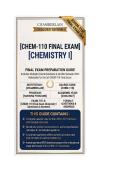
,CHEM 110 Final Exam Chemistry I Questions And Answers 2026/2027
Chamberlain
1.** Which of the following is a physical property of matter?
A) Flammability
B) Reactivity with acid
C) Boiling point
D) Ability to rust
**Correct Answer:** C) Boiling point
**Rationale:** Boiling point is a physical property because it can be observed
without changing the substance's chemical identity. Flammability (A),
reactivity with acid (B), and ability to rust (D) are chemical properties that
describe a substance's ability to undergo chemical change.
**2.** Which of the following is an example of a chemical change?
A) Melting ice
B) Boiling water
C) Rusting iron
D) Dissolving sugar in water
**Correct Answer:** C) Rusting iron
**Rationale:** Rusting iron is a chemical change because it results in the
formation of a new substance (iron oxide). Melting ice (A), boiling water (B),
and dissolving sugar in water (D) are physical changes that do not alter the
chemical composition.
,**3.** Which state of matter has a definite shape and definite volume?
A) Gas
B) Liquid
C) Solid
D) Plasma
**Correct Answer:** C) Solid
**Rationale:** Solids have a definite shape and volume because their
particles are closely packed and vibrate in place. Liquids (B) have a definite
volume but take the shape of their container. Gases (A) have no definite
shape or volume.
**4.** A pure substance that cannot be broken down into simpler substances
by chemical means is called a(n):
A) Compound
B) Element
C) Mixture
D) Solution
**Correct Answer:** B) Element
**Rationale:** An element is a pure substance that cannot be broken down
into simpler substances by chemical means. A compound (A) is formed when
two or more elements are chemically bonded together. A mixture (C) is a
combination of substances that retain their individual properties.
, **5.** Which of the following is a mixture?
A) Table salt (NaCl)
B) Water (H₂O)
C) Air
D) Carbon dioxide (CO₂)
**Correct Answer:** C) Air
**Rationale:** Air is a mixture of nitrogen, oxygen, carbon dioxide, and other
gases that retain their individual properties. Table salt (A), water (B), and
carbon dioxide (D) are compounds with fixed chemical compositions.
**6.** Which metric prefix represents 1/1000 of a base unit?
A) Kilo-
B) Centi-
C) Milli-
D) Micro-
**Correct Answer:** C) Milli-
**Rationale:** Milli- represents 1/1000 (10⁻³) of a base unit. Kilo- (A)
represents 1000 (10³), centi- (B) represents 1/100 (10⁻²), and micro- (D)
represents 1/1,000,000 (10⁻⁶).
**7.** The number 0.00450 has how many significant figures?
Chamberlain
1.** Which of the following is a physical property of matter?
A) Flammability
B) Reactivity with acid
C) Boiling point
D) Ability to rust
**Correct Answer:** C) Boiling point
**Rationale:** Boiling point is a physical property because it can be observed
without changing the substance's chemical identity. Flammability (A),
reactivity with acid (B), and ability to rust (D) are chemical properties that
describe a substance's ability to undergo chemical change.
**2.** Which of the following is an example of a chemical change?
A) Melting ice
B) Boiling water
C) Rusting iron
D) Dissolving sugar in water
**Correct Answer:** C) Rusting iron
**Rationale:** Rusting iron is a chemical change because it results in the
formation of a new substance (iron oxide). Melting ice (A), boiling water (B),
and dissolving sugar in water (D) are physical changes that do not alter the
chemical composition.
,**3.** Which state of matter has a definite shape and definite volume?
A) Gas
B) Liquid
C) Solid
D) Plasma
**Correct Answer:** C) Solid
**Rationale:** Solids have a definite shape and volume because their
particles are closely packed and vibrate in place. Liquids (B) have a definite
volume but take the shape of their container. Gases (A) have no definite
shape or volume.
**4.** A pure substance that cannot be broken down into simpler substances
by chemical means is called a(n):
A) Compound
B) Element
C) Mixture
D) Solution
**Correct Answer:** B) Element
**Rationale:** An element is a pure substance that cannot be broken down
into simpler substances by chemical means. A compound (A) is formed when
two or more elements are chemically bonded together. A mixture (C) is a
combination of substances that retain their individual properties.
, **5.** Which of the following is a mixture?
A) Table salt (NaCl)
B) Water (H₂O)
C) Air
D) Carbon dioxide (CO₂)
**Correct Answer:** C) Air
**Rationale:** Air is a mixture of nitrogen, oxygen, carbon dioxide, and other
gases that retain their individual properties. Table salt (A), water (B), and
carbon dioxide (D) are compounds with fixed chemical compositions.
**6.** Which metric prefix represents 1/1000 of a base unit?
A) Kilo-
B) Centi-
C) Milli-
D) Micro-
**Correct Answer:** C) Milli-
**Rationale:** Milli- represents 1/1000 (10⁻³) of a base unit. Kilo- (A)
represents 1000 (10³), centi- (B) represents 1/100 (10⁻²), and micro- (D)
represents 1/1,000,000 (10⁻⁶).
**7.** The number 0.00450 has how many significant figures?