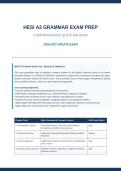
HESI A2 GRAMMAR EXAM PREP
COMPREHENSIVE QUESTION BANK
2026-2027 UPDATE EXAM
HESI A2 Grammar Exam Prep - Blueprint & Objectives
This exam preparation bank is designed to prepare students for the English Grammar section of the Health
Education Systems, Inc. (HESI) A2 Admission Assessment. It targets the core grammar principles and typical
question structures found in the official exam. These questions focus on word usage, homophones, spelling
errors, parallel structures, verb forms, and subject-verb agreement.
Core Learning Objectives:
• Correctly identify and select grammatically sound sentences.
• Differentiate confusing homophones (e.g., their/there/they're, to/too/two, aide/aid).
• Recognize parts of speech (nouns, verbs, adverbs, and adjectives) in context.
• Identify and correct sentence fragments, dangling modifiers, and misplaced modifiers.
• Apply subject-verb agreement and proper pronoun cases (subjective, objective, and possessive).
• Apply subjunctive mood structures for conditional or urgent expressions.
Chapter Focus Major Grammatical Concepts Covered HESI Exam Weight
1. Homophones & Diction Their/There/They're, To/Too/Two, Who's/Whose, High
Homophones (Ate/Eight, Hoarse/Horse)
2. Sentence Structures Fragments, Dependent/Independent Clauses, Modifier Medium
Placement
3. Verbs & Agreement Subject-Verb Concord, Collective Nouns, Active/Passive High
Voice, Tenses
4. Pronoun Cases & Concord Indefinite Pronouns, Subjective vs. Objective Pronouns, High
Reflexive Pronouns
,HESI A2 GRAMMAR EXAM PREP 2026-2027 UPDATE EXAM
Chapter Focus Major Grammatical Concepts Covered HESI Exam Weight
5. Subjunctive & Conditionals Subjunctive Mood (were, send), 3rd Conditional (would Medium
have happened)
6. Mechanics & Spelling Apostrophe Placement, Plural vs. Possessive, Medium
Demonyms, Word Usage Errors
Page 2 of 36
,HESI A2 GRAMMAR EXAM PREP 2026-2027 UPDATE EXAM
HESI A2 GRAMMAR COMPREHENSIVE TEST BANK
Answer each question below. Explanations and educational rationales are provided for every correct and
incorrect choice to reinforce fundamental grammar rules.
Question 1: Which sentence is grammatically correct regarding the use of contractions vs. possessive
pronouns?
A. Whose to blame for the sluggish economic growth?
B. Who's hat is this left sitting on the nurse's desk?
C. Whose going to vote in the upcoming local election?
D. Who's coming to the party tonight?
ANSWER : D
Explanation: Who's is a contraction of 'who is' or 'who has' (e.g., 'Who's coming' means 'Who is coming'). Whose is
a possessive pronoun used to show ownership (e.g., 'Whose hat is this?'). Option A should use 'Who's' (Who is to
blame). Option B should use 'Whose' (Whose hat). Option C should use 'Who's' (Who is going).
Question 2: Which sentence correctly demonstrates the usage of the homophones 'to', 'too', and 'two'?
A. I went two the store after my shifts were completed.
B. The nurse gave him too shorts before sending him to the clinical ward.
C. I want ice cream, too.
D. I want to know your name and too see your clinical badge.
ANSWER : C
Explanation: Too means 'also' or 'excessively' (e.g., 'I want ice cream, too'). To is a preposition indicating direction
or used before an infinitive (e.g., 'went to the store'). Two is the numerical spelling for the number 2. Option A should
use 'to'. Option B should use 'two' (two shots). Option D should use 'to' (to see).
Question 3: Select the sentence that correctly employs the adjective 'good' and the adverb 'well'.
A. He did good on his strict nutritional diet.
B. He done well on his strict nutritional diet.
C. He done good on his strict nutritional diet.
D. He did well on his diet.
ANSWER : D
Explanation: Well is typically used as an adverb to describe how an action is performed (e.g., 'did well'). Good is an
adjective describing a noun. 'Done' is a past participle that requires an auxiliary verb like 'had' or 'has' and cannot
stand alone as the simple past tense (e.g., 'He done' is grammatically incorrect; it must be 'He did' or 'He has done').
Page 3 of 36
, HESI A2 GRAMMAR EXAM PREP 2026-2027 UPDATE EXAM
Question 4: Which sentence is grammatically correct concerning singular indefinite pronouns and
pronoun-antecedent agreement?
A. Several lost his or her keys on the train.
B. Does everyone have their train tickets ready for boarding?
C. Is everyone ready for their ice-cream sundaes?
D. Somebody left his or her jacket on the train.
ANSWER : D
Explanation: Somebody is a singular indefinite pronoun that requires a singular possessive pronoun (his or her) for
formal agreement. In traditional formal English grammar, 'everyone' and 'somebody' are singular. While modern
usage increasingly accepts 'their' as a singular gender-neutral pronoun, HESI A2 exams heavily favor the traditional
formal rule: singular indefinite pronouns ('somebody', 'everyone', 'each', 'nobody') must pair with 'his or her'. 'Several'
in Option A is plural, so it should pair with 'their' (Several lost their keys).
Question 5: Which sentence should replace the following grammatically incorrect fragment? 'This door
to remain unlocked when occupied.'
A. This door to remain unclosed while open.
B. This door will remain unlocked when the office is occupied.
C. This office must have the door unlocked at all times.
D. The door remains unlocked when the office was occupied.
ANSWER : B
Explanation: The original sentence is a fragment because it lacks a finite verb ('to remain' is an infinitive and cannot
act as the main verb of the sentence). Option B corrects this fragment by introducing the complete verb phrase 'will
remain' in the future tense, establishing a clear, complete, and grammatically standard sentence.
Question 6: Which of the following sentences is grammatically correct in its use of modifiers?
A. Sarah plays her new saxophone well.
B. The dog catches the frisbee good.
C. The band did good during the half-time show.
D. The band that played before ours was well.
ANSWER : A
Explanation: In Option A, well is correctly used as an adverb modifying the verb 'plays'. In Option B, 'good' is
incorrectly used as an adverb; it should be 'well' to modify the action of catching. In Option C, 'did good' is incorrect
because an adverb ('well') is needed to modify 'did'. In Option D, 'was well' is incorrect because 'well' refers to health;
to describe the quality of the band, 'was good' (an adjective modifying the noun band) should be used.
Page 4 of 36
COMPREHENSIVE QUESTION BANK
2026-2027 UPDATE EXAM
HESI A2 Grammar Exam Prep - Blueprint & Objectives
This exam preparation bank is designed to prepare students for the English Grammar section of the Health
Education Systems, Inc. (HESI) A2 Admission Assessment. It targets the core grammar principles and typical
question structures found in the official exam. These questions focus on word usage, homophones, spelling
errors, parallel structures, verb forms, and subject-verb agreement.
Core Learning Objectives:
• Correctly identify and select grammatically sound sentences.
• Differentiate confusing homophones (e.g., their/there/they're, to/too/two, aide/aid).
• Recognize parts of speech (nouns, verbs, adverbs, and adjectives) in context.
• Identify and correct sentence fragments, dangling modifiers, and misplaced modifiers.
• Apply subject-verb agreement and proper pronoun cases (subjective, objective, and possessive).
• Apply subjunctive mood structures for conditional or urgent expressions.
Chapter Focus Major Grammatical Concepts Covered HESI Exam Weight
1. Homophones & Diction Their/There/They're, To/Too/Two, Who's/Whose, High
Homophones (Ate/Eight, Hoarse/Horse)
2. Sentence Structures Fragments, Dependent/Independent Clauses, Modifier Medium
Placement
3. Verbs & Agreement Subject-Verb Concord, Collective Nouns, Active/Passive High
Voice, Tenses
4. Pronoun Cases & Concord Indefinite Pronouns, Subjective vs. Objective Pronouns, High
Reflexive Pronouns
,HESI A2 GRAMMAR EXAM PREP 2026-2027 UPDATE EXAM
Chapter Focus Major Grammatical Concepts Covered HESI Exam Weight
5. Subjunctive & Conditionals Subjunctive Mood (were, send), 3rd Conditional (would Medium
have happened)
6. Mechanics & Spelling Apostrophe Placement, Plural vs. Possessive, Medium
Demonyms, Word Usage Errors
Page 2 of 36
,HESI A2 GRAMMAR EXAM PREP 2026-2027 UPDATE EXAM
HESI A2 GRAMMAR COMPREHENSIVE TEST BANK
Answer each question below. Explanations and educational rationales are provided for every correct and
incorrect choice to reinforce fundamental grammar rules.
Question 1: Which sentence is grammatically correct regarding the use of contractions vs. possessive
pronouns?
A. Whose to blame for the sluggish economic growth?
B. Who's hat is this left sitting on the nurse's desk?
C. Whose going to vote in the upcoming local election?
D. Who's coming to the party tonight?
ANSWER : D
Explanation: Who's is a contraction of 'who is' or 'who has' (e.g., 'Who's coming' means 'Who is coming'). Whose is
a possessive pronoun used to show ownership (e.g., 'Whose hat is this?'). Option A should use 'Who's' (Who is to
blame). Option B should use 'Whose' (Whose hat). Option C should use 'Who's' (Who is going).
Question 2: Which sentence correctly demonstrates the usage of the homophones 'to', 'too', and 'two'?
A. I went two the store after my shifts were completed.
B. The nurse gave him too shorts before sending him to the clinical ward.
C. I want ice cream, too.
D. I want to know your name and too see your clinical badge.
ANSWER : C
Explanation: Too means 'also' or 'excessively' (e.g., 'I want ice cream, too'). To is a preposition indicating direction
or used before an infinitive (e.g., 'went to the store'). Two is the numerical spelling for the number 2. Option A should
use 'to'. Option B should use 'two' (two shots). Option D should use 'to' (to see).
Question 3: Select the sentence that correctly employs the adjective 'good' and the adverb 'well'.
A. He did good on his strict nutritional diet.
B. He done well on his strict nutritional diet.
C. He done good on his strict nutritional diet.
D. He did well on his diet.
ANSWER : D
Explanation: Well is typically used as an adverb to describe how an action is performed (e.g., 'did well'). Good is an
adjective describing a noun. 'Done' is a past participle that requires an auxiliary verb like 'had' or 'has' and cannot
stand alone as the simple past tense (e.g., 'He done' is grammatically incorrect; it must be 'He did' or 'He has done').
Page 3 of 36
, HESI A2 GRAMMAR EXAM PREP 2026-2027 UPDATE EXAM
Question 4: Which sentence is grammatically correct concerning singular indefinite pronouns and
pronoun-antecedent agreement?
A. Several lost his or her keys on the train.
B. Does everyone have their train tickets ready for boarding?
C. Is everyone ready for their ice-cream sundaes?
D. Somebody left his or her jacket on the train.
ANSWER : D
Explanation: Somebody is a singular indefinite pronoun that requires a singular possessive pronoun (his or her) for
formal agreement. In traditional formal English grammar, 'everyone' and 'somebody' are singular. While modern
usage increasingly accepts 'their' as a singular gender-neutral pronoun, HESI A2 exams heavily favor the traditional
formal rule: singular indefinite pronouns ('somebody', 'everyone', 'each', 'nobody') must pair with 'his or her'. 'Several'
in Option A is plural, so it should pair with 'their' (Several lost their keys).
Question 5: Which sentence should replace the following grammatically incorrect fragment? 'This door
to remain unlocked when occupied.'
A. This door to remain unclosed while open.
B. This door will remain unlocked when the office is occupied.
C. This office must have the door unlocked at all times.
D. The door remains unlocked when the office was occupied.
ANSWER : B
Explanation: The original sentence is a fragment because it lacks a finite verb ('to remain' is an infinitive and cannot
act as the main verb of the sentence). Option B corrects this fragment by introducing the complete verb phrase 'will
remain' in the future tense, establishing a clear, complete, and grammatically standard sentence.
Question 6: Which of the following sentences is grammatically correct in its use of modifiers?
A. Sarah plays her new saxophone well.
B. The dog catches the frisbee good.
C. The band did good during the half-time show.
D. The band that played before ours was well.
ANSWER : A
Explanation: In Option A, well is correctly used as an adverb modifying the verb 'plays'. In Option B, 'good' is
incorrectly used as an adverb; it should be 'well' to modify the action of catching. In Option C, 'did good' is incorrect
because an adverb ('well') is needed to modify 'did'. In Option D, 'was well' is incorrect because 'well' refers to health;
to describe the quality of the band, 'was good' (an adjective modifying the noun band) should be used.
Page 4 of 36