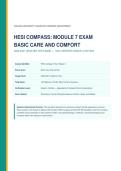
WALDEN UNIVERSITY GRADUATE NURSING DEPARTMENT
HESI COMPASS: MODULE 7 EXAM
BASIC CARE AND COMFORT
2026-2027 UPDATED TEST BANK — 100% VERIFIED GRADE A EDITION
Course Identifier: HESI Compass Prep / Module 7
Focus Area: Basic Care and Comfort
Target Term: 2026-2027 Academic Year
Total Items: 100 Rigorous, NCLEX-Style Practice Questions
Verification Level: Grade A Verified — Appended with Detailed Clinical Explanations
Core Content: Elimination, Fluid & Electrolyte Balance, Nutrition, Sleep, and Mobility
Quality & Educational Promise: This test bank represents an advanced, student-friendly preparatory resource.
Every question and answer is aligned with the latest HESI Compass and NCLEX-RN standards. Each item contains
complete clinical rationales to help students master core pathophysiologic, metabolic, and pharmacological care
concepts rather than relying on memorization.
,HESI COMPASS: BASIC CARE AND COMFORT EXAM 2026-2027 UPDATE
TABLE OF CONTENTS
Section 1: Exam Blueprint and Synthesis Overview Page 3
• Curriculum Structure and Client Needs Mapping Page 3
• High-Yield Concepts and Critical Clinical Procedures Page 4
Section 2: 2026-2027 Practice Examination (100 Questions) Page 5
• Questions 1 to 25: Foundations of Care and Elimination Page 5
• Questions 26 to 50: Mobility, Comfort, and Sleep Hygiene Page 15
• Questions 51 to 75: Advanced Nutrition, Diets, and Tube Feedings Page 25
• Questions 76 to 100: Fluids, Electrolytes, and Device-Based Interventions Page 35
WALDEN UNIVERSITY — GRADUATE NURSING DEPARTMENT
Page 2 A+ GRADED STUDY BANK
,HESI COMPASS: BASIC CARE AND COMFORT EXAM 2026-2027 UPDATE
SECTION 1: EXAM BLUEPRINT & REINFORCEMENTS
To achieve a Grade A score, students must understand the underlying rationale behind every basic care and
comfort intervention. This test bank is structured around the core client needs defined in the HESI Compass
and NCLEX frameworks, ensuring balanced clinical emphasis across all major areas.
Category / Chapter Area Clinical Focus Areas & Key Concepts HESI Exam
Weight
1. Elimination & Urinary Bladder-training readiness; renal calculi alkaline/acid ash diets; UTI 32%
Care pharmacotherapy (nitrofurantoin pH requirements); catheterization
techniques; oliguria vs anuria; and sensation volumes.
2. Fluid, Electrolyte & Diuretic therapy monitoring (furosemide I&O; targets, triamterene dietary 28%
Airway limitations); morphine respiratory depression (atelectasis prevention);
and insensible loss routes.
3. Mobility, Skin & Skeletal traction body mechanics (Buck's extension countertraction, 20%
Devices overhead trapeze friction risks); crutch-stance positioning; and cane
ambulation techniques.
4. Comfort, Nutrition & Sleep hygiene (circadian rhythm preservation); enteral nutrition 20%
Sleep monitoring (diarrhea causes, daily weights); and post-gastrectomy
dumping syndrome diets.
Critical Clinical Procedures & Verification Highlights:
• Ureterovesical Junction (UVJ) Protection: The UVJ prevents vesicoureteral reflux. Its incompetence is
the primary cause for ascending UTIs to progress into pyelonephritis.
• Skeletal Traction Care: To minimize friction and shearing on the unaffected heel (used to push up with the
trapeze), the nurse must frequently assess skin integrity and elevate the foot of the bed to provide
countertraction.
• Enema Instillation Height & Volume: For high cleansing enemas, the bag is hung 12 to 18 inches above
the hips (max volume 1000 mL); for low cleansing enemas, it is placed 3 inches or less above the hips.
• Furosemide Therapeutic Evaluation: Best evaluated by objective positive urine output exceeding intake
(e.g., negative balance of 1500 mL) and daily weight loss, rather than subjective parameters like sock
tightness.
• Acidifying vs. Alkalinizing Diets: Cranberries, plums, and prunes produce acid-ash and help acidify urine
to maximize nitrofurantoin's efficacy. Milk, spinach, and bananas produce alkaline ash, useful for renal
calculi.
WALDEN UNIVERSITY — GRADUATE NURSING DEPARTMENT
Page 3 A+ GRADED STUDY BANK
, HESI COMPASS: BASIC CARE AND COMFORT EXAM 2026-2027 UPDATE
SECTION 2: 2026-2027 PRACTICE EXAMINATION
Question 1
A nurse is providing information to a mother of a 1-year-old who has asked about bladder-training her
child. Which information should the nurse provide to the mother?
A. That she may start bladder training at any time
B. That her child is too young and that she should not yet be worrying about it
C. That bowel training should be started immediately and then begin bladder training in about 1 month
D. That a child cannot begin to control urination until approximately the age of 24 months
ANSWER ■: D — That a child cannot begin to control urination until approximately the age of 24
months
Explanation: Neuromuscular development required for voluntary control of the external urethral sphincter is
typically not sufficient until a child is approximately 18 to 24 months of age. Attempting bladder training before this
neurological maturity is achieved is ineffective and can cause frustration for both the child and caregiver. Option A
is incorrect because physiological readiness must precede training. Option B is dismissive and non-therapeutic.
Option C is incorrect because there is no rigid rule requiring bowel training to start immediately at 12 months.
Question 2
A client with renal calculi is instructed to follow an alkaline ash diet. Which menu choice by the client
indicates to the nurse that the client understands the prescribed regimen?
A. Linguini with shrimp, tossed salad, and a plum
B. Chicken, potatoes, and cranberries
C. Spinach salad, milk, and a banana
D. Peanut butter sandwich, milk, and prunes
ANSWER ■: C — Spinach salad, milk, and a banana
Explanation: An alkaline ash diet is prescribed to increase the pH of urine, which helps prevent certain types of
kidney stones (like uric acid and cystine stones). Alkaline-producing foods include milk, fruits (except cranberries,
plums, and prunes), and green vegetables like spinach. Spinach, milk, and bananas are metabolized into alkaline
end-products. Options A, B, and D are incorrect because they contain acid-ash producing foods such as shrimp,
chicken, peanut butter, cranberries, plums, and prunes, which lower urine pH and increase acidity.
WALDEN UNIVERSITY — GRADUATE NURSING DEPARTMENT
Page 4 A+ GRADED STUDY BANK
HESI COMPASS: MODULE 7 EXAM
BASIC CARE AND COMFORT
2026-2027 UPDATED TEST BANK — 100% VERIFIED GRADE A EDITION
Course Identifier: HESI Compass Prep / Module 7
Focus Area: Basic Care and Comfort
Target Term: 2026-2027 Academic Year
Total Items: 100 Rigorous, NCLEX-Style Practice Questions
Verification Level: Grade A Verified — Appended with Detailed Clinical Explanations
Core Content: Elimination, Fluid & Electrolyte Balance, Nutrition, Sleep, and Mobility
Quality & Educational Promise: This test bank represents an advanced, student-friendly preparatory resource.
Every question and answer is aligned with the latest HESI Compass and NCLEX-RN standards. Each item contains
complete clinical rationales to help students master core pathophysiologic, metabolic, and pharmacological care
concepts rather than relying on memorization.
,HESI COMPASS: BASIC CARE AND COMFORT EXAM 2026-2027 UPDATE
TABLE OF CONTENTS
Section 1: Exam Blueprint and Synthesis Overview Page 3
• Curriculum Structure and Client Needs Mapping Page 3
• High-Yield Concepts and Critical Clinical Procedures Page 4
Section 2: 2026-2027 Practice Examination (100 Questions) Page 5
• Questions 1 to 25: Foundations of Care and Elimination Page 5
• Questions 26 to 50: Mobility, Comfort, and Sleep Hygiene Page 15
• Questions 51 to 75: Advanced Nutrition, Diets, and Tube Feedings Page 25
• Questions 76 to 100: Fluids, Electrolytes, and Device-Based Interventions Page 35
WALDEN UNIVERSITY — GRADUATE NURSING DEPARTMENT
Page 2 A+ GRADED STUDY BANK
,HESI COMPASS: BASIC CARE AND COMFORT EXAM 2026-2027 UPDATE
SECTION 1: EXAM BLUEPRINT & REINFORCEMENTS
To achieve a Grade A score, students must understand the underlying rationale behind every basic care and
comfort intervention. This test bank is structured around the core client needs defined in the HESI Compass
and NCLEX frameworks, ensuring balanced clinical emphasis across all major areas.
Category / Chapter Area Clinical Focus Areas & Key Concepts HESI Exam
Weight
1. Elimination & Urinary Bladder-training readiness; renal calculi alkaline/acid ash diets; UTI 32%
Care pharmacotherapy (nitrofurantoin pH requirements); catheterization
techniques; oliguria vs anuria; and sensation volumes.
2. Fluid, Electrolyte & Diuretic therapy monitoring (furosemide I&O; targets, triamterene dietary 28%
Airway limitations); morphine respiratory depression (atelectasis prevention);
and insensible loss routes.
3. Mobility, Skin & Skeletal traction body mechanics (Buck's extension countertraction, 20%
Devices overhead trapeze friction risks); crutch-stance positioning; and cane
ambulation techniques.
4. Comfort, Nutrition & Sleep hygiene (circadian rhythm preservation); enteral nutrition 20%
Sleep monitoring (diarrhea causes, daily weights); and post-gastrectomy
dumping syndrome diets.
Critical Clinical Procedures & Verification Highlights:
• Ureterovesical Junction (UVJ) Protection: The UVJ prevents vesicoureteral reflux. Its incompetence is
the primary cause for ascending UTIs to progress into pyelonephritis.
• Skeletal Traction Care: To minimize friction and shearing on the unaffected heel (used to push up with the
trapeze), the nurse must frequently assess skin integrity and elevate the foot of the bed to provide
countertraction.
• Enema Instillation Height & Volume: For high cleansing enemas, the bag is hung 12 to 18 inches above
the hips (max volume 1000 mL); for low cleansing enemas, it is placed 3 inches or less above the hips.
• Furosemide Therapeutic Evaluation: Best evaluated by objective positive urine output exceeding intake
(e.g., negative balance of 1500 mL) and daily weight loss, rather than subjective parameters like sock
tightness.
• Acidifying vs. Alkalinizing Diets: Cranberries, plums, and prunes produce acid-ash and help acidify urine
to maximize nitrofurantoin's efficacy. Milk, spinach, and bananas produce alkaline ash, useful for renal
calculi.
WALDEN UNIVERSITY — GRADUATE NURSING DEPARTMENT
Page 3 A+ GRADED STUDY BANK
, HESI COMPASS: BASIC CARE AND COMFORT EXAM 2026-2027 UPDATE
SECTION 2: 2026-2027 PRACTICE EXAMINATION
Question 1
A nurse is providing information to a mother of a 1-year-old who has asked about bladder-training her
child. Which information should the nurse provide to the mother?
A. That she may start bladder training at any time
B. That her child is too young and that she should not yet be worrying about it
C. That bowel training should be started immediately and then begin bladder training in about 1 month
D. That a child cannot begin to control urination until approximately the age of 24 months
ANSWER ■: D — That a child cannot begin to control urination until approximately the age of 24
months
Explanation: Neuromuscular development required for voluntary control of the external urethral sphincter is
typically not sufficient until a child is approximately 18 to 24 months of age. Attempting bladder training before this
neurological maturity is achieved is ineffective and can cause frustration for both the child and caregiver. Option A
is incorrect because physiological readiness must precede training. Option B is dismissive and non-therapeutic.
Option C is incorrect because there is no rigid rule requiring bowel training to start immediately at 12 months.
Question 2
A client with renal calculi is instructed to follow an alkaline ash diet. Which menu choice by the client
indicates to the nurse that the client understands the prescribed regimen?
A. Linguini with shrimp, tossed salad, and a plum
B. Chicken, potatoes, and cranberries
C. Spinach salad, milk, and a banana
D. Peanut butter sandwich, milk, and prunes
ANSWER ■: C — Spinach salad, milk, and a banana
Explanation: An alkaline ash diet is prescribed to increase the pH of urine, which helps prevent certain types of
kidney stones (like uric acid and cystine stones). Alkaline-producing foods include milk, fruits (except cranberries,
plums, and prunes), and green vegetables like spinach. Spinach, milk, and bananas are metabolized into alkaline
end-products. Options A, B, and D are incorrect because they contain acid-ash producing foods such as shrimp,
chicken, peanut butter, cranberries, plums, and prunes, which lower urine pH and increase acidity.
WALDEN UNIVERSITY — GRADUATE NURSING DEPARTMENT
Page 4 A+ GRADED STUDY BANK