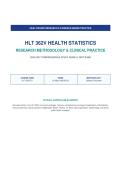
HEALTHCARE RESEARCH & EVIDENCE-BASED PRACTICE
HLT 362V HEALTH STATISTICS
RESEARCH METHODOLOGY & CLINICAL PRACTICE
2026-2027 COMPREHENSIVE STUDY GUIDE & TEST BANK
COURSE CODE ITEMS METHODOLOGY
HLT-362V-D1 50 High-Yield MCQs Syllabus Grounded
OFFICIAL CURRICULUM BLUEPRINT
Grounded strictly in the HLT 362V curriculum passages. Features comprehensive coverage of applications of biostatistics,
resource planning, historical pioneers (Nightingale, Barton, Pasteur, Dr. Blue), data organization, epidemiology, and dental
public health strategies.
,HLT 362V HEALTH STATISTICS & RESEARCH METHODOLOGY: SYLLABUS
Course Scope & Objectives:
This comprehensive course study guide prepares healthcare students to apply statistical reasoning to clinical research and
public health practice. Students will master resource planning, track clinical outcomes, analyze historical public health
responses, and leverage biostatistical tools to design evidence-based preventive strategies.
Core Course Modules:
Module 1: Applications of Health Statistics Module 2: Historical Public Health Milestones
Resource utilization, planning, inventory/cost control, quality Crimean War (Nightingale), Civil War (Barton), microbe &
improvement, risk analysis, patient satisfaction, and germ theories (Pasteur), and the 1918 Influenza Pandemic
evidence-based practice. (Dr. Rupert Blue).
Module 3: Core Statistical Methods Module 4: Epidemiology & Clinical Action
Data collection, organization, and presentation using central Epidemiological comparisons (diabetes, caries) and
tendency, range, dispersion, tabulation, and pie/bar graphs. designing targeted public health prevention programs.
Commonly Confused Concepts:
Morbidity vs. Mortality Morbidity refers to the rate or prevalence of disease and illness within a population,
whereas Mortality refers specifically to the rate or count of deaths.
Central Tendency vs. Central Tendency measures pinpoint the single central value representing a dataset
Dispersion (mean, median, mode), whereas Dispersion and Range measure the variability or
spread of the data.
Descriptive vs. Analytical Descriptive statistics compile, tabulate, and present raw data in accessible, simple
Studies ways (e.g., pie graphs of caries), whereas analytical epidemiology compares and tests
hypotheses (e.g., diabetes among Asians vs. Europeans).
, APPLICATIONS OF HEALTH STATISTICS — QUESTION 1
In healthcare, what is the primary overarching goal of using health statistics and clinical data?
A. To automate medical decisions without human clinical reasoning.
B. To understand, track, improve, and plan the use of resources to improve people's lives and promote well-being.
C. To reduce the overall number of clinical trials and laboratory analyses.
D. To increase the administrative complexity of patient satisfaction surveys.
ANSWER ■: B — To understand, track, improve, and plan the use of resources to improve people's lives and
promote well-being.
Explanation: According to the source, health statistics provide the critical data necessary to understand, track, improve,
and plan the use of resources. This systematic planning is designed to improve people's lives, provide essential services,
and promote their overall well-being. Options A, C, and D are incorrect because statistics support clinical reasoning, do not
seek to reduce essential research, and aim to simplify rather than complicate administrative metrics.
APPLICATIONS OF HEALTH STATISTICS — QUESTION 2
According to the source text, which of the following is a valid administrative use of statistics in a
healthcare organization?
A. Maximizing patient length of stay to increase hospital revenue.
B. Conducting risk analysis, inventory, and cost control.
C. Bypassing the need for professional education and progress assessments.
D. Formulating direct-to-consumer advertising for new biological therapies.
ANSWER ■: B — Conducting risk analysis, inventory, and cost control.
Explanation: The source explicitly states that in healthcare, statistics are used for 'risk analysis, inventory and cost control.'
Option A is incorrect because statistics help track length of stay to optimize resource utilization, not artificially maximize it.
Option C is incorrect because statistics are used to support, not bypass, education and progress assessments. Option D is
incorrect because pharmaceutical marketing is not mentioned as a statistical application in the text.
HLT 362V HEALTH STATISTICS
RESEARCH METHODOLOGY & CLINICAL PRACTICE
2026-2027 COMPREHENSIVE STUDY GUIDE & TEST BANK
COURSE CODE ITEMS METHODOLOGY
HLT-362V-D1 50 High-Yield MCQs Syllabus Grounded
OFFICIAL CURRICULUM BLUEPRINT
Grounded strictly in the HLT 362V curriculum passages. Features comprehensive coverage of applications of biostatistics,
resource planning, historical pioneers (Nightingale, Barton, Pasteur, Dr. Blue), data organization, epidemiology, and dental
public health strategies.
,HLT 362V HEALTH STATISTICS & RESEARCH METHODOLOGY: SYLLABUS
Course Scope & Objectives:
This comprehensive course study guide prepares healthcare students to apply statistical reasoning to clinical research and
public health practice. Students will master resource planning, track clinical outcomes, analyze historical public health
responses, and leverage biostatistical tools to design evidence-based preventive strategies.
Core Course Modules:
Module 1: Applications of Health Statistics Module 2: Historical Public Health Milestones
Resource utilization, planning, inventory/cost control, quality Crimean War (Nightingale), Civil War (Barton), microbe &
improvement, risk analysis, patient satisfaction, and germ theories (Pasteur), and the 1918 Influenza Pandemic
evidence-based practice. (Dr. Rupert Blue).
Module 3: Core Statistical Methods Module 4: Epidemiology & Clinical Action
Data collection, organization, and presentation using central Epidemiological comparisons (diabetes, caries) and
tendency, range, dispersion, tabulation, and pie/bar graphs. designing targeted public health prevention programs.
Commonly Confused Concepts:
Morbidity vs. Mortality Morbidity refers to the rate or prevalence of disease and illness within a population,
whereas Mortality refers specifically to the rate or count of deaths.
Central Tendency vs. Central Tendency measures pinpoint the single central value representing a dataset
Dispersion (mean, median, mode), whereas Dispersion and Range measure the variability or
spread of the data.
Descriptive vs. Analytical Descriptive statistics compile, tabulate, and present raw data in accessible, simple
Studies ways (e.g., pie graphs of caries), whereas analytical epidemiology compares and tests
hypotheses (e.g., diabetes among Asians vs. Europeans).
, APPLICATIONS OF HEALTH STATISTICS — QUESTION 1
In healthcare, what is the primary overarching goal of using health statistics and clinical data?
A. To automate medical decisions without human clinical reasoning.
B. To understand, track, improve, and plan the use of resources to improve people's lives and promote well-being.
C. To reduce the overall number of clinical trials and laboratory analyses.
D. To increase the administrative complexity of patient satisfaction surveys.
ANSWER ■: B — To understand, track, improve, and plan the use of resources to improve people's lives and
promote well-being.
Explanation: According to the source, health statistics provide the critical data necessary to understand, track, improve,
and plan the use of resources. This systematic planning is designed to improve people's lives, provide essential services,
and promote their overall well-being. Options A, C, and D are incorrect because statistics support clinical reasoning, do not
seek to reduce essential research, and aim to simplify rather than complicate administrative metrics.
APPLICATIONS OF HEALTH STATISTICS — QUESTION 2
According to the source text, which of the following is a valid administrative use of statistics in a
healthcare organization?
A. Maximizing patient length of stay to increase hospital revenue.
B. Conducting risk analysis, inventory, and cost control.
C. Bypassing the need for professional education and progress assessments.
D. Formulating direct-to-consumer advertising for new biological therapies.
ANSWER ■: B — Conducting risk analysis, inventory, and cost control.
Explanation: The source explicitly states that in healthcare, statistics are used for 'risk analysis, inventory and cost control.'
Option A is incorrect because statistics help track length of stay to optimize resource utilization, not artificially maximize it.
Option C is incorrect because statistics are used to support, not bypass, education and progress assessments. Option D is
incorrect because pharmaceutical marketing is not mentioned as a statistical application in the text.