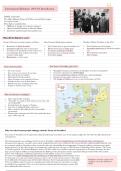
International Relations 1919-39: Introduction
WWII: 1914-1918
The allies (Britain, France & USA) won and had to agree
on a peace treaty…
They had to consider that:
• Millions of people were dead or injured
• Many wanted Germany to take the blame
• Everyone wanted to prevent another war
What did the Big three want?
Georges Clemenceau: prime minister of France Lloyd George: British prime minister Woodrow Wilson: President of the USA
• Restitution of Alsace Lorraine • Not a harsh treaty to prevent another war • Not a harsh treaty on Germany
• Germany to split into states to lose power • Britain & Germany to trade again • Strengthen democracy in defeated countries
• Germany to be punished severely as there was • To avoid a communist revolution tries
lots of damage done to France & so they • Germany to lose its navy & colonies • International co-operation
wouldn’t attack again • To keep his empire • The 14 points
• Reperations + a strict treaty
Some of the 14 points: The Treaty of Versailles, June 1919
• No secret treaties • War guilt: Germany was forced to accept blame in order to be punished
• Free access to sea at peace & war time • Germany: reparations of £6’600 million
• Free trade between countries • German armed forces reduced: 100’000 men, only 6 battleships
• Disarmament by all countries • Germany lost its empire and a lot of territory
• Alsace Lorraine to be returned to France • The League of Nation was to be set up: no Germany, no USA
• Colonies to have a say in their future
• Poland to become an independent state
• League of Nations to be set up…
Why was Germany so unhappy?
• They expected the 14 points
• ‘War guilt’ was unfair as they felt they weren’t the only
ones responsible
• Excluded from the League of Nations
• Lost a lot of industrial land: coal & steel
• Have a massive debt while they have an unstable
government
• Massive debt (announced in 1921) that would take them
up to 1980 to pay off
Why were the German people unhappy with the Treaty of Versailles?
The treaty of Versailles was the agreement which intended to prevent future wars. It was signed on June 28, 1919 after the allies defeated the
central powers.
First German people were unhappy with the treaty of Versailles as they were punished more severely than the other central powers.
Germany had to sign the ‘war guilt’ clause which established that they were to blame for the war, so that they could be punished harshly. This
was extremely unfair to Germany as they weren’t the only ones who initially showed aggression. Germany’s military restrictions were much
harsher than a lot of the other treaties, for example they could only have an army of 100 '000 men, 6 battleships and no airforce. The Treaty
of Neuilly, signed in 1919, limited Bulgaria’s army to 20 '000, which was a smaller restriction in proportion to Germany. Germany also lost
huge areas of land in addition to being divided by the Polish corridor. Germany’s massive reparations debt proceeded while other central
powers such as Hungary, couldn’t pay reparations of 100 million, so they were cancelled.
Germans were further unhappy about the consequences of their huge debt. Industrial lands such as
the Saar land were taken away from Germany as well as a lot of their natural resources. This made
it very difficult for Germany to pay off their debt. Moreover, the German government was unstable. Mandates: German colonies that
There was inflation and an increase in unemployment which led to poverty. Germany’s economy would be run by the LON post
was badly hit by reparations. They were also extremely embarrassed about having a massive debt WWI
that would burden their recovery.
, Peace Treaties
Treaty of Versailles compared to other treaties:
1.) Austria: St. Germain, 1919 1.) Germany divide by Polish corridor
• Divided from Hungary in 1918 • Reperationso hit with economic problems due to
• Stopped Austria from joining Germany land loss
• Lost land to new countries: Czechoslovakia, Yugoslavia,
Poland
- Led to huge economic problems
2.) Germany lost land
2.) Bulgaria: Treaty of Neuilly, 1920 - Amy restriction are much greater in proportion
• Land losses - Reperations are much higher
• Denied access to sea
• Army limited to to 20’000
• Pay 100 million in reparations 3) - Hungary suffered greater proportional land loss
than Germany
3.) Hungary: Treaty of Trianon, 1920 - German reparations pursued withinvasion of Ruhr
• Lost huge areas of land
- 3 Million citizens in other countries 4) similar military restrictions
• Reparations - unable to pay Turkey lost more land
4.) Turkey: Treaty of Sèvres, 1920
• Lost land to Greece & large parts of it’s empire to
Britain and France.
• Only 50’000 army +finances controlled by Br. &Fr.
• No airforce
—>military coup in Turkey: Seized back Thrace &
Armenia & Smyrna
-Allies agreed for Turkey to keep Thrace & Smyrna (Treaty
of Lausanne 1923) events showed the allies might not back
up the treaties
Exam question:
‘The Treaty of Versailles was a fair settlement. 'How far do you agree with this statement?’ Explain your
answer.
Agree:
Territorial Adjustments: The treaty redrew the map of Europe, addressing some long-standing issues and aiming to establish
stable borders. It allowed for the creation of new nations, such as Poland and Czechoslovakia, and attempted to address the
principle of self-determination.
Disarmament: To prevent future aggression, the Treaty of Versailles included provisions for the demilitarisation of Germany.
The goal was to reduce the threat of militarism and ensure that Germany could not quickly rebuild its military capabilities. In
addition Germany wouldn’t need arms as wars should be prevented
The treaty established the League of Nations, an international organisation aimed at promoting peace and preventing future
conflicts. The League was seen as a fair and progressive approach to global governance, although its effectiveness was limited.
Germany had caused much death and damage.
Disagree:
Unfair compared to other treaties
Left the Germans with an unstable government and humiliated
Excluded Germany from LON which discouraged international co-operation
WWII: 1914-1918
The allies (Britain, France & USA) won and had to agree
on a peace treaty…
They had to consider that:
• Millions of people were dead or injured
• Many wanted Germany to take the blame
• Everyone wanted to prevent another war
What did the Big three want?
Georges Clemenceau: prime minister of France Lloyd George: British prime minister Woodrow Wilson: President of the USA
• Restitution of Alsace Lorraine • Not a harsh treaty to prevent another war • Not a harsh treaty on Germany
• Germany to split into states to lose power • Britain & Germany to trade again • Strengthen democracy in defeated countries
• Germany to be punished severely as there was • To avoid a communist revolution tries
lots of damage done to France & so they • Germany to lose its navy & colonies • International co-operation
wouldn’t attack again • To keep his empire • The 14 points
• Reperations + a strict treaty
Some of the 14 points: The Treaty of Versailles, June 1919
• No secret treaties • War guilt: Germany was forced to accept blame in order to be punished
• Free access to sea at peace & war time • Germany: reparations of £6’600 million
• Free trade between countries • German armed forces reduced: 100’000 men, only 6 battleships
• Disarmament by all countries • Germany lost its empire and a lot of territory
• Alsace Lorraine to be returned to France • The League of Nation was to be set up: no Germany, no USA
• Colonies to have a say in their future
• Poland to become an independent state
• League of Nations to be set up…
Why was Germany so unhappy?
• They expected the 14 points
• ‘War guilt’ was unfair as they felt they weren’t the only
ones responsible
• Excluded from the League of Nations
• Lost a lot of industrial land: coal & steel
• Have a massive debt while they have an unstable
government
• Massive debt (announced in 1921) that would take them
up to 1980 to pay off
Why were the German people unhappy with the Treaty of Versailles?
The treaty of Versailles was the agreement which intended to prevent future wars. It was signed on June 28, 1919 after the allies defeated the
central powers.
First German people were unhappy with the treaty of Versailles as they were punished more severely than the other central powers.
Germany had to sign the ‘war guilt’ clause which established that they were to blame for the war, so that they could be punished harshly. This
was extremely unfair to Germany as they weren’t the only ones who initially showed aggression. Germany’s military restrictions were much
harsher than a lot of the other treaties, for example they could only have an army of 100 '000 men, 6 battleships and no airforce. The Treaty
of Neuilly, signed in 1919, limited Bulgaria’s army to 20 '000, which was a smaller restriction in proportion to Germany. Germany also lost
huge areas of land in addition to being divided by the Polish corridor. Germany’s massive reparations debt proceeded while other central
powers such as Hungary, couldn’t pay reparations of 100 million, so they were cancelled.
Germans were further unhappy about the consequences of their huge debt. Industrial lands such as
the Saar land were taken away from Germany as well as a lot of their natural resources. This made
it very difficult for Germany to pay off their debt. Moreover, the German government was unstable. Mandates: German colonies that
There was inflation and an increase in unemployment which led to poverty. Germany’s economy would be run by the LON post
was badly hit by reparations. They were also extremely embarrassed about having a massive debt WWI
that would burden their recovery.
, Peace Treaties
Treaty of Versailles compared to other treaties:
1.) Austria: St. Germain, 1919 1.) Germany divide by Polish corridor
• Divided from Hungary in 1918 • Reperationso hit with economic problems due to
• Stopped Austria from joining Germany land loss
• Lost land to new countries: Czechoslovakia, Yugoslavia,
Poland
- Led to huge economic problems
2.) Germany lost land
2.) Bulgaria: Treaty of Neuilly, 1920 - Amy restriction are much greater in proportion
• Land losses - Reperations are much higher
• Denied access to sea
• Army limited to to 20’000
• Pay 100 million in reparations 3) - Hungary suffered greater proportional land loss
than Germany
3.) Hungary: Treaty of Trianon, 1920 - German reparations pursued withinvasion of Ruhr
• Lost huge areas of land
- 3 Million citizens in other countries 4) similar military restrictions
• Reparations - unable to pay Turkey lost more land
4.) Turkey: Treaty of Sèvres, 1920
• Lost land to Greece & large parts of it’s empire to
Britain and France.
• Only 50’000 army +finances controlled by Br. &Fr.
• No airforce
—>military coup in Turkey: Seized back Thrace &
Armenia & Smyrna
-Allies agreed for Turkey to keep Thrace & Smyrna (Treaty
of Lausanne 1923) events showed the allies might not back
up the treaties
Exam question:
‘The Treaty of Versailles was a fair settlement. 'How far do you agree with this statement?’ Explain your
answer.
Agree:
Territorial Adjustments: The treaty redrew the map of Europe, addressing some long-standing issues and aiming to establish
stable borders. It allowed for the creation of new nations, such as Poland and Czechoslovakia, and attempted to address the
principle of self-determination.
Disarmament: To prevent future aggression, the Treaty of Versailles included provisions for the demilitarisation of Germany.
The goal was to reduce the threat of militarism and ensure that Germany could not quickly rebuild its military capabilities. In
addition Germany wouldn’t need arms as wars should be prevented
The treaty established the League of Nations, an international organisation aimed at promoting peace and preventing future
conflicts. The League was seen as a fair and progressive approach to global governance, although its effectiveness was limited.
Germany had caused much death and damage.
Disagree:
Unfair compared to other treaties
Left the Germans with an unstable government and humiliated
Excluded Germany from LON which discouraged international co-operation