
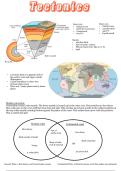
Inner core: Outer core:
• Nickel & iron • Nickel & iron
• Solid due to pressure • 2300km thick
• Compressed • 4400°C
• 6000°C • Liquid metall
Mantle:
• 2900km thick
• 84% of earth’s volume
• Silicone based rock: Mg, Is, O, Fe
• rigid
• A tectonic plate is a gigantic slab of
the earth’s crust and upper mantle
(lithosphere.
• A plate boundary is where two
tectonic plates meet.
• There are 7 major plates and 15 minor
plates
Mantle convection:
Convection occurs in the mantle. The lower mantle is heated up by the outer core. Hot particles are less dense
than cold ones so they rise until they lose heat and sink. This circular movement results in the coldest particles at
the top of the mantle creating friction against the plates of the crust. This makes them move with the particles.
This is called slab pull.
Oceanic crust Continental crust
More dense
Part of
earths crust Less dense
Made mostly of basalt
Made of granite
Made of solid
Old
Young rock & material
5-10km thick 30-50 km tick
Oceanic Plate: a thin dense crust found under oceans Continental Plate: a thick less dense crust that makes up continents
, Volcano: a mountain with a large circular hole at the top through which lava, gases, steam and dust are or have been
forced out
• Volcanoes are at constructive & destructive plate
If
boundaries and hotspots
At constructive plate boundaries:
#
- Convection currents in the mantle
result in two tectonic plates moving
away from each other.
- This creates a gap between the oceanic
plates. magma chamber
- Magma rises through the gap towards
the surface (seafloor) Extinct Volcanoes: Dormant Volcanoes: Active volcanoes:
- Rising magma cools to form new Erupted in the past, but will not Inactive but may become Erupted at some point
erupt again in the last 80 years
oceanic crust and mid-ocean ridge active in the future
(under water mountain ranges) through
the process of seafloor spreading
At destructive plate boundaries: Hotspots:
- Convection currents in the mantle result in two tectonic plates - Some locations beneath the earth’s
moving towards each other crust are hotter than others
- The more dense plate is subducted in the subduction zone - theories include that some areas of
- Heat from the mantle, friction and pressure cause the oceanic plate the earth’s crust are unusually thin or
to melt and be destroyed weak or that particularly hot, rising
- The melting plate, mixed with seawater, creates lighter magma that plumes (hot rock) of magma can burn
rises toward the surface through faults in the less dense plate a hole through the crust
Types of Volcanoes: Shield & Stratovolcano
sta
relage
Infrequent but violent
·
ste
·
Destructive Plate eruptions
Frequent but gentle eruptions
Constructive Plate
Boundary
large ask cloud
Boundary Basic lava (runny
W
Crater
Small ask cloud
Steep slopes
..
*
som
u
layers of crater Parasitic cone & ask
Solidified lava
=
Viscous acid lava flow
gentle
o
,
slopes
- *
-
- *
·
main vent a
vent Earth's Crust Secondary Earth's crust
· Do
~
z
magma chamber Magna Chamber
Shield Stratovolcano
Shield: Stratovolcano:
- Lower viscosity (lava flows quicker) - Higher viscosity (lava flows slower)
- Less steep (gentle slope) - Steeper slope
- More basic - More acidic
- Low/ no silica content - High silica content
- Less explosive - More explosive
- Wider - Less wide
- Smaller ash cloud - Larger ash cloud
Silica: (silicon dioxide) gives lava a lighter colour and different properties such as higher viscosity. It doesn’t allow
any gases out when the volcano is heated, so pressure builds up until the volcano explodes
Global timing: temperatures decrease as particles reflect UV light
• Nickel & iron • Nickel & iron
• Solid due to pressure • 2300km thick
• Compressed • 4400°C
• 6000°C • Liquid metall
Mantle:
• 2900km thick
• 84% of earth’s volume
• Silicone based rock: Mg, Is, O, Fe
• rigid
• A tectonic plate is a gigantic slab of
the earth’s crust and upper mantle
(lithosphere.
• A plate boundary is where two
tectonic plates meet.
• There are 7 major plates and 15 minor
plates
Mantle convection:
Convection occurs in the mantle. The lower mantle is heated up by the outer core. Hot particles are less dense
than cold ones so they rise until they lose heat and sink. This circular movement results in the coldest particles at
the top of the mantle creating friction against the plates of the crust. This makes them move with the particles.
This is called slab pull.
Oceanic crust Continental crust
More dense
Part of
earths crust Less dense
Made mostly of basalt
Made of granite
Made of solid
Old
Young rock & material
5-10km thick 30-50 km tick
Oceanic Plate: a thin dense crust found under oceans Continental Plate: a thick less dense crust that makes up continents
, Volcano: a mountain with a large circular hole at the top through which lava, gases, steam and dust are or have been
forced out
• Volcanoes are at constructive & destructive plate
If
boundaries and hotspots
At constructive plate boundaries:
#
- Convection currents in the mantle
result in two tectonic plates moving
away from each other.
- This creates a gap between the oceanic
plates. magma chamber
- Magma rises through the gap towards
the surface (seafloor) Extinct Volcanoes: Dormant Volcanoes: Active volcanoes:
- Rising magma cools to form new Erupted in the past, but will not Inactive but may become Erupted at some point
erupt again in the last 80 years
oceanic crust and mid-ocean ridge active in the future
(under water mountain ranges) through
the process of seafloor spreading
At destructive plate boundaries: Hotspots:
- Convection currents in the mantle result in two tectonic plates - Some locations beneath the earth’s
moving towards each other crust are hotter than others
- The more dense plate is subducted in the subduction zone - theories include that some areas of
- Heat from the mantle, friction and pressure cause the oceanic plate the earth’s crust are unusually thin or
to melt and be destroyed weak or that particularly hot, rising
- The melting plate, mixed with seawater, creates lighter magma that plumes (hot rock) of magma can burn
rises toward the surface through faults in the less dense plate a hole through the crust
Types of Volcanoes: Shield & Stratovolcano
sta
relage
Infrequent but violent
·
ste
·
Destructive Plate eruptions
Frequent but gentle eruptions
Constructive Plate
Boundary
large ask cloud
Boundary Basic lava (runny
W
Crater
Small ask cloud
Steep slopes
..
*
som
u
layers of crater Parasitic cone & ask
Solidified lava
=
Viscous acid lava flow
gentle
o
,
slopes
- *
-
- *
·
main vent a
vent Earth's Crust Secondary Earth's crust
· Do
~
z
magma chamber Magna Chamber
Shield Stratovolcano
Shield: Stratovolcano:
- Lower viscosity (lava flows quicker) - Higher viscosity (lava flows slower)
- Less steep (gentle slope) - Steeper slope
- More basic - More acidic
- Low/ no silica content - High silica content
- Less explosive - More explosive
- Wider - Less wide
- Smaller ash cloud - Larger ash cloud
Silica: (silicon dioxide) gives lava a lighter colour and different properties such as higher viscosity. It doesn’t allow
any gases out when the volcano is heated, so pressure builds up until the volcano explodes
Global timing: temperatures decrease as particles reflect UV light


