

Anatomy & Physiology II · Exam 3
Respiratory · Digestive · Metabolism 50 questions · graded
QUESTION 1 pts
During intense exercise, the oxygen–hemoglobin dissociation curve shifts
to the right. Which of the following BEST explains this physiological
adaptation?
Bohr effect · 2,3-DPG · temperature · pH
Increased H⁺ and temperature decrease hemoglobin’s affinity for O₂
Increased pH and decreased temperature shift the curve left
Hemoglobin binds O₂ more tightly, reducing O₂ unloading
, The curve shift is primarily due to increased plasma CO₂ only
correct Right shift = decreased affinity, enhanced O₂ delivery to tissues.
QUESTION 2 pts
Carbon dioxide is transported in the blood via several mechanisms. The
chloride shift is essential for which of the following processes?
RBC · bicarbonate · ion exchange · CO₂ transport
Chloride moves into RBCs to facilitate the conversion of CO₂ to carbonic acid
Bicarbonate ions exit RBCs in exchange for chloride, maintaining electrical
balance
Chloride directly binds to CO₂ to form carbamino compounds
, The chloride shift occurs only in pulmonary capillaries
incorrect The chloride shift: bicarbonate exits, chloride enters RBCs.
QUESTION 3 pts
Which of the following correctly describes the secretions of gastric gland
parietal cells and their primary role in digestion?
Stomach · HCl · intrinsic factor · pepsinogen
Hydrochloric acid (HCl) and intrinsic factor; HCl activates pepsin and kills
pathogens
Pepsinogen and gastric lipase; initiate protein and fat digestion
Mucus and bicarbonate; protect the gastric mucosa from acid
, Gastrin and histamine; regulate acid secretion via endocrine signaling
correct Parietal cells secrete HCl and intrinsic factor (B₁₂ absorption).
QUESTION 4 pts
In the digestive system, cholecystokinin (CCK) and secretin are enteric
hormones that regulate pancreatic and biliary function. Which of the
following BEST describes their synergistic action?
Pancreas · bile · bicarbonate · enzyme secretion
CCK stimulates pancreatic enzyme secretion and gallbladder contraction; secretin
stimulates pancreatic bicarbonate secretion
CCK inhibits gastric emptying while secretin stimulates acid secretion
Respiratory · Digestive · Metabolism 50 questions · graded
QUESTION 1 pts
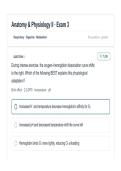
During intense exercise, the oxygen–hemoglobin dissociation curve shifts
to the right. Which of the following BEST explains this physiological
adaptation?
Bohr effect · 2,3-DPG · temperature · pH
Increased H⁺ and temperature decrease hemoglobin’s affinity for O₂
Increased pH and decreased temperature shift the curve left
Hemoglobin binds O₂ more tightly, reducing O₂ unloading
, The curve shift is primarily due to increased plasma CO₂ only
correct Right shift = decreased affinity, enhanced O₂ delivery to tissues.
QUESTION 2 pts
Carbon dioxide is transported in the blood via several mechanisms. The
chloride shift is essential for which of the following processes?
RBC · bicarbonate · ion exchange · CO₂ transport
Chloride moves into RBCs to facilitate the conversion of CO₂ to carbonic acid
Bicarbonate ions exit RBCs in exchange for chloride, maintaining electrical
balance
Chloride directly binds to CO₂ to form carbamino compounds
, The chloride shift occurs only in pulmonary capillaries
incorrect The chloride shift: bicarbonate exits, chloride enters RBCs.
QUESTION 3 pts
Which of the following correctly describes the secretions of gastric gland
parietal cells and their primary role in digestion?
Stomach · HCl · intrinsic factor · pepsinogen
Hydrochloric acid (HCl) and intrinsic factor; HCl activates pepsin and kills
pathogens
Pepsinogen and gastric lipase; initiate protein and fat digestion
Mucus and bicarbonate; protect the gastric mucosa from acid
, Gastrin and histamine; regulate acid secretion via endocrine signaling
correct Parietal cells secrete HCl and intrinsic factor (B₁₂ absorption).
QUESTION 4 pts
In the digestive system, cholecystokinin (CCK) and secretin are enteric
hormones that regulate pancreatic and biliary function. Which of the
following BEST describes their synergistic action?
Pancreas · bile · bicarbonate · enzyme secretion
CCK stimulates pancreatic enzyme secretion and gallbladder contraction; secretin
stimulates pancreatic bicarbonate secretion
CCK inhibits gastric emptying while secretin stimulates acid secretion


