
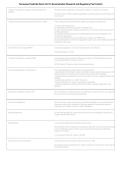
Tennessee Pesticide Exam Cat 10- Demonstration Research and Regulatory Pest Control
*Federal Insecticide, Fungicide, and Rodenticide Act Required federal registration of pesticides shipped in interstate commerce
(FIFRA)
Under the 194 7 FIFRA, registered pesticides could be used by almost anyone for
any purpose
*Federal Environmental Pesticides Control Act (1972) 1972 amendment to the FIFRA that added key regulatory mechanisms
(1) Follow label instructions;
(2) Classified pesticides as general or restricted use;
(3) The restricted category may be used only by or under the direct supervision of
certified applicators;
(4) establish general categories of certified applicators: private applicators and
commercial applicators;
(5) provide penalties (fines and jail terms) for violations of FIFRA; and
(6) provide states the authority to regulate the sale or use of any federally registered
pesticides in that state.
Civil Penalties for violating FIFRA Commercial applicator: not more than $5,000 for each offense
Private applicators: $1,000
*Criminal Penalties for violating FIFRA any applicator who knowingly violates any provision of FIFRA shall be fined not
more than $25,000 or one year in prison
($1,000 and/or 30 days in prison for private applicators
Tennessee Application of Pesticide Act Tennessee Department of Agriculture is responsible for:
- the protection of the health, safety and welfare of pest control employees and the
general public from hazards and consequences of pest control activities
- ensuring that all pesticides are used in accordance with the registered labels and
labeling
-regulating all pesticide use within Tennessee
-issuing certification for uses of restricted-use pesticides
- enforcing regulations dealing with pesticide safety, handling, application, and
disposal
What does certification mean in TN? the commissioner of agriculture has the authority to authorize one to use, supervise
the use, buy or sell restricted-use pesticides
commercial applicators those who use or supervise the use of restricted pesticides on any property other
than as provided by the definition of A private applicator Commercial pesticide
applicators are certified to work in certain categories
licensed applicator an individual engaged in commercial pest control with a chartered company and
charge a fee for their service.
Recertification a commercial applicator's certification lasts 3 years
Recertification may be obtained by acquiring a specified number of points during the
current certification period. Points may be awarded for attending conferences,
programs, seminars
C10 requires 6 points all 3 years (18 total)
Point System for Recertification In-house points will be limited to 50 percent of your total
All training must be submitted to the office no later than 45 days prior to the date of
the training session
, Tennessee Pesticide Exam Cat 10- Demonstration Research and Regulatory Pest Control
Tennessee Insecticide, Fungicide, and Rodenticide Act 1) It is unlawful for any person to distribute, sell or transport in intrastate or
(TIFRA) interstate commerce any pesticide that is not registered or labeled correctly, or use
contrary to label
2)It is unlawful to alter the label or lie about what it does, or store in a harmful way
3) All pesticides must be registered with the state
4) The Commissioner is authorized to inspect, seize, stop sale of all pesticides
Worker Protection Standard (WPS) A set of regulations from the EPA aimed at reducing the risk of pesticide poisonings,
injuries, and exposure to agricultural workers and handlers.
Federal Hazardous Material Transportation Law DOT regulates the shipment of hazardous materials in commerce
The Research and Special Programs Administration (RSPA) is responsible for
promulgating, administering, enforcing and interpreting hazardous materials
regulations.
The Office of Hazardous Materials Safety (OHMS) within RSPA is in charge of
writing regulations, granting exemptions, providing interpretations and enforcement.
How many different species of insect, mites, spiders, and about 300,000
arthropods are there in the US?
How many invertebrate species are of economic 100
importance on an average farm?
*What are the 3 invertebrate categories? 1- only minor importance to man (99%)
2- beneficial insects and mites
3- Destructive insects (smallest category)
Types of Insect Damage to plants (6) 1. Destruction of foliage
2. Damage to fruit or seeds
3. Insects in the stem of the plant
4. Sucking damage--> weakened plant, honeydew
5. Young plants are cut off near the ground
6. Root damage
Types of insect pests of livestock (4) 1. Bloodsuckers
2. Pester and annoy
3. Parasites (destroy tissue)
4. Scab mites
*Bacillus thuringiensis (Bt) aerobic, gram-positive, spore-forming bacterium common in the environment
*Pyrethroids Synthetic insecticide pesticides, based on the natural chemicals originally extracted
from chrysanthemum flowers (pyrethrins).
They are not persistent and have low mammalian toxicity
How many total arthropod species are there, and how 300,000 and 100
many are of concern to farms?
Any chemical intended for defoliating or desiccating plants Pesticide
or for preventing, destroying, repelling, or mitigating any
insects, rodents, fungi, bacteria and weeds, is known as a:
*Federal Insecticide, Fungicide, and Rodenticide Act Required federal registration of pesticides shipped in interstate commerce
(FIFRA)
Under the 194 7 FIFRA, registered pesticides could be used by almost anyone for
any purpose
*Federal Environmental Pesticides Control Act (1972) 1972 amendment to the FIFRA that added key regulatory mechanisms
(1) Follow label instructions;
(2) Classified pesticides as general or restricted use;
(3) The restricted category may be used only by or under the direct supervision of
certified applicators;
(4) establish general categories of certified applicators: private applicators and
commercial applicators;
(5) provide penalties (fines and jail terms) for violations of FIFRA; and
(6) provide states the authority to regulate the sale or use of any federally registered
pesticides in that state.
Civil Penalties for violating FIFRA Commercial applicator: not more than $5,000 for each offense
Private applicators: $1,000
*Criminal Penalties for violating FIFRA any applicator who knowingly violates any provision of FIFRA shall be fined not
more than $25,000 or one year in prison
($1,000 and/or 30 days in prison for private applicators
Tennessee Application of Pesticide Act Tennessee Department of Agriculture is responsible for:
- the protection of the health, safety and welfare of pest control employees and the
general public from hazards and consequences of pest control activities
- ensuring that all pesticides are used in accordance with the registered labels and
labeling
-regulating all pesticide use within Tennessee
-issuing certification for uses of restricted-use pesticides
- enforcing regulations dealing with pesticide safety, handling, application, and
disposal
What does certification mean in TN? the commissioner of agriculture has the authority to authorize one to use, supervise
the use, buy or sell restricted-use pesticides
commercial applicators those who use or supervise the use of restricted pesticides on any property other
than as provided by the definition of A private applicator Commercial pesticide
applicators are certified to work in certain categories
licensed applicator an individual engaged in commercial pest control with a chartered company and
charge a fee for their service.
Recertification a commercial applicator's certification lasts 3 years
Recertification may be obtained by acquiring a specified number of points during the
current certification period. Points may be awarded for attending conferences,
programs, seminars
C10 requires 6 points all 3 years (18 total)
Point System for Recertification In-house points will be limited to 50 percent of your total
All training must be submitted to the office no later than 45 days prior to the date of
the training session
, Tennessee Pesticide Exam Cat 10- Demonstration Research and Regulatory Pest Control
Tennessee Insecticide, Fungicide, and Rodenticide Act 1) It is unlawful for any person to distribute, sell or transport in intrastate or
(TIFRA) interstate commerce any pesticide that is not registered or labeled correctly, or use
contrary to label
2)It is unlawful to alter the label or lie about what it does, or store in a harmful way
3) All pesticides must be registered with the state
4) The Commissioner is authorized to inspect, seize, stop sale of all pesticides
Worker Protection Standard (WPS) A set of regulations from the EPA aimed at reducing the risk of pesticide poisonings,
injuries, and exposure to agricultural workers and handlers.
Federal Hazardous Material Transportation Law DOT regulates the shipment of hazardous materials in commerce
The Research and Special Programs Administration (RSPA) is responsible for
promulgating, administering, enforcing and interpreting hazardous materials
regulations.
The Office of Hazardous Materials Safety (OHMS) within RSPA is in charge of
writing regulations, granting exemptions, providing interpretations and enforcement.
How many different species of insect, mites, spiders, and about 300,000
arthropods are there in the US?
How many invertebrate species are of economic 100
importance on an average farm?
*What are the 3 invertebrate categories? 1- only minor importance to man (99%)
2- beneficial insects and mites
3- Destructive insects (smallest category)
Types of Insect Damage to plants (6) 1. Destruction of foliage
2. Damage to fruit or seeds
3. Insects in the stem of the plant
4. Sucking damage--> weakened plant, honeydew
5. Young plants are cut off near the ground
6. Root damage
Types of insect pests of livestock (4) 1. Bloodsuckers
2. Pester and annoy
3. Parasites (destroy tissue)
4. Scab mites
*Bacillus thuringiensis (Bt) aerobic, gram-positive, spore-forming bacterium common in the environment
*Pyrethroids Synthetic insecticide pesticides, based on the natural chemicals originally extracted
from chrysanthemum flowers (pyrethrins).
They are not persistent and have low mammalian toxicity
How many total arthropod species are there, and how 300,000 and 100
many are of concern to farms?
Any chemical intended for defoliating or desiccating plants Pesticide
or for preventing, destroying, repelling, or mitigating any
insects, rodents, fungi, bacteria and weeds, is known as a:


