

D664: Learners and Learning Science
2026 OA STUDY GUIDE | 350+ PRACTICE QUESTIONS
Mastering Memory, Motivation, and Cognitive Theory
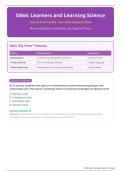
D664 "Big Three" Theories:
Theory Key Concepts Key Name
Behaviorism Conditioning, Rewards/Punishment Skinner, Pavlov
Constructivism ZPD, Scaffolding, Schemas Piaget, Vygotsky
Information Proc. Working Memory, Encoding, Retrieval Miller, Sweller
Cognitive Load Theory
Q1: A teacher simplifies the layout of a worksheet to remove distracting images and
unnecessary text. This action is primarily aimed at reducing which type of cognitive load?
A. Intrinsic Load
B. Extraneous Load
C. Germane Load
D. Sensory Load
Correct Answer: B
Rationale: Extraneous load is the mental effort spent on processing info that does not contribute to learning
(distractions). Reducing it helps free up working memory for the actual task.
WGU D664 Learning Science OA - Page 1
, Information Processing Model
Q2: According to the Information Processing Model, what is the best strategy for moving
information from short-term/working memory into long-term memory?
A. Maintenance Rehearsal
B. Sensory Buffering
C. Elaborative Rehearsal
D. Cognitive Dissonance
Correct Answer: C
Rationale: Elaborative rehearsal involves connecting new information to existing knowledge (schemas), which is
significantly more effective for encoding into long-term memory than rote repetition.
Constructivism - Piaget vs. Vygotsky
Q3: A teacher uses 'Scaffolding' to help a student solve a math problem that is just slightly
beyond their independent ability. This strategy is based on which of Vygotsky's concepts?
A. Cognitive Equilibrium
B. Zone of Proximal Development (ZPD)
C. Object Permanence
D. Formal Operational Stage
Correct Answer: B
Rationale: The ZPD is the distance between what a learner can do alone and what they can do with guidance.
Scaffolding is the support provided within that zone.
Metacognition
Q4: During a reading assignment, a student realizes they didn't understand the last
paragraph and decides to go back and re-read it. This 'thinking about thinking' is an
example of:
A. Self-Efficacy
B. Procedural Knowledge
C. Metacognition
D. Classical Conditioning
Correct Answer: C
Rationale: Metacognition involves monitoring, directing, and regulating one's own cognitive processes. Re-reading for
clarity is a metacognitive monitoring strategy.
WGU D664 Learning Science OA - Page 2
, Motivation - Growth Mindset
Q5: A student receives a low grade and says, 'I'm just not a math person.' According to
Carol Dweck, this student is demonstrating which of the following?
A. Growth Mindset
B. Fixed Mindset
C. Intrinsic Motivation
D. External Locus of Control
Correct Answer: B
Rationale: A fixed mindset is the belief that intelligence or abilities are static traits that cannot be significantly
changed. A growth mindset believes abilities can be developed through effort.
Cognitive Load Theory
Q6: A teacher simplifies the layout of a worksheet to remove distracting images and
unnecessary text. This action is primarily aimed at reducing which type of cognitive load?
A. Intrinsic Load
B. Extraneous Load
C. Germane Load
D. Sensory Load
Correct Answer: B
Rationale: Extraneous load is the mental effort spent on processing info that does not contribute to learning
(distractions). Reducing it helps free up working memory for the actual task.
Information Processing Model
Q7: According to the Information Processing Model, what is the best strategy for moving
information from short-term/working memory into long-term memory?
A. Maintenance Rehearsal
B. Sensory Buffering
C. Elaborative Rehearsal
D. Cognitive Dissonance
Correct Answer: C
Rationale: Elaborative rehearsal involves connecting new information to existing knowledge (schemas), which is
significantly more effective for encoding into long-term memory than rote repetition.
WGU D664 Learning Science OA - Page 3
, Constructivism - Piaget vs. Vygotsky
Q8: A teacher uses 'Scaffolding' to help a student solve a math problem that is just slightly
beyond their independent ability. This strategy is based on which of Vygotsky's concepts?
A. Cognitive Equilibrium
B. Zone of Proximal Development (ZPD)
C. Object Permanence
D. Formal Operational Stage
Correct Answer: B
Rationale: The ZPD is the distance between what a learner can do alone and what they can do with guidance.
Scaffolding is the support provided within that zone.
Metacognition
Q9: During a reading assignment, a student realizes they didn't understand the last
paragraph and decides to go back and re-read it. This 'thinking about thinking' is an
example of:
A. Self-Efficacy
B. Procedural Knowledge
C. Metacognition
D. Classical Conditioning
Correct Answer: C
Rationale: Metacognition involves monitoring, directing, and regulating one's own cognitive processes. Re-reading for
clarity is a metacognitive monitoring strategy.
Motivation - Growth Mindset
Q10: A student receives a low grade and says, 'I'm just not a math person.' According to
Carol Dweck, this student is demonstrating which of the following?
A. Growth Mindset
B. Fixed Mindset
C. Intrinsic Motivation
D. External Locus of Control
Correct Answer: B
Rationale: A fixed mindset is the belief that intelligence or abilities are static traits that cannot be significantly
changed. A growth mindset believes abilities can be developed through effort.
WGU D664 Learning Science OA - Page 4
2026 OA STUDY GUIDE | 350+ PRACTICE QUESTIONS
Mastering Memory, Motivation, and Cognitive Theory
D664 "Big Three" Theories:
Theory Key Concepts Key Name
Behaviorism Conditioning, Rewards/Punishment Skinner, Pavlov
Constructivism ZPD, Scaffolding, Schemas Piaget, Vygotsky
Information Proc. Working Memory, Encoding, Retrieval Miller, Sweller
Cognitive Load Theory
Q1: A teacher simplifies the layout of a worksheet to remove distracting images and
unnecessary text. This action is primarily aimed at reducing which type of cognitive load?
A. Intrinsic Load
B. Extraneous Load
C. Germane Load
D. Sensory Load
Correct Answer: B
Rationale: Extraneous load is the mental effort spent on processing info that does not contribute to learning
(distractions). Reducing it helps free up working memory for the actual task.
WGU D664 Learning Science OA - Page 1
, Information Processing Model
Q2: According to the Information Processing Model, what is the best strategy for moving
information from short-term/working memory into long-term memory?
A. Maintenance Rehearsal
B. Sensory Buffering
C. Elaborative Rehearsal
D. Cognitive Dissonance
Correct Answer: C
Rationale: Elaborative rehearsal involves connecting new information to existing knowledge (schemas), which is
significantly more effective for encoding into long-term memory than rote repetition.
Constructivism - Piaget vs. Vygotsky
Q3: A teacher uses 'Scaffolding' to help a student solve a math problem that is just slightly
beyond their independent ability. This strategy is based on which of Vygotsky's concepts?
A. Cognitive Equilibrium
B. Zone of Proximal Development (ZPD)
C. Object Permanence
D. Formal Operational Stage
Correct Answer: B
Rationale: The ZPD is the distance between what a learner can do alone and what they can do with guidance.
Scaffolding is the support provided within that zone.
Metacognition
Q4: During a reading assignment, a student realizes they didn't understand the last
paragraph and decides to go back and re-read it. This 'thinking about thinking' is an
example of:
A. Self-Efficacy
B. Procedural Knowledge
C. Metacognition
D. Classical Conditioning
Correct Answer: C
Rationale: Metacognition involves monitoring, directing, and regulating one's own cognitive processes. Re-reading for
clarity is a metacognitive monitoring strategy.
WGU D664 Learning Science OA - Page 2
, Motivation - Growth Mindset
Q5: A student receives a low grade and says, 'I'm just not a math person.' According to
Carol Dweck, this student is demonstrating which of the following?
A. Growth Mindset
B. Fixed Mindset
C. Intrinsic Motivation
D. External Locus of Control
Correct Answer: B
Rationale: A fixed mindset is the belief that intelligence or abilities are static traits that cannot be significantly
changed. A growth mindset believes abilities can be developed through effort.
Cognitive Load Theory
Q6: A teacher simplifies the layout of a worksheet to remove distracting images and
unnecessary text. This action is primarily aimed at reducing which type of cognitive load?
A. Intrinsic Load
B. Extraneous Load
C. Germane Load
D. Sensory Load
Correct Answer: B
Rationale: Extraneous load is the mental effort spent on processing info that does not contribute to learning
(distractions). Reducing it helps free up working memory for the actual task.
Information Processing Model
Q7: According to the Information Processing Model, what is the best strategy for moving
information from short-term/working memory into long-term memory?
A. Maintenance Rehearsal
B. Sensory Buffering
C. Elaborative Rehearsal
D. Cognitive Dissonance
Correct Answer: C
Rationale: Elaborative rehearsal involves connecting new information to existing knowledge (schemas), which is
significantly more effective for encoding into long-term memory than rote repetition.
WGU D664 Learning Science OA - Page 3
, Constructivism - Piaget vs. Vygotsky
Q8: A teacher uses 'Scaffolding' to help a student solve a math problem that is just slightly
beyond their independent ability. This strategy is based on which of Vygotsky's concepts?
A. Cognitive Equilibrium
B. Zone of Proximal Development (ZPD)
C. Object Permanence
D. Formal Operational Stage
Correct Answer: B
Rationale: The ZPD is the distance between what a learner can do alone and what they can do with guidance.
Scaffolding is the support provided within that zone.
Metacognition
Q9: During a reading assignment, a student realizes they didn't understand the last
paragraph and decides to go back and re-read it. This 'thinking about thinking' is an
example of:
A. Self-Efficacy
B. Procedural Knowledge
C. Metacognition
D. Classical Conditioning
Correct Answer: C
Rationale: Metacognition involves monitoring, directing, and regulating one's own cognitive processes. Re-reading for
clarity is a metacognitive monitoring strategy.
Motivation - Growth Mindset
Q10: A student receives a low grade and says, 'I'm just not a math person.' According to
Carol Dweck, this student is demonstrating which of the following?
A. Growth Mindset
B. Fixed Mindset
C. Intrinsic Motivation
D. External Locus of Control
Correct Answer: B
Rationale: A fixed mindset is the belief that intelligence or abilities are static traits that cannot be significantly
changed. A growth mindset believes abilities can be developed through effort.
WGU D664 Learning Science OA - Page 4


