

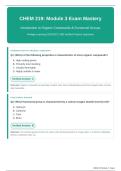
CHEM 219: Module 3 Exam Mastery
Introduction to Organic Compounds & Functional Groups
Portage Learning 2026/2027 | 500 Verified Practice Questions
INTRODUCTION TO ORGANIC CHEMISTRY
Q1: Which of the following properties is characteristic of most organic compounds?
A. High melting points
B. Primarily ionic bonding
C. Usually flammable
D. Highly soluble in water
Verified Answer: C
Rationale: Organic compounds are generally covalent, have lower melting/boiling points than inorganic salts, and are
often flammable.
FUNCTIONAL GROUPS
Q2: Which functional group is characterized by a carbon-oxygen double bond (C=O)?
A. Hydroxyl
B. Carbonyl
C. Thiol
D. Ether
Verified Answer: B
Rationale: The carbonyl group consists of a carbon atom double-bonded to an oxygen atom. It is found in aldehydes,
ketones, carboxylic acids, etc.
CHEM 219 Module 3 - Page 1
,NAMING FUNDAMENTALS
Q3: What is the IUPAC prefix for a parent carbon chain containing six carbon atoms?
A. Pent-
B. Hex-
C. Hept-
D. Oct-
Verified Answer: B
Rationale: Standard IUPAC prefixes: 1=meth, 2=eth, 3=prop, 4=but, 5=pent, 6=hex, 7=hept, 8=oct, 9=non, 10=dec.
ALKYL GROUPS
Q4: A substituent group consisting of a three-carbon chain attached at the middle
carbon is called a(n):
A. Propyl group
B. Isopropyl group
C. Butyl group
D. Ethyl group
Verified Answer: B
Rationale: An isopropyl group is an alkyl group derived from propane by removing a hydrogen atom from the central
carbon.
FUNCTIONAL GROUP IDENTIFICATION
Q5: Which of the following contains an Oxygen atom bonded to two carbon atoms (R-
O-R)?
A. Alcohol
B. Ester
C. Ether
D. Ketone
Verified Answer: C
Rationale: Ethers feature an oxygen atom connected to two alkyl or aryl groups.
CHEM 219 Module 3 - Page 2
,CLASSIFICATION OF CARBONS
Q6: A carbon atom that is bonded to only one other carbon atom is classified as:
A. Primary (1°)
B. Secondary (2°)
C. Tertiary (3°)
D. Quaternary (4°)
Verified Answer: A
Rationale: Primary carbons are bonded to one other carbon; secondary to two; tertiary to three; and quaternary to
four.
INTRODUCTION TO ORGANIC CHEMISTRY
Q7: Which of the following properties is characteristic of most organic compounds?
A. High melting points
B. Primarily ionic bonding
C. Usually flammable
D. Highly soluble in water
Verified Answer: C
Rationale: Organic compounds are generally covalent, have lower melting/boiling points than inorganic salts, and are
often flammable.
FUNCTIONAL GROUPS
Q8: Which functional group is characterized by a carbon-oxygen double bond (C=O)?
A. Hydroxyl
B. Carbonyl
C. Thiol
D. Ether
Verified Answer: B
Rationale: The carbonyl group consists of a carbon atom double-bonded to an oxygen atom. It is found in aldehydes,
ketones, carboxylic acids, etc.
CHEM 219 Module 3 - Page 3
, NAMING FUNDAMENTALS
Q9: What is the IUPAC prefix for a parent carbon chain containing six carbon atoms?
A. Pent-
B. Hex-
C. Hept-
D. Oct-
Verified Answer: B
Rationale: Standard IUPAC prefixes: 1=meth, 2=eth, 3=prop, 4=but, 5=pent, 6=hex, 7=hept, 8=oct, 9=non, 10=dec.
ALKYL GROUPS
Q10: A substituent group consisting of a three-carbon chain attached at the middle
carbon is called a(n):
A. Propyl group
B. Isopropyl group
C. Butyl group
D. Ethyl group
Verified Answer: B
Rationale: An isopropyl group is an alkyl group derived from propane by removing a hydrogen atom from the central
carbon.
FUNCTIONAL GROUP IDENTIFICATION
Q11: Which of the following contains an Oxygen atom bonded to two carbon atoms (R-
O-R)?
A. Alcohol
B. Ester
C. Ether
D. Ketone
Verified Answer: C
Rationale: Ethers feature an oxygen atom connected to two alkyl or aryl groups.
CHEM 219 Module 3 - Page 4
Introduction to Organic Compounds & Functional Groups
Portage Learning 2026/2027 | 500 Verified Practice Questions
INTRODUCTION TO ORGANIC CHEMISTRY
Q1: Which of the following properties is characteristic of most organic compounds?
A. High melting points
B. Primarily ionic bonding
C. Usually flammable
D. Highly soluble in water
Verified Answer: C
Rationale: Organic compounds are generally covalent, have lower melting/boiling points than inorganic salts, and are
often flammable.
FUNCTIONAL GROUPS
Q2: Which functional group is characterized by a carbon-oxygen double bond (C=O)?
A. Hydroxyl
B. Carbonyl
C. Thiol
D. Ether
Verified Answer: B
Rationale: The carbonyl group consists of a carbon atom double-bonded to an oxygen atom. It is found in aldehydes,
ketones, carboxylic acids, etc.
CHEM 219 Module 3 - Page 1
,NAMING FUNDAMENTALS
Q3: What is the IUPAC prefix for a parent carbon chain containing six carbon atoms?
A. Pent-
B. Hex-
C. Hept-
D. Oct-
Verified Answer: B
Rationale: Standard IUPAC prefixes: 1=meth, 2=eth, 3=prop, 4=but, 5=pent, 6=hex, 7=hept, 8=oct, 9=non, 10=dec.
ALKYL GROUPS
Q4: A substituent group consisting of a three-carbon chain attached at the middle
carbon is called a(n):
A. Propyl group
B. Isopropyl group
C. Butyl group
D. Ethyl group
Verified Answer: B
Rationale: An isopropyl group is an alkyl group derived from propane by removing a hydrogen atom from the central
carbon.
FUNCTIONAL GROUP IDENTIFICATION
Q5: Which of the following contains an Oxygen atom bonded to two carbon atoms (R-
O-R)?
A. Alcohol
B. Ester
C. Ether
D. Ketone
Verified Answer: C
Rationale: Ethers feature an oxygen atom connected to two alkyl or aryl groups.
CHEM 219 Module 3 - Page 2
,CLASSIFICATION OF CARBONS
Q6: A carbon atom that is bonded to only one other carbon atom is classified as:
A. Primary (1°)
B. Secondary (2°)
C. Tertiary (3°)
D. Quaternary (4°)
Verified Answer: A
Rationale: Primary carbons are bonded to one other carbon; secondary to two; tertiary to three; and quaternary to
four.
INTRODUCTION TO ORGANIC CHEMISTRY
Q7: Which of the following properties is characteristic of most organic compounds?
A. High melting points
B. Primarily ionic bonding
C. Usually flammable
D. Highly soluble in water
Verified Answer: C
Rationale: Organic compounds are generally covalent, have lower melting/boiling points than inorganic salts, and are
often flammable.
FUNCTIONAL GROUPS
Q8: Which functional group is characterized by a carbon-oxygen double bond (C=O)?
A. Hydroxyl
B. Carbonyl
C. Thiol
D. Ether
Verified Answer: B
Rationale: The carbonyl group consists of a carbon atom double-bonded to an oxygen atom. It is found in aldehydes,
ketones, carboxylic acids, etc.
CHEM 219 Module 3 - Page 3
, NAMING FUNDAMENTALS
Q9: What is the IUPAC prefix for a parent carbon chain containing six carbon atoms?
A. Pent-
B. Hex-
C. Hept-
D. Oct-
Verified Answer: B
Rationale: Standard IUPAC prefixes: 1=meth, 2=eth, 3=prop, 4=but, 5=pent, 6=hex, 7=hept, 8=oct, 9=non, 10=dec.
ALKYL GROUPS
Q10: A substituent group consisting of a three-carbon chain attached at the middle
carbon is called a(n):
A. Propyl group
B. Isopropyl group
C. Butyl group
D. Ethyl group
Verified Answer: B
Rationale: An isopropyl group is an alkyl group derived from propane by removing a hydrogen atom from the central
carbon.
FUNCTIONAL GROUP IDENTIFICATION
Q11: Which of the following contains an Oxygen atom bonded to two carbon atoms (R-
O-R)?
A. Alcohol
B. Ester
C. Ether
D. Ketone
Verified Answer: C
Rationale: Ethers feature an oxygen atom connected to two alkyl or aryl groups.
CHEM 219 Module 3 - Page 4


