

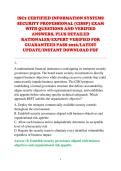
ISC2 CERTIFIED INFORMATION SYSTEMS
SECURITY PROFESSIONAL (CISSP) EXAM
WITH QUESTIONS AND VERIFIED
ANSWERS, PLUS DETAILED
RATIONALES/EXPERT VERIFIED FOR
GUARANTEED PASS 2026/LATEST
UPDATE/INSTANT DOWNLOAD PDF
1.
A multinational financial institution is redesigning its enterprise security
governance program. The board wants security investments to directly
support business objectives while avoiding excessive controls that could
unnecessarily impede business operations. The CISO proposes
establishing a formal governance structure that defines accountability,
aligns security objectives with organizational strategy, and establishes
risk appetite before selecting specific technical safeguards. Which
approach BEST satisfies the organization's objective?
A. Deploy the strongest commercially available security controls
throughout the environment
B. Establish security governance aligned with business objectives and
organizational risk appetite
C. Allow each business unit to independently determine its acceptable
level of cybersecurity risk
D. Require the security team to eliminate every identified vulnerability
regardless of business impact
Answer: B. Establish security governance aligned with business
objectives and organizational risk appetite
1
,Rationale: Security governance establishes the direction,
accountability, authority, and decision-making structure through
which security supports organizational objectives. A mature CISSP
approach begins with business requirements and risk appetite rather
than immediately selecting technologies. Option A may create
excessive cost and operational friction. Option C creates inconsistent
enterprise risk management. Option D is unrealistic because risk
cannot normally be reduced to zero and resources must be prioritized
according to business impact.
2.
A company identifies a critical database vulnerability that could expose
confidential customer information. Management determines that
remediation would cost $2 million, while the expected annualized loss
from the vulnerability is approximately $300,000. The organization has
strong financial reserves and determines that the risk is within its
established risk appetite. Which risk response is MOST appropriate?
A. Risk avoidance
B. Risk transfer
C. Risk acceptance
D. Risk elimination
Answer: C. Risk acceptance
Rationale: Risk acceptance occurs when management knowingly
decides to retain a risk after evaluating its likelihood, impact, cost of
treatment, and alignment with risk appetite. The decision must be
made by appropriate management authority, not simply by the security
administrator. Risk avoidance would involve eliminating the activity
causing the risk. Risk transfer shifts some financial consequences to
another party, such as through insurance or contractual
arrangements. "Risk elimination" is generally not a practical
2
,universal response because many organizational risks cannot be
completely eliminated.
3.
During a business impact analysis, a payment-processing application is
determined to support critical revenue-generating operations. Business
executives state that the application cannot be unavailable for more than
four hours without causing severe financial and reputational
consequences. Which metric BEST represents this requirement?
A. Recovery point objective
B. Recovery time objective
C. Maximum tolerable downtime
D. Mean time between failures
Answer: B. Recovery time objective
Rationale: Recovery Time Objective (RTO) represents the targeted
maximum amount of time required to restore a service or system
following disruption. If the business requires restoration within four
hours, the RTO is four hours or less. Recovery Point Objective (RPO)
addresses how much data loss, measured in time, the organization can
tolerate. Maximum Tolerable Downtime (MTD) represents the
maximum period a business process can be unavailable before
unacceptable consequences occur and is generally a broader business
requirement than the operational restoration target.
4.
A security manager discovers that a terminated administrator still has
active privileged credentials. The manager immediately disables the
account and then reviews whether the organization's personnel
3
, termination process consistently removes access. Which principle BEST
explains the reason for establishing such a process?
A. Separation of duties
B. Least privilege
C. Personnel security lifecycle management
D. Mandatory access control
Answer: C. Personnel security lifecycle management
Rationale: Personnel security includes controls associated with hiring,
onboarding, transfers, role changes, termination, and post-
employment activities. Timely account deprovisioning is critical
because terminated employees may retain unnecessary access if
identity lifecycle processes are weak. Least privilege determines the
minimum permissions a user should have, while separation of duties
divides sensitive responsibilities among multiple individuals.
Mandatory access control concerns centrally enforced authorization
based on security labels or classifications.
5.
An organization is evaluating a new third-party cloud provider that will
process sensitive corporate information. The security team wants to
ensure that risks associated with the provider's software, infrastructure,
subcontractors, and supply chain are addressed before signing the
contract. Which action is MOST appropriate?
A. Perform a third-party risk assessment and establish contractual
security requirements
B. Rely entirely on the provider's marketing documentation
C. Require the provider to eliminate every possible cybersecurity
vulnerability
D. Allow the provider to define the organization's risk appetite
4
SECURITY PROFESSIONAL (CISSP) EXAM
WITH QUESTIONS AND VERIFIED
ANSWERS, PLUS DETAILED
RATIONALES/EXPERT VERIFIED FOR
GUARANTEED PASS 2026/LATEST
UPDATE/INSTANT DOWNLOAD PDF
1.
A multinational financial institution is redesigning its enterprise security
governance program. The board wants security investments to directly
support business objectives while avoiding excessive controls that could
unnecessarily impede business operations. The CISO proposes
establishing a formal governance structure that defines accountability,
aligns security objectives with organizational strategy, and establishes
risk appetite before selecting specific technical safeguards. Which
approach BEST satisfies the organization's objective?
A. Deploy the strongest commercially available security controls
throughout the environment
B. Establish security governance aligned with business objectives and
organizational risk appetite
C. Allow each business unit to independently determine its acceptable
level of cybersecurity risk
D. Require the security team to eliminate every identified vulnerability
regardless of business impact
Answer: B. Establish security governance aligned with business
objectives and organizational risk appetite
1
,Rationale: Security governance establishes the direction,
accountability, authority, and decision-making structure through
which security supports organizational objectives. A mature CISSP
approach begins with business requirements and risk appetite rather
than immediately selecting technologies. Option A may create
excessive cost and operational friction. Option C creates inconsistent
enterprise risk management. Option D is unrealistic because risk
cannot normally be reduced to zero and resources must be prioritized
according to business impact.
2.
A company identifies a critical database vulnerability that could expose
confidential customer information. Management determines that
remediation would cost $2 million, while the expected annualized loss
from the vulnerability is approximately $300,000. The organization has
strong financial reserves and determines that the risk is within its
established risk appetite. Which risk response is MOST appropriate?
A. Risk avoidance
B. Risk transfer
C. Risk acceptance
D. Risk elimination
Answer: C. Risk acceptance
Rationale: Risk acceptance occurs when management knowingly
decides to retain a risk after evaluating its likelihood, impact, cost of
treatment, and alignment with risk appetite. The decision must be
made by appropriate management authority, not simply by the security
administrator. Risk avoidance would involve eliminating the activity
causing the risk. Risk transfer shifts some financial consequences to
another party, such as through insurance or contractual
arrangements. "Risk elimination" is generally not a practical
2
,universal response because many organizational risks cannot be
completely eliminated.
3.
During a business impact analysis, a payment-processing application is
determined to support critical revenue-generating operations. Business
executives state that the application cannot be unavailable for more than
four hours without causing severe financial and reputational
consequences. Which metric BEST represents this requirement?
A. Recovery point objective
B. Recovery time objective
C. Maximum tolerable downtime
D. Mean time between failures
Answer: B. Recovery time objective
Rationale: Recovery Time Objective (RTO) represents the targeted
maximum amount of time required to restore a service or system
following disruption. If the business requires restoration within four
hours, the RTO is four hours or less. Recovery Point Objective (RPO)
addresses how much data loss, measured in time, the organization can
tolerate. Maximum Tolerable Downtime (MTD) represents the
maximum period a business process can be unavailable before
unacceptable consequences occur and is generally a broader business
requirement than the operational restoration target.
4.
A security manager discovers that a terminated administrator still has
active privileged credentials. The manager immediately disables the
account and then reviews whether the organization's personnel
3
, termination process consistently removes access. Which principle BEST
explains the reason for establishing such a process?
A. Separation of duties
B. Least privilege
C. Personnel security lifecycle management
D. Mandatory access control
Answer: C. Personnel security lifecycle management
Rationale: Personnel security includes controls associated with hiring,
onboarding, transfers, role changes, termination, and post-
employment activities. Timely account deprovisioning is critical
because terminated employees may retain unnecessary access if
identity lifecycle processes are weak. Least privilege determines the
minimum permissions a user should have, while separation of duties
divides sensitive responsibilities among multiple individuals.
Mandatory access control concerns centrally enforced authorization
based on security labels or classifications.
5.
An organization is evaluating a new third-party cloud provider that will
process sensitive corporate information. The security team wants to
ensure that risks associated with the provider's software, infrastructure,
subcontractors, and supply chain are addressed before signing the
contract. Which action is MOST appropriate?
A. Perform a third-party risk assessment and establish contractual
security requirements
B. Rely entirely on the provider's marketing documentation
C. Require the provider to eliminate every possible cybersecurity
vulnerability
D. Allow the provider to define the organization's risk appetite
4


