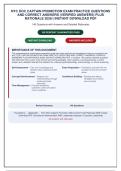
NYC DOC CAPTAIN PROMOTION EXAM PRACTICE QUESTIONS
AND CORRECT ANSWERS (VERIFIED ANSWERS) PLUS
RATIONALE 2026/| INSTANT DOWNLOAD PDF
140 Questions with Answers and Detailed Rationales
100 PERCENT GUARANTEED PASS
INSTANT DOWNLOAD ANSWERS INCLUDED
IMPORTANCE OF THIS DOCUMENT
This comprehensive examination preparation guide has been meticulously developed to help you succeed in the
NYC DOC CAPTAIN PROMOTION EXAM PRACTICE QUESTIONS AND CORRECT ANSWERS (VERIFIED
ANSWERS) PLUS RATIONALE 2026/| INSTANT DOWNLOAD PDF. It contains 140 carefully selected questions
that reflect the most current exam content and testing strategies. Each question is accompanied by a correct
answer and a detailed rationale that explains the underlying pathophysiology, pharmacology, or clinical reasoning.
Self-Assessment – Test your knowledge and Exam Preparation – Familiarize yourself with the
identify areas requiring further question format and content
study areas
Concept Reinforcement – Deepen your Confidence Building – Develop test-taking
understanding through strategies and reduce
evidence-based exam anxiety
rationales
Time Management – Practice answering
questions under simulated
exam conditions
Review Summary 140 Questions
Foundations - Application - NYC DOC Captain Promotion AND Correct PLUS Rationale 2026/ Instant
Download PDF Correctional Administration AND Leadership Graduate / Executive Leadership
All answers with rationales
,Table of Contents
Content Area Questions Key Topics
Supervision AND 1-24 Captain, Housing, Inmate, Use-of-force, Officer
Management
Personnel Management AND 25-48 Captain, Officer, Inmate, Legal, Housing
Labor Relations
Security AND Emergency 49-72 Captain, Officer, Force, Inmate, Policy
Response
Investigations AND Incident 73-96 Captain, Inmate, Officer, Force, Legal
Command
USE OF Force AND Legal 97-120 Captain, Principle, Officer, Effective, NYC DOC
Issues
Training AND Staff 121-140 Captain, Force, Policy, Officer S, Determining
Development
TOTAL 140 All questions include answers and detailed rationales
,Section A - Supervision AND Management
Q1.
During a facility-wide lockdown, an officer reports an inmate with a suspected overdose.
The inmate is unresponsive but breathing. According to the latest NYCDOC protocols,
what is the captain's immediate priority?
A. Initiate emergency medical response and B. Wait for medical staff to arrive before any
provide Narcan if available. intervention.
C. Move the inmate to the infirmary before D. Complete incident paperwork before
assessment. addressing the medical emergency.
Correct: A - Initiate emergency medical response and provide Narcan if available.
Rationale:The immediate priority is life safety; initiating emergency medical response and
administering Narcan for suspected opioid overdose aligns with current protocols and saves
lives. Delaying intervention (B) or moving the inmate (C) can worsen outcomes. Paperwork
(D) is secondary to medical emergency.
Why the other answers are wrong:
B. Waiting for medical staff without initiating first aid delays critical intervention and violates
duty to act.
C. Moving an unresponsive inmate before medical assessment can exacerbate injuries and is
against protocol.
D. Administrative tasks are subordinate to immediate life-saving measures.
Reference: NYCDOC Health Services Division, Opioid Overdose Response Protocol (2025).
Q2.
A captain receives a grievance from a union delegate alleging that a new post order
violates the collective bargaining agreement. What is the captain's best course of action?
A. Immediately rescind the post order to B. Acknowledge receipt, review the order,
avoid litigation. and consult with labor relations.
C. Ignore the grievance as it is not formally D. Discipline the delegate for
filed. insubordination.
Correct: B - Acknowledge receipt, review the order, and consult with labor relations.
Rationale:Proper handling involves acknowledging the grievance, reviewing the contested
order, and consulting labor relations to ensure compliance with the CBA. Rescinding without
review (A) undermines authority; ignoring (C) escalates issues; disciplining (D) is retaliatory
and unlawful.
Why the other answers are wrong:
Page 3
, Section A - Supervision AND Management
A. Unilateral rescission without review may be hasty and undermine operational needs.
C. Ignoring grievances can lead to unfair labor practice charges and increased tensions.
D. Discipline for filing a grievance is prohibited retaliation.
Reference: NYCDOC Labor Relations Manual, Grievance Procedures (2026).
Q3.
During a hostage negotiation, the captain must balance the safety of hostages and the
need to maintain security. Which principle is paramount in this situation?
A. Use of tactical intervention as soon as B. Containment and time as allies.
possible.
C. Immediate compliance with hostage taker D. Isolation of the incident to prevent media
demands. coverage.
Correct: B - Containment and time as allies.
Rationale:In hostage situations, time and containment are key strategies that allow for
de-escalation and negotiation, reducing risk to hostages. Immediate tactical intervention (A)
can increase danger; capitulation (C) encourages future incidents; isolation (D) is not a
primary safety principle.
Why the other answers are wrong:
A. Rushing tactical intervention can lead to casualties and is a last resort.
C. Giving in to demands sets a dangerous precedent and may not guarantee safety.
D. Media management is secondary to the safety of hostages and staff.
Reference: NYPD/NYCDOC Hostage Negotiation Guidelines (2025).
Q4.
A captain is reviewing the use of force reports after a cell extraction. Which factor is most
critical in determining whether the force used was reasonable?
A. The severity of the inmate's initial B. The inmate's prior disciplinary history.
offense.
C. The threat posed by the inmate at the D. The number of officers involved in the
moment of force. extraction.
Correct: C - The threat posed by the inmate at the moment of force.
Rationale:Reasonableness of force is judged based on the immediate threat perceived by the
officer, per Graham v. Connor. Prior history (B) and the initial offense (A) do not justify force if
no immediate threat exists. The number of officers (D) is not a primary factor.
Why the other answers are wrong:
A. The initial offense is not a direct indicator of the threat at the moment force is used.
B. Prior history is not sufficient to establish reasonableness without an immediate threat.
Page 4
AND CORRECT ANSWERS (VERIFIED ANSWERS) PLUS
RATIONALE 2026/| INSTANT DOWNLOAD PDF
140 Questions with Answers and Detailed Rationales
100 PERCENT GUARANTEED PASS
INSTANT DOWNLOAD ANSWERS INCLUDED
IMPORTANCE OF THIS DOCUMENT
This comprehensive examination preparation guide has been meticulously developed to help you succeed in the
NYC DOC CAPTAIN PROMOTION EXAM PRACTICE QUESTIONS AND CORRECT ANSWERS (VERIFIED
ANSWERS) PLUS RATIONALE 2026/| INSTANT DOWNLOAD PDF. It contains 140 carefully selected questions
that reflect the most current exam content and testing strategies. Each question is accompanied by a correct
answer and a detailed rationale that explains the underlying pathophysiology, pharmacology, or clinical reasoning.
Self-Assessment – Test your knowledge and Exam Preparation – Familiarize yourself with the
identify areas requiring further question format and content
study areas
Concept Reinforcement – Deepen your Confidence Building – Develop test-taking
understanding through strategies and reduce
evidence-based exam anxiety
rationales
Time Management – Practice answering
questions under simulated
exam conditions
Review Summary 140 Questions
Foundations - Application - NYC DOC Captain Promotion AND Correct PLUS Rationale 2026/ Instant
Download PDF Correctional Administration AND Leadership Graduate / Executive Leadership
All answers with rationales
,Table of Contents
Content Area Questions Key Topics
Supervision AND 1-24 Captain, Housing, Inmate, Use-of-force, Officer
Management
Personnel Management AND 25-48 Captain, Officer, Inmate, Legal, Housing
Labor Relations
Security AND Emergency 49-72 Captain, Officer, Force, Inmate, Policy
Response
Investigations AND Incident 73-96 Captain, Inmate, Officer, Force, Legal
Command
USE OF Force AND Legal 97-120 Captain, Principle, Officer, Effective, NYC DOC
Issues
Training AND Staff 121-140 Captain, Force, Policy, Officer S, Determining
Development
TOTAL 140 All questions include answers and detailed rationales
,Section A - Supervision AND Management
Q1.
During a facility-wide lockdown, an officer reports an inmate with a suspected overdose.
The inmate is unresponsive but breathing. According to the latest NYCDOC protocols,
what is the captain's immediate priority?
A. Initiate emergency medical response and B. Wait for medical staff to arrive before any
provide Narcan if available. intervention.
C. Move the inmate to the infirmary before D. Complete incident paperwork before
assessment. addressing the medical emergency.
Correct: A - Initiate emergency medical response and provide Narcan if available.
Rationale:The immediate priority is life safety; initiating emergency medical response and
administering Narcan for suspected opioid overdose aligns with current protocols and saves
lives. Delaying intervention (B) or moving the inmate (C) can worsen outcomes. Paperwork
(D) is secondary to medical emergency.
Why the other answers are wrong:
B. Waiting for medical staff without initiating first aid delays critical intervention and violates
duty to act.
C. Moving an unresponsive inmate before medical assessment can exacerbate injuries and is
against protocol.
D. Administrative tasks are subordinate to immediate life-saving measures.
Reference: NYCDOC Health Services Division, Opioid Overdose Response Protocol (2025).
Q2.
A captain receives a grievance from a union delegate alleging that a new post order
violates the collective bargaining agreement. What is the captain's best course of action?
A. Immediately rescind the post order to B. Acknowledge receipt, review the order,
avoid litigation. and consult with labor relations.
C. Ignore the grievance as it is not formally D. Discipline the delegate for
filed. insubordination.
Correct: B - Acknowledge receipt, review the order, and consult with labor relations.
Rationale:Proper handling involves acknowledging the grievance, reviewing the contested
order, and consulting labor relations to ensure compliance with the CBA. Rescinding without
review (A) undermines authority; ignoring (C) escalates issues; disciplining (D) is retaliatory
and unlawful.
Why the other answers are wrong:
Page 3
, Section A - Supervision AND Management
A. Unilateral rescission without review may be hasty and undermine operational needs.
C. Ignoring grievances can lead to unfair labor practice charges and increased tensions.
D. Discipline for filing a grievance is prohibited retaliation.
Reference: NYCDOC Labor Relations Manual, Grievance Procedures (2026).
Q3.
During a hostage negotiation, the captain must balance the safety of hostages and the
need to maintain security. Which principle is paramount in this situation?
A. Use of tactical intervention as soon as B. Containment and time as allies.
possible.
C. Immediate compliance with hostage taker D. Isolation of the incident to prevent media
demands. coverage.
Correct: B - Containment and time as allies.
Rationale:In hostage situations, time and containment are key strategies that allow for
de-escalation and negotiation, reducing risk to hostages. Immediate tactical intervention (A)
can increase danger; capitulation (C) encourages future incidents; isolation (D) is not a
primary safety principle.
Why the other answers are wrong:
A. Rushing tactical intervention can lead to casualties and is a last resort.
C. Giving in to demands sets a dangerous precedent and may not guarantee safety.
D. Media management is secondary to the safety of hostages and staff.
Reference: NYPD/NYCDOC Hostage Negotiation Guidelines (2025).
Q4.
A captain is reviewing the use of force reports after a cell extraction. Which factor is most
critical in determining whether the force used was reasonable?
A. The severity of the inmate's initial B. The inmate's prior disciplinary history.
offense.
C. The threat posed by the inmate at the D. The number of officers involved in the
moment of force. extraction.
Correct: C - The threat posed by the inmate at the moment of force.
Rationale:Reasonableness of force is judged based on the immediate threat perceived by the
officer, per Graham v. Connor. Prior history (B) and the initial offense (A) do not justify force if
no immediate threat exists. The number of officers (D) is not a primary factor.
Why the other answers are wrong:
A. The initial offense is not a direct indicator of the threat at the moment force is used.
B. Prior history is not sufficient to establish reasonableness without an immediate threat.
Page 4