

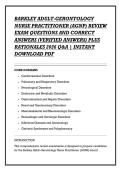
BARKLEY ADULT-GERONTOLOGY
NURSE PRACTITIONER (AGNP) REVIEW
EXAM QUESTIONS AND CORRECT
ANSWERS (VERIFIED ANSWERS) PLUS
RATIONALES 2026 Q&A | INSTANT
DOWNLOAD PDF
CORE DOMAINS
• Cardiovascular Disorders
• Pulmonary and Respiratory Disorders
• Neurological Disorders
• Endocrine and Metabolic Disorders
• Gastrointestinal and Hepatic Disorders
• Renal and Genitourinary Disorders
• Musculoskeletal and Rheumatologic Disorders
• Hematologic and Oncologic Disorders
• Infectious Diseases and Immunology
• Geriatric Syndromes and Polypharmacy
INTRODUCTION
This comprehensive review examination is designed to prepare candidates
for the Barkley Adult-Gerontology Nurse Practitioner (AGNP) board
,certification examination, which assesses advanced practice nursing
competence in primary and acute care for adult and geriatric populations.
The test covers the full spectrum of adult-gerontology practice including
chronic disease management, health promotion, disease prevention, and
management of acute and complex conditions. Questions are structured to
reflect the clinical reasoning, diagnostic decision-making, and evidence-
based practice required in primary care, outpatient clinics, and long-term
care settings. Emphasis is placed on comprehensive assessment,
differential diagnosis, pharmacologic and non-pharmacologic
interventions, and patient-centered care across the adult lifespan.
Successful completion of this practice test indicates readiness for board
certification and entry into advanced nursing practice with adult and
geriatric populations.
SECTION ONE: QUESTIONS 1–100
Question 1
A 72-year-old patient presents with a blood pressure of 152/92 mmHg
on two separate visits. The patient has no history of cardiovascular
disease and has no target organ damage. According to the JNC-8
guidelines, what is the most appropriate initial treatment target?
A. Blood pressure < 120/80 mmHg
B. Blood pressure < 130/80 mmHg
C. Blood pressure < 140/90 mmHg
D. Blood pressure < 150/90 mmHg
D. Blood pressure < 150/90 mmHg
RATIONALE: According to JNC-8 guidelines, the recommended
blood pressure target for adults aged 60 years and older is less than
150/90 mmHg. This recommendation is based on evidence that
aggressive targets in older adults may lead to adverse effects without
,additional cardiovascular benefit. The target for younger adults is <
140/90 mmHg.
Question 2
A 65-year-old patient with type 2 diabetes mellitus presents with a
fasting blood glucose of 168 mg/dL and HbA1c of 8.5%. The patient is
currently on metformin 1000 mg twice daily. Which medication should
the AGNP add as second-line therapy?
A. Insulin glargine
B. Sulfonylurea
C. DPP-4 inhibitor
D. SGLT2 inhibitor
D. SGLT2 inhibitor
RATIONALE: SGLT2 inhibitors (such as empagliflozin, canagliflozin)
are recommended as second-line therapy in patients with type 2
diabetes, especially those with established cardiovascular disease or
multiple risk factors, due to their cardiovascular and renal protective
benefits. They also have a lower risk of hypoglycemia compared to
sulfonylureas and insulin.
Question 3
A 70-year-old patient with a history of COPD presents with worsening
dyspnea, increased sputum production, and a fever. The patient is
coughing up purulent sputum. Which antibiotic is most appropriate for
empiric treatment of acute exacerbation of COPD?
A. Azithromycin
B. Doxycycline
C. Amoxicillin-clavulanate
D. Levofloxacin
, C. Amoxicillin-clavulanate
RATIONALE: For acute exacerbation of COPD with purulent sputum
and increased dyspnea, amoxicillin-clavulanate provides adequate
coverage for common pathogens including Streptococcus pneumoniae,
Haemophilus influenzae, and Moraxella catarrhalis. Levofloxacin may be
used but has higher resistance rates and side effects. Azithromycin and
doxycycline are alternative options but less broad-spectrum.
Question 4
A 62-year-old patient presents with new onset of rest tremor, rigidity,
and bradykinesia. The patient reports difficulty with fine motor tasks and
a shuffling gait. What is the first-line medication for symptomatic
treatment of Parkinson's disease in this patient?
A. Levodopa-carbidopa
B. Pramipexole
C. Selegiline
D. Benztropine
A. Levodopa-carbidopa
RATIONALE: Levodopa-carbidopa is the most effective first-line
medication for symptomatic treatment of Parkinson's disease,
particularly in patients with significant functional impairment. Dopamine
agonists (pramipexole) may be used in younger patients with milder
symptoms to delay levodopa use. Selegiline is an MAO-B inhibitor with
modest benefit. Benztropine is used for tremor in younger patients.
Question 5
A 68-year-old patient with a history of heart failure presents with
progressive dyspnea, orthopnea, and lower extremity edema. The
NURSE PRACTITIONER (AGNP) REVIEW
EXAM QUESTIONS AND CORRECT
ANSWERS (VERIFIED ANSWERS) PLUS
RATIONALES 2026 Q&A | INSTANT
DOWNLOAD PDF
CORE DOMAINS
• Cardiovascular Disorders
• Pulmonary and Respiratory Disorders
• Neurological Disorders
• Endocrine and Metabolic Disorders
• Gastrointestinal and Hepatic Disorders
• Renal and Genitourinary Disorders
• Musculoskeletal and Rheumatologic Disorders
• Hematologic and Oncologic Disorders
• Infectious Diseases and Immunology
• Geriatric Syndromes and Polypharmacy
INTRODUCTION
This comprehensive review examination is designed to prepare candidates
for the Barkley Adult-Gerontology Nurse Practitioner (AGNP) board
,certification examination, which assesses advanced practice nursing
competence in primary and acute care for adult and geriatric populations.
The test covers the full spectrum of adult-gerontology practice including
chronic disease management, health promotion, disease prevention, and
management of acute and complex conditions. Questions are structured to
reflect the clinical reasoning, diagnostic decision-making, and evidence-
based practice required in primary care, outpatient clinics, and long-term
care settings. Emphasis is placed on comprehensive assessment,
differential diagnosis, pharmacologic and non-pharmacologic
interventions, and patient-centered care across the adult lifespan.
Successful completion of this practice test indicates readiness for board
certification and entry into advanced nursing practice with adult and
geriatric populations.
SECTION ONE: QUESTIONS 1–100
Question 1
A 72-year-old patient presents with a blood pressure of 152/92 mmHg
on two separate visits. The patient has no history of cardiovascular
disease and has no target organ damage. According to the JNC-8
guidelines, what is the most appropriate initial treatment target?
A. Blood pressure < 120/80 mmHg
B. Blood pressure < 130/80 mmHg
C. Blood pressure < 140/90 mmHg
D. Blood pressure < 150/90 mmHg
D. Blood pressure < 150/90 mmHg
RATIONALE: According to JNC-8 guidelines, the recommended
blood pressure target for adults aged 60 years and older is less than
150/90 mmHg. This recommendation is based on evidence that
aggressive targets in older adults may lead to adverse effects without
,additional cardiovascular benefit. The target for younger adults is <
140/90 mmHg.
Question 2
A 65-year-old patient with type 2 diabetes mellitus presents with a
fasting blood glucose of 168 mg/dL and HbA1c of 8.5%. The patient is
currently on metformin 1000 mg twice daily. Which medication should
the AGNP add as second-line therapy?
A. Insulin glargine
B. Sulfonylurea
C. DPP-4 inhibitor
D. SGLT2 inhibitor
D. SGLT2 inhibitor
RATIONALE: SGLT2 inhibitors (such as empagliflozin, canagliflozin)
are recommended as second-line therapy in patients with type 2
diabetes, especially those with established cardiovascular disease or
multiple risk factors, due to their cardiovascular and renal protective
benefits. They also have a lower risk of hypoglycemia compared to
sulfonylureas and insulin.
Question 3
A 70-year-old patient with a history of COPD presents with worsening
dyspnea, increased sputum production, and a fever. The patient is
coughing up purulent sputum. Which antibiotic is most appropriate for
empiric treatment of acute exacerbation of COPD?
A. Azithromycin
B. Doxycycline
C. Amoxicillin-clavulanate
D. Levofloxacin
, C. Amoxicillin-clavulanate
RATIONALE: For acute exacerbation of COPD with purulent sputum
and increased dyspnea, amoxicillin-clavulanate provides adequate
coverage for common pathogens including Streptococcus pneumoniae,
Haemophilus influenzae, and Moraxella catarrhalis. Levofloxacin may be
used but has higher resistance rates and side effects. Azithromycin and
doxycycline are alternative options but less broad-spectrum.
Question 4
A 62-year-old patient presents with new onset of rest tremor, rigidity,
and bradykinesia. The patient reports difficulty with fine motor tasks and
a shuffling gait. What is the first-line medication for symptomatic
treatment of Parkinson's disease in this patient?
A. Levodopa-carbidopa
B. Pramipexole
C. Selegiline
D. Benztropine
A. Levodopa-carbidopa
RATIONALE: Levodopa-carbidopa is the most effective first-line
medication for symptomatic treatment of Parkinson's disease,
particularly in patients with significant functional impairment. Dopamine
agonists (pramipexole) may be used in younger patients with milder
symptoms to delay levodopa use. Selegiline is an MAO-B inhibitor with
modest benefit. Benztropine is used for tremor in younger patients.
Question 5
A 68-year-old patient with a history of heart failure presents with
progressive dyspnea, orthopnea, and lower extremity edema. The


