
BIOC 384 Final Exam Prep 2026/2027 | Questions & Correct
Answers | Graded A+
1. What is the formula used to calculate the energy charge of a cell?
Energy Charge = [ATP] - [ADP] + [AMP]
Energy Charge = ([ATP] + 0.5[ADP]) / ([ATP] + [ADP] + [AMP])
Energy Charge = [ATP] + [ADP] + [AMP]
Energy Charge = [ATP] / ([ATP] + [ADP])
2. Describe the significance of the denaturation phase in the PCR process.
The denaturation phase is crucial as it separates the double-
stranded DNA into single strands, allowing primers to bind.
The denaturation phase is where the DNA is amplified.
The denaturation phase allows for the synthesis of new DNA strands.
The denaturation phase stabilizes the DNA structure for replication.
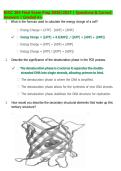
3. How would you describe the secondary structural elements that make up this
tertiary structure?
, Domains of alpha helix adjacent to domains of beta sheets
Intermixed alpha helix and beta sheets
Predominantly beta sheets
Predominantly alpha helix
4. What is the primary application of plasmids in molecular biology?
gene cloning
cell movement
replication of nucleus
production of chromatin
5. Describe the relationship between hydrogen ion concentration and pH in a
solution.
As the concentration of hydrogen ions increases, the pH of the
solution decreases.
pH is always a positive value regardless of hydrogen ion
concentration.
As the concentration of hydrogen ions increases, the pH of the
solution increases.
Hydrogen ion concentration and pH are unrelated.
6. What did Chargaff's rules reveal about the base composition of DNA?
The number of A = the number of T and the number of G = the
number of C
The number of A + T = the number of G + C
The number of A + G + T + C = 100%
, The number of A + G = the number of T + C
7. What is the structure formed by the packing of nucleosomes in eukaryotic
cells?
histones
chromosomes
chromatin
genes
8. What type of bond character does a peptide bond exhibit?
is purely a single bond
is purely a double bond
has a mix of single and double bond characters
is a triple bond
9. The mixing and matching of novel genes in eukaryotic cells occurs through
untranslated regions.
promoter regions.
operons.
exon shuffling.
10. What type of interaction occurs between an amino group and a carboxylate
group in biochemistry?
ionic interactions
a covalent bond
, van der Waals interactions
hydrogen bonds
11. What is the name of the common protein fold characterized by alternating
alpha helices and beta sheets?
Greek key
Rossman
a/b barrel
FERM domain
12. Describe the structural characteristics that define the a/b barrel protein fold.
The a/b barrel is defined by its alternating arrangement of alpha
helices and beta sheets, forming a barrel-like structure.
The a/b barrel is characterized by a single type of secondary
structure, either alpha helices or beta sheets.
The a/b barrel is a linear arrangement of amino acids without any
secondary structure.
The a/b barrel consists only of beta sheets arranged in a circular
pattern.
13. How is the tertiary structure of a protein changed when exposed to high or
low pH?
The changes in pH disrupt the peptide bonds between side chains.
The changes in pH disrupt the hydrogen and ionic bonds between
the peptide backbone.
The changes in pH disrupt the hydrogen and ionic bonds between
side chains.
Answers | Graded A+
1. What is the formula used to calculate the energy charge of a cell?
Energy Charge = [ATP] - [ADP] + [AMP]
Energy Charge = ([ATP] + 0.5[ADP]) / ([ATP] + [ADP] + [AMP])
Energy Charge = [ATP] + [ADP] + [AMP]
Energy Charge = [ATP] / ([ATP] + [ADP])
2. Describe the significance of the denaturation phase in the PCR process.
The denaturation phase is crucial as it separates the double-
stranded DNA into single strands, allowing primers to bind.
The denaturation phase is where the DNA is amplified.
The denaturation phase allows for the synthesis of new DNA strands.
The denaturation phase stabilizes the DNA structure for replication.
3. How would you describe the secondary structural elements that make up this
tertiary structure?
, Domains of alpha helix adjacent to domains of beta sheets
Intermixed alpha helix and beta sheets
Predominantly beta sheets
Predominantly alpha helix
4. What is the primary application of plasmids in molecular biology?
gene cloning
cell movement
replication of nucleus
production of chromatin
5. Describe the relationship between hydrogen ion concentration and pH in a
solution.
As the concentration of hydrogen ions increases, the pH of the
solution decreases.
pH is always a positive value regardless of hydrogen ion
concentration.
As the concentration of hydrogen ions increases, the pH of the
solution increases.
Hydrogen ion concentration and pH are unrelated.
6. What did Chargaff's rules reveal about the base composition of DNA?
The number of A = the number of T and the number of G = the
number of C
The number of A + T = the number of G + C
The number of A + G + T + C = 100%
, The number of A + G = the number of T + C
7. What is the structure formed by the packing of nucleosomes in eukaryotic
cells?
histones
chromosomes
chromatin
genes
8. What type of bond character does a peptide bond exhibit?
is purely a single bond
is purely a double bond
has a mix of single and double bond characters
is a triple bond
9. The mixing and matching of novel genes in eukaryotic cells occurs through
untranslated regions.
promoter regions.
operons.
exon shuffling.
10. What type of interaction occurs between an amino group and a carboxylate
group in biochemistry?
ionic interactions
a covalent bond
, van der Waals interactions
hydrogen bonds
11. What is the name of the common protein fold characterized by alternating
alpha helices and beta sheets?
Greek key
Rossman
a/b barrel
FERM domain
12. Describe the structural characteristics that define the a/b barrel protein fold.
The a/b barrel is defined by its alternating arrangement of alpha
helices and beta sheets, forming a barrel-like structure.
The a/b barrel is characterized by a single type of secondary
structure, either alpha helices or beta sheets.
The a/b barrel is a linear arrangement of amino acids without any
secondary structure.
The a/b barrel consists only of beta sheets arranged in a circular
pattern.
13. How is the tertiary structure of a protein changed when exposed to high or
low pH?
The changes in pH disrupt the peptide bonds between side chains.
The changes in pH disrupt the hydrogen and ionic bonds between
the peptide backbone.
The changes in pH disrupt the hydrogen and ionic bonds between
side chains.


