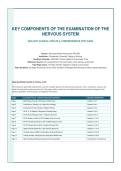
KEY COMPONENTS OF THE EXAMINATION OF THE
NERVOUS SYSTEM
2026-2027 CLINICAL UPDATE & COMPREHENSIVE TEST BANK
Course: Advanced Health Assessment (NR 509)
Institution: Chamberlain University College of Nursing
Academic Calendar: 2026-2027 Clinical Update & Examination Prep
Reference Source: key-components-of-the-examination-of-the-nervous-system.pdf
Total Page Count: 13 Pages (Strictly mapped to original course layout)
Total Questions: 22 Highly Structured Clinical Case Questions (Packaged with thorough evidence-based rationales)
EXAM BLUEPRINT MATRIX & TOPICAL FLOW
This test bank is specifically engineered to cover the complete spectrum of advanced neurovascular, motor, coordination, sensory, and
cranial nerve physical assessment protocols. Each page contains exactly two multi-tiered clinical scenario questions designed to test
cognitive application, clinical analysis, and diagnostic formulation.
Pages Curricular Focus / Clinical Assessment Domains Question Distribution
Page 2 Mental Status Evaluation & Aphasia Comprehension Questions 1 & 2
Page 3 Cranial Nerve I (Olfactory) & II (Optic Disc Pathology) Questions 3 & 4
Page 4 Cranial Nerve II (Visual Fields) & Pupillary Reflexes Questions 5 & 6
Page 5 CN III, IV, VI (Diplopia) & Nystagmus Pathophysiology Questions 7 & 8
Page 6 CN III (Ptosis Pathways) & CN V (Trigeminal Domains) Questions 9 & 10
Page 7 CN VII (Stroke vs. Bell's) & CN VIII (Weber & Rinne Tuning) Questions 11 & 12
Page 8 CN IX/X (Palate Symmetries) & CN XI (SCM/Trapezius Levels) Questions 13 & 14
Page 9 CN XII (Tongue Devs) & Motor Tone/Bulk (Pronator Drift) Questions 15 & 16
Page 10 Upper Extremity Myotomes & Lower Extremity Myotomes Questions 17 & 18
Page 11 Cerebellar Ataxias (RAM) & Proprioceptive Romberg Mechanics Questions 19 & 20
Page 12 Cortical Sensation (Stereognosis) & Deep Stretch Reflex levels Questions 21 & 22
Page 13 High-Yield Advanced Physical Assessment Summary Matrix Cranial Nerves I-XII reference
, KEY COMPONENTS OF THE EXAMINATION OF THE NERVOUS SYSTEM 2026-2027 CLINICAL UPDATE & TEST BANK
QUESTION 1: MENTAL STATUS: ABSTRACT REASONING VS. BASIC ORIENTATION
Learning Objective: Differentiate between higher-order cortical cognitive domains and standard baseline orientation measurements.
During a comprehensive neurological exam, the clinician seeks to evaluate the patient's abstract reasoning. Based on advanced
health assessment standards, which of the following tasks is most appropriate to evaluate this specific cognitive domain?
A. Orientation to time, place, and person
B. Proverb interpretation and identifying similarities between objects
C. Calculating serial sevens and spelling a simple word backward
D. Short-term and long-term memory recall of family milestones
ANSWER ■: B — Proverb interpretation and identifying similarities between objects
Explanation: Abstract reasoning is a higher-order cortical function evaluated by asking patients to interpret a common proverb (e.g., 'Don't
cry over spilled milk') or to find a common relationship or similarity between objects (e.g., 'In what way are an apple and an orange alike?').
Option A evaluates basic orientation. Option C evaluates attention, concentration, and calculation. Option D evaluates memory recall. None
of these other tests measure abstract reasoning.
QUESTION 2: LANGUAGE FUNCTION: SYSTEMATIC APHASIA SCREENING
Learning Objective: Evaluate language function systematically to screen for fluent and non-fluent cortical aphasias.
A patient presenting with acute stroke-like symptoms demonstrates difficulty speaking. To perform a comprehensive clinical
evaluation of the patient's language function, which combination of assessments must the clinician prioritize?
A. Instructing the patient to read from a near-vision chart to test Wernicke's area
B. Auscultating for carotid bruits to determine perfusion of Wernicke's area
C. Evaluating conversational fluency, reading comprehension, repeating a phrase, and object naming
D. Performing deep tendon reflex checks to evaluate spinal autonomic pathways
ANSWER ■: C — Evaluating conversational fluency, reading comprehension, repeating a phrase, and object naming
Explanation: A thorough language function evaluation requires assessing several discrete components: conversational fluency (expressive
output), comprehension of commands/reading, ability to repeat phrases, and naming common objects. This systematic approach allows the
clinician to localize lesions and differentiate fluent Wernicke's aphasia from non-fluent Broca's aphasia. The other options are isolated,
non-comprehensive tests.
Advanced Health Assessment Study Resource — Chamberlain University Page 2 of 13
NERVOUS SYSTEM
2026-2027 CLINICAL UPDATE & COMPREHENSIVE TEST BANK
Course: Advanced Health Assessment (NR 509)
Institution: Chamberlain University College of Nursing
Academic Calendar: 2026-2027 Clinical Update & Examination Prep
Reference Source: key-components-of-the-examination-of-the-nervous-system.pdf
Total Page Count: 13 Pages (Strictly mapped to original course layout)
Total Questions: 22 Highly Structured Clinical Case Questions (Packaged with thorough evidence-based rationales)
EXAM BLUEPRINT MATRIX & TOPICAL FLOW
This test bank is specifically engineered to cover the complete spectrum of advanced neurovascular, motor, coordination, sensory, and
cranial nerve physical assessment protocols. Each page contains exactly two multi-tiered clinical scenario questions designed to test
cognitive application, clinical analysis, and diagnostic formulation.
Pages Curricular Focus / Clinical Assessment Domains Question Distribution
Page 2 Mental Status Evaluation & Aphasia Comprehension Questions 1 & 2
Page 3 Cranial Nerve I (Olfactory) & II (Optic Disc Pathology) Questions 3 & 4
Page 4 Cranial Nerve II (Visual Fields) & Pupillary Reflexes Questions 5 & 6
Page 5 CN III, IV, VI (Diplopia) & Nystagmus Pathophysiology Questions 7 & 8
Page 6 CN III (Ptosis Pathways) & CN V (Trigeminal Domains) Questions 9 & 10
Page 7 CN VII (Stroke vs. Bell's) & CN VIII (Weber & Rinne Tuning) Questions 11 & 12
Page 8 CN IX/X (Palate Symmetries) & CN XI (SCM/Trapezius Levels) Questions 13 & 14
Page 9 CN XII (Tongue Devs) & Motor Tone/Bulk (Pronator Drift) Questions 15 & 16
Page 10 Upper Extremity Myotomes & Lower Extremity Myotomes Questions 17 & 18
Page 11 Cerebellar Ataxias (RAM) & Proprioceptive Romberg Mechanics Questions 19 & 20
Page 12 Cortical Sensation (Stereognosis) & Deep Stretch Reflex levels Questions 21 & 22
Page 13 High-Yield Advanced Physical Assessment Summary Matrix Cranial Nerves I-XII reference
, KEY COMPONENTS OF THE EXAMINATION OF THE NERVOUS SYSTEM 2026-2027 CLINICAL UPDATE & TEST BANK
QUESTION 1: MENTAL STATUS: ABSTRACT REASONING VS. BASIC ORIENTATION
Learning Objective: Differentiate between higher-order cortical cognitive domains and standard baseline orientation measurements.
During a comprehensive neurological exam, the clinician seeks to evaluate the patient's abstract reasoning. Based on advanced
health assessment standards, which of the following tasks is most appropriate to evaluate this specific cognitive domain?
A. Orientation to time, place, and person
B. Proverb interpretation and identifying similarities between objects
C. Calculating serial sevens and spelling a simple word backward
D. Short-term and long-term memory recall of family milestones
ANSWER ■: B — Proverb interpretation and identifying similarities between objects
Explanation: Abstract reasoning is a higher-order cortical function evaluated by asking patients to interpret a common proverb (e.g., 'Don't
cry over spilled milk') or to find a common relationship or similarity between objects (e.g., 'In what way are an apple and an orange alike?').
Option A evaluates basic orientation. Option C evaluates attention, concentration, and calculation. Option D evaluates memory recall. None
of these other tests measure abstract reasoning.
QUESTION 2: LANGUAGE FUNCTION: SYSTEMATIC APHASIA SCREENING
Learning Objective: Evaluate language function systematically to screen for fluent and non-fluent cortical aphasias.
A patient presenting with acute stroke-like symptoms demonstrates difficulty speaking. To perform a comprehensive clinical
evaluation of the patient's language function, which combination of assessments must the clinician prioritize?
A. Instructing the patient to read from a near-vision chart to test Wernicke's area
B. Auscultating for carotid bruits to determine perfusion of Wernicke's area
C. Evaluating conversational fluency, reading comprehension, repeating a phrase, and object naming
D. Performing deep tendon reflex checks to evaluate spinal autonomic pathways
ANSWER ■: C — Evaluating conversational fluency, reading comprehension, repeating a phrase, and object naming
Explanation: A thorough language function evaluation requires assessing several discrete components: conversational fluency (expressive
output), comprehension of commands/reading, ability to repeat phrases, and naming common objects. This systematic approach allows the
clinician to localize lesions and differentiate fluent Wernicke's aphasia from non-fluent Broca's aphasia. The other options are isolated,
non-comprehensive tests.
Advanced Health Assessment Study Resource — Chamberlain University Page 2 of 13