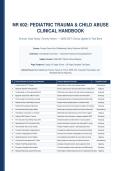
NR 602: PEDIATRIC TRAUMA & CHILD ABUSE
CLINICAL HANDBOOK
iHuman Case Study (Tommy Acker) — 2026-2027 Clinical Update & Test Bank
Course: Primary Care of the Childbearing Family Practicum (NR 602)
Institution: Chamberlain University — Advanced Practice Nursing Department
Update Version: 2026-2027 Official Clinical Release
Page Footprint: Exactly 21 Pages (Cover + 20-Page Complete Test Bank)
Clinical Focus: Blunt Abdominal Trauma, Failure to Thrive, SIRS, AKI, Traumatic Pancreatitis, and
Mandated Abuse Reporting
Q Clinical Domain & Core Topic Evaluated Primary Objective Checked Cognitive Level
1 Growth Failure & FTT Criteria Identify failure to thrive and nutritional neglect Remembering
2 Repaired ASD/CHF Hemodynamics Assess cardiovascular risks during fluid volume replacement Applying
3 Compensated vs. Decompensated Shock Differentiate early reflexes from late systemic hypoperfusion Analyzing
4 Epigastric Ecchymosis & Blunt Trauma Analyze abdominal trauma markers and mechanisms Analyzing
5 Peritoneal Signs & Involuntary Guarding Evaluate physical signs of parietal peritoneal inflammation Evaluating
6 Skeletal Survey & Multi-Stage Fractures Interpret healing skeletal patterns in pediatric abuse Analyzing
7 Pediatric Rib Compliance Mechanics Explain mechanical forces required for pediatric rib fractures Analyzing
8 Circumferential Wrist Ligature Marks Identify signs of physical restraint and forced confinement Remembering
9 Child Abuse: Commission vs. Omission Differentiate direct physical trauma from chronic neglect Applying
10 Pediatric SIRS Criteria in Trauma Synthesize clinical indicators to diagnose pediatric SIRS Evaluating
11 Post-Traumatic Acute Kidney Injury (AKI) Interpret elevated renal biomarkers in trauma patients Analyzing
12 Hyperkalemia & ECG Conduction Risks Analyze electrolyte conduction risks and peaked T-waves Analyzing
13 Venous Blood Gas & Lactic Acidosis Interpret metabolic acidosis in decompensated shock Evaluating
14 Traumatic Pancreatitis & Hypocalcemia Correlate blunt abdominal injury with severe pancreatitis Analyzing
15 Traumatic Coagulopathy & PT/INR Evaluate acute traumatic coagulopathy from tissue injury Evaluating
16 Hypoproteinemia & Chronic Neglect Link metabolic protein deficits to severe failure to thrive Applying
17 Contrast-Enhanced Abdominal CT Role Identify abdominal solid organ and bowel lacerations Remembering
18 Pediatric Fluid Resuscitation Bolus Calculate and select isotonic volume expansion limits Applying
19 Emergency Outpatient Resuscitation Formulate outpatient shock stabilization and EMS transfer Evaluating
20 Mandated Reporting Legal & Ethical Duty Outline legal mandated reporting rules for suspected child abuse Applying
,SECTION 1: GROWTH FAILURE & FTT CRITERIA
Learning Objective: Identify failure to thrive and chronic nutritional neglect in pediatric patients using growth velocity and
percentile curves.
Question 1: Tommy is a 26-month-old male presenting with height and weight both significantly below
the 5th percentile for his age. Which clinical parameter is the most critical first step in determining
whether this represents organic vs. non-organic Failure to Thrive (FTT) in the primary care setting?
A. Ordering immediate chromosomal microarray and comprehensive metabolic genetic panels.
B. Conducting a thorough dietary recall, complete birth history, developmental milestone review, and direct
observation of parent-child bonding, paired with a 3-day calorie journal.
C. Prescribing high-dose recombinant human growth hormone therapy to stimulate immediate linear bone growth.
D. Initiating immediate peripheral parenteral nutrition (PPN) in the outpatient clinic to correct calorie deficit.
ANSWER ■: B — Conducting a thorough dietary recall, complete birth history, developmental
milestone review, and direct observation of parent-child bonding, paired with a 3-day calorie journal.
Explanation: Determining organic (medical disease) vs. non-organic (psychosocial/neglect) Failure to Thrive
(FTT) begins with a thorough history and observation. A detailed 3-day dietary recall, birth history, and parent-child
interaction assessment identify feeding dynamic failures or direct environmental neglect before ordering invasive,
expensive laboratory or genetic tests (Option A). Recombinant growth hormone (Option C) is contraindicated
without a diagnosed hormone deficiency. Outpatient PPN (Option D) is highly unsafe and is reserved for severe
malabsorption in inpatient settings.
Key Concept: Failure to Thrive diagnostic algorithms prioritize a comprehensive dietary and psychosocial
history over immediate invasive, high-cost genetic or endocrinological workups.
Common Mistake: Students often rush to order complex endocrine or genetic workups (Option A) for toddlers with
severe growth failure, bypassing the foundational history and nutritional-intake log.
DIFFICULTY: Cognitive Level: Remembering (Knowledge) | MSC: Client Needs: Health Promotion and Maintenance
, SECTION 2: REPAIRED ASD/CHF HEMODYNAMICS
Learning Objective: Assess cardiovascular risks during fluid volume replacement in pediatric patients with congenital
cardiac history.
Question 2: Tommy has a history of repaired Atrial Septal Defect (ASD) and associated Congestive
Heart Failure (CHF). As the clinician initiates rapid intravenous fluid resuscitation for his acute shock,
which physical assessment finding represents the most critical indicator of developing volume
overload and pulmonary congestion?
A. Mild, localized dependent edema in the diaper and sacral areas.
B. Progressive bilateral coarse crackles on lung auscultation, acute tachypnea, and an audible S3 gallop on cardiac
examination.
C. A steady, gradual reduction in the resting heart rate from 160 bpm to a stable 110 bpm.
D. The emergence of a transient, soft Grade II/VI systolic flow murmur loudest over the left upper sternal border.
ANSWER ■: B — Progressive bilateral coarse crackles on lung auscultation, acute tachypnea, and
an audible S3 gallop on cardiac examination.
Explanation: In patients with a congenital cardiac history (even after repair), rapid volume expansion carries a
high risk of precipitating acute congestive heart failure. Progressive coarse crackles, worsening tachypnea, and a
third heart sound (S3 gallop) represent increased left-atrial pressures and pulmonary venous congestion. This
warrants immediate suspension of fluid boluses and administration of diuretics. Diaper edema (Option A) is a
chronic, slower-onset sign of fluid retention. A reduction in heart rate (Option C) is a therapeutic sign of successful
shock resuscitation. A soft flow murmur (Option D) is common in high-flow states and does not indicate heart
failure.
Key Concept: In pediatric patients with a history of CHF or structural heart disease, fluid resuscitation
must be monitored closely with frequent auscultation for crackles and gallops to prevent fluid overload.
Common Mistake: Students often focus exclusively on blood pressure and heart rate recovery, failing to perform
close-interval cardiopulmonary auscultation during rapid pediatric fluid resuscitation.
DIFFICULTY: Cognitive Level: Applying (Application) | MSC: Client Needs: Physiological Integrity: Physiological Adaptation
CLINICAL HANDBOOK
iHuman Case Study (Tommy Acker) — 2026-2027 Clinical Update & Test Bank
Course: Primary Care of the Childbearing Family Practicum (NR 602)
Institution: Chamberlain University — Advanced Practice Nursing Department
Update Version: 2026-2027 Official Clinical Release
Page Footprint: Exactly 21 Pages (Cover + 20-Page Complete Test Bank)
Clinical Focus: Blunt Abdominal Trauma, Failure to Thrive, SIRS, AKI, Traumatic Pancreatitis, and
Mandated Abuse Reporting
Q Clinical Domain & Core Topic Evaluated Primary Objective Checked Cognitive Level
1 Growth Failure & FTT Criteria Identify failure to thrive and nutritional neglect Remembering
2 Repaired ASD/CHF Hemodynamics Assess cardiovascular risks during fluid volume replacement Applying
3 Compensated vs. Decompensated Shock Differentiate early reflexes from late systemic hypoperfusion Analyzing
4 Epigastric Ecchymosis & Blunt Trauma Analyze abdominal trauma markers and mechanisms Analyzing
5 Peritoneal Signs & Involuntary Guarding Evaluate physical signs of parietal peritoneal inflammation Evaluating
6 Skeletal Survey & Multi-Stage Fractures Interpret healing skeletal patterns in pediatric abuse Analyzing
7 Pediatric Rib Compliance Mechanics Explain mechanical forces required for pediatric rib fractures Analyzing
8 Circumferential Wrist Ligature Marks Identify signs of physical restraint and forced confinement Remembering
9 Child Abuse: Commission vs. Omission Differentiate direct physical trauma from chronic neglect Applying
10 Pediatric SIRS Criteria in Trauma Synthesize clinical indicators to diagnose pediatric SIRS Evaluating
11 Post-Traumatic Acute Kidney Injury (AKI) Interpret elevated renal biomarkers in trauma patients Analyzing
12 Hyperkalemia & ECG Conduction Risks Analyze electrolyte conduction risks and peaked T-waves Analyzing
13 Venous Blood Gas & Lactic Acidosis Interpret metabolic acidosis in decompensated shock Evaluating
14 Traumatic Pancreatitis & Hypocalcemia Correlate blunt abdominal injury with severe pancreatitis Analyzing
15 Traumatic Coagulopathy & PT/INR Evaluate acute traumatic coagulopathy from tissue injury Evaluating
16 Hypoproteinemia & Chronic Neglect Link metabolic protein deficits to severe failure to thrive Applying
17 Contrast-Enhanced Abdominal CT Role Identify abdominal solid organ and bowel lacerations Remembering
18 Pediatric Fluid Resuscitation Bolus Calculate and select isotonic volume expansion limits Applying
19 Emergency Outpatient Resuscitation Formulate outpatient shock stabilization and EMS transfer Evaluating
20 Mandated Reporting Legal & Ethical Duty Outline legal mandated reporting rules for suspected child abuse Applying
,SECTION 1: GROWTH FAILURE & FTT CRITERIA
Learning Objective: Identify failure to thrive and chronic nutritional neglect in pediatric patients using growth velocity and
percentile curves.
Question 1: Tommy is a 26-month-old male presenting with height and weight both significantly below
the 5th percentile for his age. Which clinical parameter is the most critical first step in determining
whether this represents organic vs. non-organic Failure to Thrive (FTT) in the primary care setting?
A. Ordering immediate chromosomal microarray and comprehensive metabolic genetic panels.
B. Conducting a thorough dietary recall, complete birth history, developmental milestone review, and direct
observation of parent-child bonding, paired with a 3-day calorie journal.
C. Prescribing high-dose recombinant human growth hormone therapy to stimulate immediate linear bone growth.
D. Initiating immediate peripheral parenteral nutrition (PPN) in the outpatient clinic to correct calorie deficit.
ANSWER ■: B — Conducting a thorough dietary recall, complete birth history, developmental
milestone review, and direct observation of parent-child bonding, paired with a 3-day calorie journal.
Explanation: Determining organic (medical disease) vs. non-organic (psychosocial/neglect) Failure to Thrive
(FTT) begins with a thorough history and observation. A detailed 3-day dietary recall, birth history, and parent-child
interaction assessment identify feeding dynamic failures or direct environmental neglect before ordering invasive,
expensive laboratory or genetic tests (Option A). Recombinant growth hormone (Option C) is contraindicated
without a diagnosed hormone deficiency. Outpatient PPN (Option D) is highly unsafe and is reserved for severe
malabsorption in inpatient settings.
Key Concept: Failure to Thrive diagnostic algorithms prioritize a comprehensive dietary and psychosocial
history over immediate invasive, high-cost genetic or endocrinological workups.
Common Mistake: Students often rush to order complex endocrine or genetic workups (Option A) for toddlers with
severe growth failure, bypassing the foundational history and nutritional-intake log.
DIFFICULTY: Cognitive Level: Remembering (Knowledge) | MSC: Client Needs: Health Promotion and Maintenance
, SECTION 2: REPAIRED ASD/CHF HEMODYNAMICS
Learning Objective: Assess cardiovascular risks during fluid volume replacement in pediatric patients with congenital
cardiac history.
Question 2: Tommy has a history of repaired Atrial Septal Defect (ASD) and associated Congestive
Heart Failure (CHF). As the clinician initiates rapid intravenous fluid resuscitation for his acute shock,
which physical assessment finding represents the most critical indicator of developing volume
overload and pulmonary congestion?
A. Mild, localized dependent edema in the diaper and sacral areas.
B. Progressive bilateral coarse crackles on lung auscultation, acute tachypnea, and an audible S3 gallop on cardiac
examination.
C. A steady, gradual reduction in the resting heart rate from 160 bpm to a stable 110 bpm.
D. The emergence of a transient, soft Grade II/VI systolic flow murmur loudest over the left upper sternal border.
ANSWER ■: B — Progressive bilateral coarse crackles on lung auscultation, acute tachypnea, and
an audible S3 gallop on cardiac examination.
Explanation: In patients with a congenital cardiac history (even after repair), rapid volume expansion carries a
high risk of precipitating acute congestive heart failure. Progressive coarse crackles, worsening tachypnea, and a
third heart sound (S3 gallop) represent increased left-atrial pressures and pulmonary venous congestion. This
warrants immediate suspension of fluid boluses and administration of diuretics. Diaper edema (Option A) is a
chronic, slower-onset sign of fluid retention. A reduction in heart rate (Option C) is a therapeutic sign of successful
shock resuscitation. A soft flow murmur (Option D) is common in high-flow states and does not indicate heart
failure.
Key Concept: In pediatric patients with a history of CHF or structural heart disease, fluid resuscitation
must be monitored closely with frequent auscultation for crackles and gallops to prevent fluid overload.
Common Mistake: Students often focus exclusively on blood pressure and heart rate recovery, failing to perform
close-interval cardiopulmonary auscultation during rapid pediatric fluid resuscitation.
DIFFICULTY: Cognitive Level: Applying (Application) | MSC: Client Needs: Physiological Integrity: Physiological Adaptation