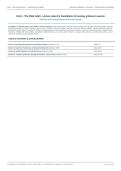
UNIT 4 - THE OLDER ADULT — PROFESSOR LAVERNE OAKLAND COMMUNITY COLLEGE — FOUNDATIONS OF NURSING
Unit 4 - The Older Adult - Lecture notes for foundations of nursing, professor Laverne
2026-2027 100% verified questions and answers Agrade
Foundations of Nursing Exam Study Guide & Practice Resource: This comprehensive test bank contains exactly 101 high-yield, board-style practice questions
thoroughly grounded in Professor Laverne's lecture notes at Oakland Community College. Spanning multi-system physical changes, cognitive development theories,
psychosocial stages (Erikson's Integrity vs. Despair), gerotranscendence, health disparities among ethnic minorities, preventive nursing intervention models (Primary,
Secondary, Tertiary), fall safety profiles, and geriatric palliative/hospice care. Every question features a unique learning objective, a board-style question, and an
exhaustive rationale to ensure academic mastery.
TABLE OF CONTENTS & EXAM BLUEPRINT
Section I: Physiologic Development & Age-Related Changes (Questions 1-35) Pages 3-37
Section II: Cognitive, Psychosocial, & Spiritual Development (Questions 36-65) Pages 38-67
Section III: Health Disparities & Accidental Injuries (Questions 66-80) Pages 68-82
Section IV: Cognitive Syndromes, Nursing Interventions, & End of Life (Questions 81-101) Pages 83-103
CHAMBERLAIN UNIVERSITY STUDY RESOURCE — PROFESSOR LAVERNE LECTURE NOTES Page 1 of 103
,UNIT 4 - THE OLDER ADULT — PROFESSOR LAVERNE OAKLAND COMMUNITY COLLEGE — FOUNDATIONS OF NURSING
SECTION I: PHYSIOLOGIC DEVELOPMENT & AGE-RELATED CHANGES
Question 1 of 101
Learning Objective: Analyze general physiologic developmental changes and organ system decline in maturing older adults.
Question: An older adult patient is undergoing an annual wellness evaluation. The nurse practitioner understands that which of the following is true regarding general
physiologic development in older adults?
A. All organ systems remain completely stable, with only the cognitive system B. All organ systems undergo some degree of decline in overall functioning, and the
experiencing a gradual decline. body becomes less efficient.
C. Physiologic reserves increase systematically with advanced age to compensate for D. Organ efficiency increases due to lifelong adaptational modifications.
external stressors.
ANSWER : B
Explanation: Professor Laverne's lecture notes explicitly state that during physiologic development in older adults, all organ systems undergo some degree of decline in
overall functioning, and the body becomes less efficient. Cognitive decline is not a normal part of aging, and physiologic reserves actually decrease rather than increase.
CHAMBERLAIN UNIVERSITY STUDY RESOURCE — PROFESSOR LAVERNE LECTURE NOTES Page 2 of 103
,UNIT 4 - THE OLDER ADULT — PROFESSOR LAVERNE OAKLAND COMMUNITY COLLEGE — FOUNDATIONS OF NURSING
SECTION I: PHYSIOLOGIC DEVELOPMENT & AGE-RELATED CHANGES
Question 2 of 101
Learning Objective: Identify sarcopenia as the natural age-related loss of skeletal muscle mass.
Question: An older adult patient is admitted with a diagnosis of natural age-related skeletal muscle loss. The nurse documents this condition in the patient's medical chart
as which of the following?
A. Sarcopenic dystrophy B. Sarcopenia
C. Myofibril atrophy D. Cachexia
ANSWER : B
Explanation: The lecture notes state that sarcopenia is defined as the loss of muscle mass that frequently occurs in older adults as part of the natural aging process.
Dystrophy implies a pathological genetic disease, and cachexia is associated with cancer/wasting, whereas sarcopenia is normal age-related muscle loss.
CHAMBERLAIN UNIVERSITY STUDY RESOURCE — PROFESSOR LAVERNE LECTURE NOTES Page 3 of 103
, UNIT 4 - THE OLDER ADULT — PROFESSOR LAVERNE OAKLAND COMMUNITY COLLEGE — FOUNDATIONS OF NURSING
SECTION I: PHYSIOLOGIC DEVELOPMENT & AGE-RELATED CHANGES
Question 3 of 101
Learning Objective: Evaluate normal age-related vision changes including blurring, acuity, and near vision.
Question: An older adult patient complains that their vision is increasingly blurry and that reading small print has become difficult. What normal age-related ocular changes
should the nurse discuss with the patient?
A. Increased vascularity of the iris and macular expansion B. Blurring of vision, decreased visual acuity, and reduced near vision
C. Permanent complete loss of peripheral visual fields D. Spontaneous corneal thickening and increased intraocular pressure
ANSWER : B
Explanation: Normal sensory changes with age include blurring of vision, decreased visual acuity, and reduced near vision (presbyopia) as detailed in the slide notes.
Peripheral fields are not completely lost, and intraocular pressure elevation is pathologic (glaucoma), not a normal age-related change.
CHAMBERLAIN UNIVERSITY STUDY RESOURCE — PROFESSOR LAVERNE LECTURE NOTES Page 4 of 103
Unit 4 - The Older Adult - Lecture notes for foundations of nursing, professor Laverne
2026-2027 100% verified questions and answers Agrade
Foundations of Nursing Exam Study Guide & Practice Resource: This comprehensive test bank contains exactly 101 high-yield, board-style practice questions
thoroughly grounded in Professor Laverne's lecture notes at Oakland Community College. Spanning multi-system physical changes, cognitive development theories,
psychosocial stages (Erikson's Integrity vs. Despair), gerotranscendence, health disparities among ethnic minorities, preventive nursing intervention models (Primary,
Secondary, Tertiary), fall safety profiles, and geriatric palliative/hospice care. Every question features a unique learning objective, a board-style question, and an
exhaustive rationale to ensure academic mastery.
TABLE OF CONTENTS & EXAM BLUEPRINT
Section I: Physiologic Development & Age-Related Changes (Questions 1-35) Pages 3-37
Section II: Cognitive, Psychosocial, & Spiritual Development (Questions 36-65) Pages 38-67
Section III: Health Disparities & Accidental Injuries (Questions 66-80) Pages 68-82
Section IV: Cognitive Syndromes, Nursing Interventions, & End of Life (Questions 81-101) Pages 83-103
CHAMBERLAIN UNIVERSITY STUDY RESOURCE — PROFESSOR LAVERNE LECTURE NOTES Page 1 of 103
,UNIT 4 - THE OLDER ADULT — PROFESSOR LAVERNE OAKLAND COMMUNITY COLLEGE — FOUNDATIONS OF NURSING
SECTION I: PHYSIOLOGIC DEVELOPMENT & AGE-RELATED CHANGES
Question 1 of 101
Learning Objective: Analyze general physiologic developmental changes and organ system decline in maturing older adults.
Question: An older adult patient is undergoing an annual wellness evaluation. The nurse practitioner understands that which of the following is true regarding general
physiologic development in older adults?
A. All organ systems remain completely stable, with only the cognitive system B. All organ systems undergo some degree of decline in overall functioning, and the
experiencing a gradual decline. body becomes less efficient.
C. Physiologic reserves increase systematically with advanced age to compensate for D. Organ efficiency increases due to lifelong adaptational modifications.
external stressors.
ANSWER : B
Explanation: Professor Laverne's lecture notes explicitly state that during physiologic development in older adults, all organ systems undergo some degree of decline in
overall functioning, and the body becomes less efficient. Cognitive decline is not a normal part of aging, and physiologic reserves actually decrease rather than increase.
CHAMBERLAIN UNIVERSITY STUDY RESOURCE — PROFESSOR LAVERNE LECTURE NOTES Page 2 of 103
,UNIT 4 - THE OLDER ADULT — PROFESSOR LAVERNE OAKLAND COMMUNITY COLLEGE — FOUNDATIONS OF NURSING
SECTION I: PHYSIOLOGIC DEVELOPMENT & AGE-RELATED CHANGES
Question 2 of 101
Learning Objective: Identify sarcopenia as the natural age-related loss of skeletal muscle mass.
Question: An older adult patient is admitted with a diagnosis of natural age-related skeletal muscle loss. The nurse documents this condition in the patient's medical chart
as which of the following?
A. Sarcopenic dystrophy B. Sarcopenia
C. Myofibril atrophy D. Cachexia
ANSWER : B
Explanation: The lecture notes state that sarcopenia is defined as the loss of muscle mass that frequently occurs in older adults as part of the natural aging process.
Dystrophy implies a pathological genetic disease, and cachexia is associated with cancer/wasting, whereas sarcopenia is normal age-related muscle loss.
CHAMBERLAIN UNIVERSITY STUDY RESOURCE — PROFESSOR LAVERNE LECTURE NOTES Page 3 of 103
, UNIT 4 - THE OLDER ADULT — PROFESSOR LAVERNE OAKLAND COMMUNITY COLLEGE — FOUNDATIONS OF NURSING
SECTION I: PHYSIOLOGIC DEVELOPMENT & AGE-RELATED CHANGES
Question 3 of 101
Learning Objective: Evaluate normal age-related vision changes including blurring, acuity, and near vision.
Question: An older adult patient complains that their vision is increasingly blurry and that reading small print has become difficult. What normal age-related ocular changes
should the nurse discuss with the patient?
A. Increased vascularity of the iris and macular expansion B. Blurring of vision, decreased visual acuity, and reduced near vision
C. Permanent complete loss of peripheral visual fields D. Spontaneous corneal thickening and increased intraocular pressure
ANSWER : B
Explanation: Normal sensory changes with age include blurring of vision, decreased visual acuity, and reduced near vision (presbyopia) as detailed in the slide notes.
Peripheral fields are not completely lost, and intraocular pressure elevation is pathologic (glaucoma), not a normal age-related change.
CHAMBERLAIN UNIVERSITY STUDY RESOURCE — PROFESSOR LAVERNE LECTURE NOTES Page 4 of 103