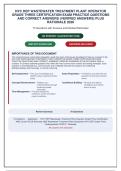
NYC DEP WASTEWATER TREATMENT PLANT OPERATOR
GRADE THREE CERTIFICATION EXAM PRACTICE QUESTIONS
AND CORRECT ANSWERS (VERIFIED ANSWERS) PLUS
RATIONALE 2026
70 Questions with Answers and Detailed Rationales
100 PERCENT GUARANTEED PASS
INSTANT DOWNLOAD ANSWERS INCLUDED
IMPORTANCE OF THIS DOCUMENT
This comprehensive examination preparation guide has been meticulously developed to help you succeed in the
NYC DEP WASTEWATER TREATMENT PLANT OPERATOR GRADE THREE CERTIFICATION EXAM
PRACTICE QUESTIONS AND CORRECT ANSWERS (VERIFIED ANSWERS) PLUS RATIONALE 2026. It
contains 70 carefully selected questions that reflect the most current exam content and testing strategies. Each
question is accompanied by a correct answer and a detailed rationale that explains the underlying
pathophysiology, pharmacology, or clinical reasoning.
Self-Assessment – Test your knowledge and Exam Preparation – Familiarize yourself with the
identify areas requiring further question format and content
study areas
Concept Reinforcement – Deepen your Confidence Building – Develop test-taking
understanding through strategies and reduce
evidence-based exam anxiety
rationales
Time Management – Practice answering
questions under simulated
exam conditions
Review Summary 70 Questions
Foundations - Application - NYC DEP Wastewater Treatment Plant Operator Grade Three Certification
AND Correct PLUS Rationale 2026 Wastewater Treatment Plant Operations NYC DEP Grade Three
Undergraduate YEAR 3 / Graduate
All answers with rationales
,Table of Contents
Content Area Questions Key Topics
Wastewater Treatment 1-12 Plant, Effluent, Operator, Sludge, Concentration
Processes
Plant Operations AND 13-24 Operator, Effluent, Sludge, Concentration, Chlorine
Maintenance
Laboratory Analysis AND 25-36 Plant, Effluent, Total, Influent, Volatile
Process Control
Safety AND Emergency 37-48 Effluent, Operator, Plant, Alkalinity, Likely Cause
Response
Regulations AND 49-60 Operator, Sludge, Plant, Effluent, Likely
Compliance
Equipment AND 61-70 Solids, Plant, Sludge, Oxygen, Concentration
Instrumentation
TOTAL 70 All questions include answers and detailed rationales
,Section A - Wastewater Treatment Processes
Q1.
A secondary clarifier at a step-feed BNR plant is experiencing rising sludge with high
nitrate concentration in the return activated sludge (RAS). Given an anoxic zone with
inadequate carbon source, which operational adjustment most effectively reduces
denitrification in the clarifier while maintaining effluent quality?
A. Increase RAS flow to reduce sludge B. Decrease dissolved oxygen in the
retention time in the clarifier aeration basin to reduce nitrification
C. Add supplemental carbon (e.g., D. Increase waste activated sludge (WAS)
methanol) to the anoxic zone rate to lower sludge age
Correct: C - Add supplemental carbon (e.g., methanol) to the anoxic zone
Rationale:Rising sludge in clarifiers is caused by denitrification producing nitrogen gas.
Adding supplemental carbon to the anoxic zone enhances denitrification, reducing nitrate in
RAS and preventing gas formation in the clarifier. Increasing RAS or WAS may alter solids
balance but doesn't directly address nitrate. Decreasing DO could reduce nitrification but risks
effluent ammonia and is less targeted.
Why the other answers are wrong:
A. Increasing RAS flow only dilutes nitrate but does not reduce its concentration or prevent
denitrification in the clarifier.
B. Decreasing DO may reduce nitrification but can cause incomplete nitrification and does not
directly address existing nitrate in RAS.
D. Increasing WAS rate lowers sludge age but does not eliminate nitrate; it may worsen
effluent quality by reducing nitrification.
Reference: WEF, Biological Nutrient Removal (BNR) Operation in Wastewater Treatment Plants, Ch. 8
Q2.
During a confined space entry into a wet well, the continuous gas monitor alarms at an
oxygen concentration of 19.2% and a hydrogen sulfide level of 12 ppm. According to
OSHA 29 CFR 1910.146 and typical NYC DEP protocols, what is the immediate required
action?
A. Continue entry because O2 is above B. Evacuate the space immediately and
19.5% and H2S is below 15 ppm re-evaluate the atmosphere after ventilation
C. Order the entrant to wear a half-face D. Lower the monitor into the space for 5
respirator with acid gas cartridges minutes to confirm readings
Correct: B - Evacuate the space immediately and re-evaluate the atmosphere after
ventilation
Page 3
, Section A - Wastewater Treatment Processes
Rationale: OSHA requires evacuation when O2 is below 19.5% or when any atmospheric
hazard exceeds established limits. H2S at 12 ppm exceeds the NIOSH IDLH? No, but it
exceeds the OSHA PEL of 10 ppm, and with O2 below 19.5%, the space is immediately
dangerous to life or health (IDLH)? Actually, IDLH for H2S is 100 ppm, but O2 below 19.5% is
an IDLH condition. Therefore, immediate evacuation is mandatory. Continuing entry or using
a respirator is not allowed; re-evaluation after ventilation is the correct procedure.
Why the other answers are wrong:
A. O2 below 19.5% is an immediate IDLH condition, so entry must stop regardless of H2S
levels.
C. Respirators are not permitted for IDLH atmospheres; immediate evacuation is required.
D. Delaying action to re-check readings violates the requirement to evacuate immediately upon
alarm.
Reference: OSHA 29 CFR 1910.146, Permit-Required Confined Spaces; NYC DEP Confined Space
Entry Program
Q3.
A plant's effluent total phosphorus (TP) limit is 0.5 mg/L. The current chemical feed of
alum is 40 mg/L as Al, and the soluble orthophosphate (OP) in the secondary effluent is
0.3 mg/L. The plant wants to reduce OP to 0.1 mg/L. Using a stoichiometric Al:P molar
ratio of 2.0:1, what alum dose (as Al) is required, assuming the influent OP is 1.2 mg/L?
A. 62 mg/L B. 75 mg/L
C. 90 mg/L D. 110 mg/L
Correct: B - 75 mg/L
Page 4
GRADE THREE CERTIFICATION EXAM PRACTICE QUESTIONS
AND CORRECT ANSWERS (VERIFIED ANSWERS) PLUS
RATIONALE 2026
70 Questions with Answers and Detailed Rationales
100 PERCENT GUARANTEED PASS
INSTANT DOWNLOAD ANSWERS INCLUDED
IMPORTANCE OF THIS DOCUMENT
This comprehensive examination preparation guide has been meticulously developed to help you succeed in the
NYC DEP WASTEWATER TREATMENT PLANT OPERATOR GRADE THREE CERTIFICATION EXAM
PRACTICE QUESTIONS AND CORRECT ANSWERS (VERIFIED ANSWERS) PLUS RATIONALE 2026. It
contains 70 carefully selected questions that reflect the most current exam content and testing strategies. Each
question is accompanied by a correct answer and a detailed rationale that explains the underlying
pathophysiology, pharmacology, or clinical reasoning.
Self-Assessment – Test your knowledge and Exam Preparation – Familiarize yourself with the
identify areas requiring further question format and content
study areas
Concept Reinforcement – Deepen your Confidence Building – Develop test-taking
understanding through strategies and reduce
evidence-based exam anxiety
rationales
Time Management – Practice answering
questions under simulated
exam conditions
Review Summary 70 Questions
Foundations - Application - NYC DEP Wastewater Treatment Plant Operator Grade Three Certification
AND Correct PLUS Rationale 2026 Wastewater Treatment Plant Operations NYC DEP Grade Three
Undergraduate YEAR 3 / Graduate
All answers with rationales
,Table of Contents
Content Area Questions Key Topics
Wastewater Treatment 1-12 Plant, Effluent, Operator, Sludge, Concentration
Processes
Plant Operations AND 13-24 Operator, Effluent, Sludge, Concentration, Chlorine
Maintenance
Laboratory Analysis AND 25-36 Plant, Effluent, Total, Influent, Volatile
Process Control
Safety AND Emergency 37-48 Effluent, Operator, Plant, Alkalinity, Likely Cause
Response
Regulations AND 49-60 Operator, Sludge, Plant, Effluent, Likely
Compliance
Equipment AND 61-70 Solids, Plant, Sludge, Oxygen, Concentration
Instrumentation
TOTAL 70 All questions include answers and detailed rationales
,Section A - Wastewater Treatment Processes
Q1.
A secondary clarifier at a step-feed BNR plant is experiencing rising sludge with high
nitrate concentration in the return activated sludge (RAS). Given an anoxic zone with
inadequate carbon source, which operational adjustment most effectively reduces
denitrification in the clarifier while maintaining effluent quality?
A. Increase RAS flow to reduce sludge B. Decrease dissolved oxygen in the
retention time in the clarifier aeration basin to reduce nitrification
C. Add supplemental carbon (e.g., D. Increase waste activated sludge (WAS)
methanol) to the anoxic zone rate to lower sludge age
Correct: C - Add supplemental carbon (e.g., methanol) to the anoxic zone
Rationale:Rising sludge in clarifiers is caused by denitrification producing nitrogen gas.
Adding supplemental carbon to the anoxic zone enhances denitrification, reducing nitrate in
RAS and preventing gas formation in the clarifier. Increasing RAS or WAS may alter solids
balance but doesn't directly address nitrate. Decreasing DO could reduce nitrification but risks
effluent ammonia and is less targeted.
Why the other answers are wrong:
A. Increasing RAS flow only dilutes nitrate but does not reduce its concentration or prevent
denitrification in the clarifier.
B. Decreasing DO may reduce nitrification but can cause incomplete nitrification and does not
directly address existing nitrate in RAS.
D. Increasing WAS rate lowers sludge age but does not eliminate nitrate; it may worsen
effluent quality by reducing nitrification.
Reference: WEF, Biological Nutrient Removal (BNR) Operation in Wastewater Treatment Plants, Ch. 8
Q2.
During a confined space entry into a wet well, the continuous gas monitor alarms at an
oxygen concentration of 19.2% and a hydrogen sulfide level of 12 ppm. According to
OSHA 29 CFR 1910.146 and typical NYC DEP protocols, what is the immediate required
action?
A. Continue entry because O2 is above B. Evacuate the space immediately and
19.5% and H2S is below 15 ppm re-evaluate the atmosphere after ventilation
C. Order the entrant to wear a half-face D. Lower the monitor into the space for 5
respirator with acid gas cartridges minutes to confirm readings
Correct: B - Evacuate the space immediately and re-evaluate the atmosphere after
ventilation
Page 3
, Section A - Wastewater Treatment Processes
Rationale: OSHA requires evacuation when O2 is below 19.5% or when any atmospheric
hazard exceeds established limits. H2S at 12 ppm exceeds the NIOSH IDLH? No, but it
exceeds the OSHA PEL of 10 ppm, and with O2 below 19.5%, the space is immediately
dangerous to life or health (IDLH)? Actually, IDLH for H2S is 100 ppm, but O2 below 19.5% is
an IDLH condition. Therefore, immediate evacuation is mandatory. Continuing entry or using
a respirator is not allowed; re-evaluation after ventilation is the correct procedure.
Why the other answers are wrong:
A. O2 below 19.5% is an immediate IDLH condition, so entry must stop regardless of H2S
levels.
C. Respirators are not permitted for IDLH atmospheres; immediate evacuation is required.
D. Delaying action to re-check readings violates the requirement to evacuate immediately upon
alarm.
Reference: OSHA 29 CFR 1910.146, Permit-Required Confined Spaces; NYC DEP Confined Space
Entry Program
Q3.
A plant's effluent total phosphorus (TP) limit is 0.5 mg/L. The current chemical feed of
alum is 40 mg/L as Al, and the soluble orthophosphate (OP) in the secondary effluent is
0.3 mg/L. The plant wants to reduce OP to 0.1 mg/L. Using a stoichiometric Al:P molar
ratio of 2.0:1, what alum dose (as Al) is required, assuming the influent OP is 1.2 mg/L?
A. 62 mg/L B. 75 mg/L
C. 90 mg/L D. 110 mg/L
Correct: B - 75 mg/L
Page 4