

500 Flashcards Veterinary Technician National Exam (Vtne) Exam
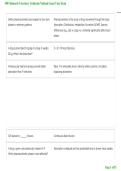
Define pharmacokinetics and explain its four main Pharmacokinetics is the study of drug movement through the body:
phases in veterinary patients. Absorption, Distribution, Metabolism, Excretion (ADME). Species
differences (e.g., cats vs. dogs vs. ruminants) significantly affect each
phase.
A dog is prescribed 5 mg/kg of a drug. It weighs 5 × 22 = 110 mg total dose.
22 kg. What is the total dose?
Intramuscular injections always provide faster False. IV is immediate since it directly enters systemic circulation,
absorption than IV injections. bypassing absorption.
CRI stands for __________ infusion. Continuous Rate Infusion.
A drug is given subcutaneously instead of IV. Absorption is delayed and less predictable due to slower tissue uptake.
Which pharmacokinetic phase is most affected?
Page 1 of 53
,500 Flashcards Veterinary Technician National Exam (Vtne) Exam
Which organ is primarily responsible for drug Liver (hepatic cytochrome P450 enzymes).
metabolism?
A drug causes tachycardia as a side effect. What A systemic adverse cardiovascular effect.
type of effect is this?
Calculate: 250 mL fluid over 5 hours. mL/hr? 250 ÷ 5 = 50 mL/hr.
Drugs with narrow therapeutic index require Frequent therapeutic drug monitoring.
__________ monitoring.
Cat receives dog dose of acetaminophen. Major Severe toxicity due to lack of glucuronidation → liver failure and
risk? methemoglobinemia.
NSAIDs inhibit cyclooxygenase enzymes. True (COX inhibition → decreased prostaglandins).
What is pharmacodynamics? Study of drug effects on the body and receptor interactions.
Page 2 of 53
,500 Flashcards Veterinary Technician National Exam (Vtne) Exam
A 10 kg dog receives 0.2 mg/kg. Stock is 1 mg/mL. Dose = 2 mg → 2 ÷ 1 = 2 mL.
mL needed?
Why is weight verification critical before dosing? Prevents dose miscalculation leading to toxicity or therapeutic failure.
Controlled substances are regulated under DEA I-V schedules.
schedules __________.
Which routes avoid first-pass metabolism? IV, IM, SC, transdermal (partial).
Drug is highly protein-bound. What happens in Increased free drug → toxicity risk increases.
hypoalbuminemia?
Lipophilic drugs are rapidly excreted. False; they are stored in fat and eliminated slowly.
Mechanism of opioids? Bind mu, kappa, delta receptors → analgesia and sedation.
Most common route for emergency drug Intravenous (IV).
administration?
CRI miscalculation leads to overdose. Immediate Hemodynamic instability, toxicity, possible death.
risk?
Page 3 of 53
, 500 Flashcards Veterinary Technician National Exam (Vtne) Exam
Drug class linked to renal toxicity? Aminoglycosides (e.g., gentamicin).
All antibiotics are safe in pregnancy. False; tetracyclines and fluoroquinolones are harmful.
Define bioavailability. Fraction of drug reaching systemic circulation unchanged.
Antidote for acetaminophen toxicity is ________. N-acetylcysteine (NAC).
Dog receives insulin overdose. First clinical sign? Hypoglycemia → weakness, seizures, collapse.
What affects drug distribution most? Blood flow, lipid solubility, protein binding.
IV drugs require absorption phase. False, they directly enter bloodstream.
Purpose of controlled drug logs? Track usage, prevent diversion, ensure legal compliance.
Page 4 of 53
Define pharmacokinetics and explain its four main Pharmacokinetics is the study of drug movement through the body:
phases in veterinary patients. Absorption, Distribution, Metabolism, Excretion (ADME). Species
differences (e.g., cats vs. dogs vs. ruminants) significantly affect each
phase.
A dog is prescribed 5 mg/kg of a drug. It weighs 5 × 22 = 110 mg total dose.
22 kg. What is the total dose?
Intramuscular injections always provide faster False. IV is immediate since it directly enters systemic circulation,
absorption than IV injections. bypassing absorption.
CRI stands for __________ infusion. Continuous Rate Infusion.
A drug is given subcutaneously instead of IV. Absorption is delayed and less predictable due to slower tissue uptake.
Which pharmacokinetic phase is most affected?
Page 1 of 53
,500 Flashcards Veterinary Technician National Exam (Vtne) Exam
Which organ is primarily responsible for drug Liver (hepatic cytochrome P450 enzymes).
metabolism?
A drug causes tachycardia as a side effect. What A systemic adverse cardiovascular effect.
type of effect is this?
Calculate: 250 mL fluid over 5 hours. mL/hr? 250 ÷ 5 = 50 mL/hr.
Drugs with narrow therapeutic index require Frequent therapeutic drug monitoring.
__________ monitoring.
Cat receives dog dose of acetaminophen. Major Severe toxicity due to lack of glucuronidation → liver failure and
risk? methemoglobinemia.
NSAIDs inhibit cyclooxygenase enzymes. True (COX inhibition → decreased prostaglandins).
What is pharmacodynamics? Study of drug effects on the body and receptor interactions.
Page 2 of 53
,500 Flashcards Veterinary Technician National Exam (Vtne) Exam
A 10 kg dog receives 0.2 mg/kg. Stock is 1 mg/mL. Dose = 2 mg → 2 ÷ 1 = 2 mL.
mL needed?
Why is weight verification critical before dosing? Prevents dose miscalculation leading to toxicity or therapeutic failure.
Controlled substances are regulated under DEA I-V schedules.
schedules __________.
Which routes avoid first-pass metabolism? IV, IM, SC, transdermal (partial).
Drug is highly protein-bound. What happens in Increased free drug → toxicity risk increases.
hypoalbuminemia?
Lipophilic drugs are rapidly excreted. False; they are stored in fat and eliminated slowly.
Mechanism of opioids? Bind mu, kappa, delta receptors → analgesia and sedation.
Most common route for emergency drug Intravenous (IV).
administration?
CRI miscalculation leads to overdose. Immediate Hemodynamic instability, toxicity, possible death.
risk?
Page 3 of 53
, 500 Flashcards Veterinary Technician National Exam (Vtne) Exam
Drug class linked to renal toxicity? Aminoglycosides (e.g., gentamicin).
All antibiotics are safe in pregnancy. False; tetracyclines and fluoroquinolones are harmful.
Define bioavailability. Fraction of drug reaching systemic circulation unchanged.
Antidote for acetaminophen toxicity is ________. N-acetylcysteine (NAC).
Dog receives insulin overdose. First clinical sign? Hypoglycemia → weakness, seizures, collapse.
What affects drug distribution most? Blood flow, lipid solubility, protein binding.
IV drugs require absorption phase. False, they directly enter bloodstream.
Purpose of controlled drug logs? Track usage, prevent diversion, ensure legal compliance.
Page 4 of 53


