
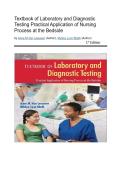
Textbook of Laboratory and Diagnostic
Testing Practical Application of Nursing
Process at the Bedside
by Anne M Van Leeuwen (Author), Mickey Lynn Bladh (Author)
1st Edition
,TABLE OF CONTENTS
UNIT I — Foundations of Laboratory & Diagnostic Testing
ChapterTitle
1 Introduction to Laboratory and Diagnostic Testing
2 Specimen Collection, Handling, and Processing
UNIT II — Hematology, Coagulation, and Immunology
ChapterTitle
3 Hematology
4 Coagulation Studies
5 Immunology and Serology
UNIT III — Body Fluids and Clinical Chemistry
ChapterTitle
6 Urinalysis and Body Fluid Analysis
7 Clinical Chemistry
8 Arterial Blood Gases and Acid–Base Balance
UNIT IV — Specialized Laboratory Testing
ChapterTitle
9 Endocrinology
10 Toxicology and Therapeutic Drug Monitoring
11 Microbiology and Infectious Disease
12 Molecular Diagnostics and Genetics
UNIT V — Diagnostic Testing by Body System
ChapterTitle
13 Cardiovascular System
14 Respiratory System
15 Gastrointestinal System
16 Hepatobiliary System
17 Renal and Urologic System
18 Reproductive System
,19 Musculoskeletal System
20 Neurologic System
21 Sensory Systems (Ophthalmologic and Auditory)
22 Integumentary System
, Test Bank: Textbook of Laboratory and Diagnostic Testing, 1st Edition
Van Leeuwen, 2017
Chapters 1-22
CHAPTER 1: Overview of Laboratory and Diagnostic Testing
Multiple Choice Questions
1. The nurse understands that the primary purpose of laboratory and diagnostic testing is to:
a) Replace the physical assessment
b) Provide objective data to assist in the diagnosis and management of patient conditions
c) Confirm the physician's initial impression in all cases
d) Eliminate the need for patient history taking
Answer: B
Rationale: Laboratory and diagnostic testing provides objective, measurable data that assists healthcare
providers in diagnosing, managing, and monitoring patient conditions. It supplements but does not
replace the history and physical examination.
2. Which of the following best describes a "critical value" in laboratory testing?
a) Any abnormal result that falls outside the reference range
b) A result that indicates a life-threatening condition requiring immediate notification
c) A value that is slightly elevated above normal limits
d) A result that requires repeat testing for confirmation
Answer: B
Rationale: Critical values (also called panic values) are results that indicate a potentially life-threatening
situation and require immediate notification of the healthcare provider so that prompt treatment can
be initiated.
3. When interpreting laboratory results, the nurse should consider:
Testing Practical Application of Nursing
Process at the Bedside
by Anne M Van Leeuwen (Author), Mickey Lynn Bladh (Author)
1st Edition
,TABLE OF CONTENTS
UNIT I — Foundations of Laboratory & Diagnostic Testing
ChapterTitle
1 Introduction to Laboratory and Diagnostic Testing
2 Specimen Collection, Handling, and Processing
UNIT II — Hematology, Coagulation, and Immunology
ChapterTitle
3 Hematology
4 Coagulation Studies
5 Immunology and Serology
UNIT III — Body Fluids and Clinical Chemistry
ChapterTitle
6 Urinalysis and Body Fluid Analysis
7 Clinical Chemistry
8 Arterial Blood Gases and Acid–Base Balance
UNIT IV — Specialized Laboratory Testing
ChapterTitle
9 Endocrinology
10 Toxicology and Therapeutic Drug Monitoring
11 Microbiology and Infectious Disease
12 Molecular Diagnostics and Genetics
UNIT V — Diagnostic Testing by Body System
ChapterTitle
13 Cardiovascular System
14 Respiratory System
15 Gastrointestinal System
16 Hepatobiliary System
17 Renal and Urologic System
18 Reproductive System
,19 Musculoskeletal System
20 Neurologic System
21 Sensory Systems (Ophthalmologic and Auditory)
22 Integumentary System
, Test Bank: Textbook of Laboratory and Diagnostic Testing, 1st Edition
Van Leeuwen, 2017
Chapters 1-22
CHAPTER 1: Overview of Laboratory and Diagnostic Testing
Multiple Choice Questions
1. The nurse understands that the primary purpose of laboratory and diagnostic testing is to:
a) Replace the physical assessment
b) Provide objective data to assist in the diagnosis and management of patient conditions
c) Confirm the physician's initial impression in all cases
d) Eliminate the need for patient history taking
Answer: B
Rationale: Laboratory and diagnostic testing provides objective, measurable data that assists healthcare
providers in diagnosing, managing, and monitoring patient conditions. It supplements but does not
replace the history and physical examination.
2. Which of the following best describes a "critical value" in laboratory testing?
a) Any abnormal result that falls outside the reference range
b) A result that indicates a life-threatening condition requiring immediate notification
c) A value that is slightly elevated above normal limits
d) A result that requires repeat testing for confirmation
Answer: B
Rationale: Critical values (also called panic values) are results that indicate a potentially life-threatening
situation and require immediate notification of the healthcare provider so that prompt treatment can
be initiated.
3. When interpreting laboratory results, the nurse should consider:


