

Written by students who passed Immediately available after payment Read online or as PDF Wrong document? Swap it for free 4.6 TrustPilot
logo-home
Document preview thumbnail
Preview 2 out of 8 pages
Exam (elaborations)

NEIEP 600 Final Exam 2026/2027 – 80+ Questions & Answers | Diodes, Rectifiers, SCR/TRIAC, Op-Amps, Digital Logic, Binary, AC/DC Circuits & Troubleshooting

Document preview thumbnail
Preview 2 out of 8 pages

This comprehensive NEIEP 600 Final Exam 2026/2027 study guide contains 80+ actual-style questions with answers across 8 pages, providing concentrated review of electronics and electrical troubleshooting concepts. The material covers semiconductor diodes, half-wave and full-wave rectification, bridge rectifiers, filtering, transformers, Zener diodes, SCRs, TRIACs and DIACs, phase control, operational amplifiers, digital logic gates, binary numbering, flip-flops, AC/DC fundamentals, capacitance, inductance, circuit protection, relays, three-phase motors, safety circuits, and systematic troubleshooting. The opening section focuses heavily on diodes, biasing, and rectifier circuits. Students review one-direction current flow, forward and reverse bias, half-wave rectifiers using one diode, full-wave rectification, four-diode bridge rectifiers, and the differences between half-wave and full-wave outputs. The questions then introduce ripple voltage, filtering, filter capacitance, transformers, AC-to-DC power supplies, and the use of Zener diodes for voltage regulation. A key section addresses SCR, TRIAC, DIAC, and phase-control principles. The document reviews the gate trigger and forward-bias conditions needed to turn on an SCR, holding current, the bidirectional AC conduction characteristics of a TRIAC, DIAC triggering, and regulation of output power by controlling the firing angle. Students also review how increasing the firing-angle delay affects delivered output power. The material then moves into operational amplifiers and electronic control concepts. Questions cover the basic purpose of an op-amp, its two inputs, negative feedback, gain stabilization, output saturation following loss of feedback, and comparator operation. This provides a concise foundation for recognizing the behavior of analog electronic control circuits. Another major topic is digital electronics and logic gates. Students review binary HIGH and LOW states and the operation of AND, OR, NOT, NAND, NOR, XOR, and XNOR gates. The guide explains the conditions required for each gate's output and introduces truth tables as a method of representing all possible combinations of digital inputs and outputs. The binary numbering and digital storage section covers powers of two, the significance of the rightmost binary bit, binary-to-decimal and decimal-to-binary conversion, four-bit number capacity, and binary addition. Examples include converting 1010 to decimal 10, 1111 to decimal 15, and decimal 7 to binary 111. Students also review flip-flops for binary data storage, clock signals, square waves, synchronization of digital circuits, and Gray code for preventing ambiguous transitions. The document reinforces fundamental electrical theory and Ohm's Law, including voltage as electrical potential difference, current as electron flow, resistance as opposition to current, the relationship V = I × R, and electrical power as voltage multiplied by current. AC and DC are distinguished by alternating versus constant polarity, while frequency, capacitance, and inductance are reviewed in hertz, farads, and henrys respectively. Students also review reactive components and AC behavior. The guide identifies capacitors as storing energy in electric fields and inductors as storing energy in magnetic fields. It tests the inverse relationship between frequency and capacitive reactance, the direct relationship between frequency and inductive reactance, RMS voltage as an equivalent DC heating value, and the 1.414 multiplier used to relate RMS and peak voltage in the context presented by the document. The final pages provide especially practical preparation in electrical and elevator-system troubleshooting. Questions distinguish open circuits from short circuits, explain fuse operation during overcurrent, and connect specific symptoms to likely faults. Examples include suspecting an open circuit when voltage is present but current does not flow, a short circuit when a fuse repeatedly opens, a loose connection when equipment responds to tapping, an open relay coil when voltage is present but the relay will not energize, and low voltage as a likely cause of relay chatter. The troubleshooting section also addresses three-phase motors and elevator safety circuits. A motor that hums but does not turn is associated in the material with mechanical binding or phase loss, while loss of one phase in a three-phase motor is linked to overheating and reduced torque. When elevator doors operate but the car does not run, the study guide directs attention to the safety circuit. It identifies verifying power and safety circuits as the first troubleshooting step and contrasts logical cause-and-effect diagnosis with indiscriminate component replacement or “shotgunning.” Relevant Students This document is particularly relevant for NEIEP 600 students, NEIEP final exam candidates, elevator industry apprentices, elevator constructor apprentices, elevator mechanics in training, electrical troubleshooting students, industrial electronics students, electrical technology students, elevator electrical systems learners, and technicians reviewing electronic control fundamentals. It is especially useful for learners seeking focused question-and-answer preparation in semiconductor devices, rectification, digital logic, binary systems, AC/DC fundamentals, relays, motors, safety circuits, and logical troubleshooting. Keywords NEIEP 600 Final Exam 2026/2027, NEIEP 600 questions and answers, NEIEP 600 exam study guide, NEIEP final exam, elevator apprenticeship exam, elevator electronics exam, elevator electrical troubleshooting, elevator safety circuit, electrical troubleshooting questions, electronics final exam, diode questions and answers, forward bias, reverse bias, half wave rectifier, full wave rectifier, bridge rectifier, ripple voltage, power supply filtering, Zener diode, voltage regulation, SCR electronics, silicon controlled rectifier, TRIAC, DIAC, phase control, firing angle, operational amplifier, op amp, comparator circuit, digital logic gates, AND gate, OR gate, NOT gate, NAND gate, NOR gate, XOR gate, XNOR gate, truth tables, binary numbers, binary conversion, flip flop, clock signal, Gray code, Ohms Law, AC DC circuits, capacitance, inductance, capacitive reactance, inductive reactance, RMS voltage, electrical power, open circuit, short circuit, relay troubleshooting, three phase motor, elevator motor troubleshooting, NEIEP exam preparation

Content preview

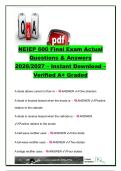
NEIEP 600 Final Exam Actual
Questions & Answers
2026/2027 – Instant Download –
Verified A+ Graded

A diode allows current to flow in: - ANSWER ✔✔One direction


A diode is forward biased when the anode is: - ANSWER ✔✔Positive

relative to the cathode


A diode is reverse biased when the cathode is: - ANSWER

✔✔Positive relative to the anode


A half-wave rectifier uses: - ANSWER ✔✔One diode


A full-wave rectifier uses: - ANSWER ✔✔Two diodes


A bridge rectifier uses: - ANSWER ✔✔Four diodes

, The output of a half-wave rectifier contains: - ANSWER ✔✔One half

of the AC cycle


The output of a full-wave rectifier contains: - ANSWER ✔✔Both

halves of the AC cycle


Ripple voltage is defined as: - ANSWER ✔✔AC variation on DC

output


Filtering is used to: - ANSWER ✔✔Reduce ripple voltage


Increasing filter capacitance will: - ANSWER ✔✔Reduce ripple


A transformer is used to: - ANSWER ✔✔Change voltage levels


A power supply converts: - ANSWER ✔✔AC to DC


A Zener diode is primarily used for: - ANSWER ✔✔Voltage regulation


A Zener diode operates in: - ANSWER ✔✔Reverse bias


If a Zener diode fails open, output voltage will: - ANSWER ✔✔Rise

toward input voltage


SCR stands for: - ANSWER ✔✔Silicon Controlled Rectifier (double

check this)

Document information

Uploaded on
August 27, 2026
Number of pages
8
Written in
2026/2027
Type
Exam (elaborations)
Contains
Questions & answers
$18.99

Wrong document? Swap it for free Within 14 days of purchase and before downloading, you can choose a different document. You can simply spend the amount again.
Written by students who passed
Immediately available after payment
Read online or as PDF

Seller avatar
Reputation scores are based on the amount of documents a seller has sold for a fee and the reviews they have received for those documents. There are three levels: Bronze, Silver and Gold. The better the reputation, the more your can rely on the quality of the sellers work.
JOSHCLAY
3.5
(83)
Sold
390
Followers
16
Items
20497
Last sold
1 day ago


Why students choose Stuvia

Created by fellow students, verified by reviews

Quality you can trust: written by students who passed their tests and reviewed by others who've used these notes.

Didn't get what you expected? Choose another document

No worries! You can instantly pick a different document that better fits what you're looking for.

Pay as you like, start learning right away

No subscription, no commitments. Pay the way you're used to via credit card and download your PDF document instantly.

Student with book image

“Bought, downloaded, and aced it. It really can be that simple.”

Alisha Student

Working on your references?

Create accurate citations in APA, MLA and Harvard with our free citation generator.

Working on your references?

Frequently asked questions

