
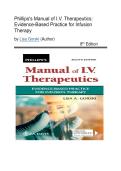
Phillips's Manual of I.V. Therapeutics:
Evidence-Based Practice for Infusion
Therapy
by Lisa Gorski (Author)
8th Edition
,TABLE OF CONTENTS
1 Overview: Professional Practice Issues and Infusion Therapy
2 Infection Prevention and Occupational Risks
3 Fundamentals of Fluid and Electrolyte Balance
4 Infusion Fluid Administration
5 Infusion Equipment
6 Peripheral IV Catheter Insertion and Management
7 Phlebotomy Techniques
8 Central Vascular Access
9 Complications of Infusion Therapy: Peripheral and Central Vascular Access
Devices
10 Infusion Medication Safety, Methods, and Routes
11 Transfusion Therapy
12 Parenteral Nutrition
13 Introduction to Biologic Therapies
,Test Bank: Phillips's Manual of I.V. Therapeutics, 8th Edition (Gorski,
2023)
Chapters 1–13
CHAPTER 1: Professional Practice Concepts for Infusion Therapy
Multiple Choice Questions
1. Which organization is considered the primary authority for establishing infusion
therapy standards of practice?
A) American Nurses Association (ANA)
B) Infusion Nurses Society (INS)
C) Centers for Disease Control and Prevention (CDC)
D) The Joint Commission (TJC)
Answer: B
Rationale: The Infusion Nurses Society (INS) develops and publishes the Infusion
Therapy Standards of Practice, which serves as the primary guide for evidence-
based infusion nursing practice.
2. The nurse understands that evidence-based practice in infusion therapy
involves:
A) Following traditional nursing practices passed down from experienced nurses
B) Integrating best research evidence with clinical expertise and patient values
C) Relying solely on randomized controlled trials
D) Implementing only physician-directed protocols
Answer: B
, Rationale: Evidence-based practice integrates the best available research
evidence with clinical expertise and patient preferences/values to guide clinical
decision-making.
3. Which level of evidence is considered the strongest for guiding clinical practice?
A) Expert opinion
B) Case studies
C) Systematic reviews and meta-analyses of randomized controlled trials
D) Descriptive studies
Answer: C
Rationale: Systematic reviews and meta-analyses of RCTs represent the highest
level of evidence in the evidence hierarchy.
4. A nurse who holds the CRNI® credential has demonstrated competency
through:
A) Completing a hospital orientation program
B) Passing a national certification examination in infusion nursing
C) Obtaining a master's degree in nursing
D) Working in infusion therapy for at least 10 years
Answer: B
Rationale: The CRNI® (Certified Registered Nurse Infusion) credential is obtained
by passing a certification examination administered by the Infusion Nurses
Certification Corporation (INCC).
Evidence-Based Practice for Infusion
Therapy
by Lisa Gorski (Author)
8th Edition
,TABLE OF CONTENTS
1 Overview: Professional Practice Issues and Infusion Therapy
2 Infection Prevention and Occupational Risks
3 Fundamentals of Fluid and Electrolyte Balance
4 Infusion Fluid Administration
5 Infusion Equipment
6 Peripheral IV Catheter Insertion and Management
7 Phlebotomy Techniques
8 Central Vascular Access
9 Complications of Infusion Therapy: Peripheral and Central Vascular Access
Devices
10 Infusion Medication Safety, Methods, and Routes
11 Transfusion Therapy
12 Parenteral Nutrition
13 Introduction to Biologic Therapies
,Test Bank: Phillips's Manual of I.V. Therapeutics, 8th Edition (Gorski,
2023)
Chapters 1–13
CHAPTER 1: Professional Practice Concepts for Infusion Therapy
Multiple Choice Questions
1. Which organization is considered the primary authority for establishing infusion
therapy standards of practice?
A) American Nurses Association (ANA)
B) Infusion Nurses Society (INS)
C) Centers for Disease Control and Prevention (CDC)
D) The Joint Commission (TJC)
Answer: B
Rationale: The Infusion Nurses Society (INS) develops and publishes the Infusion
Therapy Standards of Practice, which serves as the primary guide for evidence-
based infusion nursing practice.
2. The nurse understands that evidence-based practice in infusion therapy
involves:
A) Following traditional nursing practices passed down from experienced nurses
B) Integrating best research evidence with clinical expertise and patient values
C) Relying solely on randomized controlled trials
D) Implementing only physician-directed protocols
Answer: B
, Rationale: Evidence-based practice integrates the best available research
evidence with clinical expertise and patient preferences/values to guide clinical
decision-making.
3. Which level of evidence is considered the strongest for guiding clinical practice?
A) Expert opinion
B) Case studies
C) Systematic reviews and meta-analyses of randomized controlled trials
D) Descriptive studies
Answer: C
Rationale: Systematic reviews and meta-analyses of RCTs represent the highest
level of evidence in the evidence hierarchy.
4. A nurse who holds the CRNI® credential has demonstrated competency
through:
A) Completing a hospital orientation program
B) Passing a national certification examination in infusion nursing
C) Obtaining a master's degree in nursing
D) Working in infusion therapy for at least 10 years
Answer: B
Rationale: The CRNI® (Certified Registered Nurse Infusion) credential is obtained
by passing a certification examination administered by the Infusion Nurses
Certification Corporation (INCC).


