

Written by students who passed Immediately available after payment Read online or as PDF Wrong document? Swap it for free 4.6 TrustPilot
logo-home
Document preview thumbnail
Preview 4 out of 43 pages
Exam (elaborations)

IVCA Exam 2026/2027 – 200+ Questions & Correct Answers | Animal Chiropractic, Equine & Canine Anatomy, Neurology, Biomechanics, Gait & Lameness

Document preview thumbnail
Preview 4 out of 43 pages

This comprehensive IVCA Exam 2026/2027 study guide provides 200+ exam-style questions with correct answers across 43 pages, covering core concepts in animal chiropractic, veterinary anatomy, spinal biomechanics, neurology, chiropractic examination and adjustment, equine and canine locomotion, orthopedic conditions, gait analysis, lameness, and musculoskeletal disorders. The material gives students an extensive question-and-answer review of both theoretical principles and practical animal chiropractic concepts, with particular emphasis on horses and dogs. A major section covers animal spinal anatomy, biomechanics, and motion units. The document reviews shear forces, articulating surfaces, motion units, normal ranges of motion, elastic and anatomical barriers, paraphysiological space, joint play, end play, coupled motion, accessory joint movements, vertebral anatomy, intervertebral foramina, intervertebral discs, the annulus fibrosus and nucleus pulposus, disc nutrition through imbibition, and spinal ligaments. Students also compare important anatomical differences between equine, canine, and feline spines. The guide provides extensive coverage of animal chiropractic examination and adjustment principles. Topics include posture analysis, spinal temperature, gait analysis, static palpation, motion palpation, vertebral subluxation concepts, fixation patterns, line of correction, stabilization, specific thrust, high-velocity low-amplitude adjustment, single- and two-handed adjustment mechanics, and the relationship between force, mass, and acceleration. The material also examines chiropractic concepts such as segmental dysfunction, facilitation, nerve compression theory, compressive myelopathy, viscerosomatic and somatovisceral reflexes, and neurodystrophic concepts. Neuroanatomy, neurophysiology, and proprioception form another substantial part of the review. Questions address neurons, glial cells, Schwann cells, oligodendrocytes, astrocytes, synapses, presynaptic and postsynaptic neurons, resting membrane potential, action potentials, depolarization, hyperpolarization, refractory periods, mechanoreceptors, nociceptors, muscle spindles, Golgi tendon organs, deformation receptors, sensory and motor information, spatial and temporal summation, plasticity, proprioception, nociception, modulation, and central integration. The equine anatomy and biomechanics material includes the vertebral column, pelvis, sacroiliac joint, lumbosacral motion unit, withers, anticlinal vertebra, mammillary processes, nuchal and supraspinous ligaments, shoulder joint, equine hoof, pelvic and hindlimb muscles, and the stay apparatus. Students also review the biomechanical adaptations summarized in the document as the stomatognathic system, engagements, bow-and-string system, and stay apparatus, together with their roles in conserving energy and reducing physical stress. Considerable attention is given to equine and canine gait analysis. The guide reviews the equine walk, trot, canter or lope, gallop, double-suspension gallop, normal backing, stride mechanics, and transfer of energy through the lumbosacral motion unit. Canine and equine conformation, breed-related characteristics, saddle placement, horse measurement, posture, and biomechanical differences are also incorporated into the examination material. The document provides detailed review of spinal and neurological disorders relevant to animal chiropractic assessment. Conditions include hip dysplasia, cauda equina syndrome, degenerative lumbosacral stenosis, sciatica, intervertebral disc disease, Type I and Type II IVDD, fibrocartilaginous embolism, hemivertebra, block vertebrae, butterfly vertebra, spina bifida, dermoid sinus, myasthenia gravis, cervical instability, Wobbler syndrome, vertebral osteomyelitis, discospondylitis, meningitis, atlantoaxial luxation, vertebral canal stenosis, Horner's syndrome, and spinal neoplasia. The later sections offer extensive equine and canine orthopedic and lameness preparation. Students review laminitis and founder, osteoarthritis, bone spavin, windpuffs, navicular disease, popped splints, upward fixation of the patella, stringhalt, canine cruciate injuries, osteochondrosis, elbow dysplasia, osteochondrosis dissecans, bicipital tendinitis, eosinophilic panosteitis, hip dysplasia, and patellar luxation. The material also covers the five grades of lameness and identifies the foot as a major focus when evaluating equine lameness. Additional exam content addresses animal diseases and clinically relevant differential considerations, including equine colic, hardware disease, gastric dilation-volvulus, exertional rhabdomyolysis, polysaccharide storage myopathy, hyperkalemic periodic paralysis, nutritional myopathy, tetanus, canine distemper, rabies, toxoplasmosis, equine herpes, equine encephalitis, EPM, vestibular disease, and infectious spinal conditions. These questions broaden the review beyond manipulation and biomechanics by requiring recognition of disorders that may influence examination or clinical decision-making. For supplementary academic study, the material can be reviewed alongside established veterinary anatomy, neuroanatomy, biomechanics, and animal chiropractic references. Particularly relevant areas of supporting literature include equine and canine functional anatomy, veterinary neurology, orthopedic examination, locomotion and gait analysis, and veterinary chiropractic techniques. The uploaded guide itself does not provide a formal bibliography, so these are appropriate subject areas for deeper reference rather than claimed sources of the individual questions. Relevant Students This document is particularly relevant for IVCA examination candidates, animal chiropractic students, veterinary chiropractic students, veterinarians pursuing animal chiropractic education, chiropractors completing veterinary or animal chiropractic training, equine practitioners, canine practitioners, veterinary rehabilitation students, equine science students, veterinary medicine students, animal biomechanics students, and professionals reviewing equine and canine musculoskeletal assessment. It is especially useful for learners who need concentrated revision in spinal anatomy, chiropractic adjustments, neurophysiology, motion palpation, gait analysis, equine biomechanics, canine biomechanics, orthopedic disorders, and animal lameness. Keywords IVCA Exam 2026/2027, IVCA exam questions and answers, IVCA exam study guide, animal chiropractic exam, veterinary chiropractic exam, animal chiropractic questions, International Veterinary Chiropractic Association exam, veterinary chiropractic study guide, equine chiropractic, canine chiropractic, animal spinal anatomy, veterinary biomechanics, animal biomechanics, spinal motion unit, paraphysiological space, elastic barrier, chiropractic adjustment, HVLA adjustment, motion palpation, static palpation, vertebral subluxation, animal neurology, veterinary neurophysiology, proprioception, mechanoreceptors, nociceptors, muscle spindles, Golgi tendon organs, equine anatomy, canine anatomy, equine spine, canine spine, equine gait analysis, canine gait analysis, equine lameness, veterinary lameness, horse biomechanics, canine biomechanics, sacroiliac joint, lumbosacral spine, intervertebral disc disease, IVDD, Wobbler syndrome, cauda equina syndrome, hip dysplasia, laminitis, founder, navicular disease, cruciate injury, patellar luxation, osteochondrosis, animal chiropractic certification

Content preview

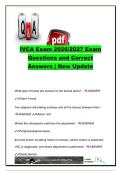
IVCA Exam 2026/2027 Exam
Questions and Correct
Answers | New Update


What type of forces are present on the animal spine? - ANSWER

✔✔Sheer Forces


Two adjacent articulating surfaces and all the tissues between them -

ANSWER ✔✔Motion Unit


Where the chiropractor performs the adjustment - ANSWER

✔✔Paraphysiological space


the area known as taking motion to tension, where motion is assessed,

VSC is diagnosed, and where adjustment is performed - ANSWER

✔✔Elastic Barrier

,chiropractic diagnoses and adjustments are performed within -

ANSWER ✔✔Normal range of motion


When adjusting animals - ANSWER ✔✔Set and Hold


Three parts of the hand that are used for adjusting large animals -

ANSWER ✔✔Thenar


Pisiform

Heel of Hand


Two handed adjustments LOC come from the - ANSWER

✔✔Episternal notch


Singled handed adjustments LOC come from - ANSWER ✔✔Elbow


Bony borders of the spinal canal - ANSWER ✔✔1) Body/Corpus


2) Pedicles (2)

3) Laminae


The canine transverse process is curved for more - ANSWER

✔✔Mobility


The equine transverse process is straight for more - ANSWER

✔✔Weight bearing

,Primary job of ligaments - ANSWER ✔✔Keep Normal Range of

Motion


Annulus Fibrosis - ANSWER ✔✔This portion of the disc provides

stability, has outer pain fibers, less water content, and is fibrous in

textures


nucleus pulposes - ANSWER ✔✔The portion of the disc is mostly

water, has no nerve or blood supply, acts like ball bearing to absorb

shock, and is gelatinous in texture


Imbibition - ANSWER ✔✔How does the disc get nutrition, specifically

in the nucleus pulposes?


Foramen Magnum to L3 - ANSWER ✔✔What is the spinal cord

length in the equine?


Foramen Magnum to L5/L6 - ANSWER ✔✔What is the spinal cord

length in canine?


Foramen Magnum to sacrum - ANSWER ✔✔What is the spinal cord

length in feline?


Intertransverse Joint - ANSWER ✔✔This joint only exists in equines

and rhinos. It provides more stability and motion.

3
COPYRIGHT©JOSHCLAY 2026/2027. YEAR PUBLISHED 2026. COMPANY REGISTRATION NUMBER: 619652435. TERMS OF USE. PRIVACY
STATEMENT. ALL RIGHTS RESERVED

, Flexion and Extension - ANSWER ✔✔What movement does the

intertransverse joint allow?


lateral flexion - ANSWER ✔✔What movement does the

intertransverse joint limit?

1) ligamentum flavum

2) joint capsule


3) Disc - ANSWER ✔✔What are the soft borders of the IVF?


1) Pedicles


2) Vertebral Notches - ANSWER ✔✔What are the bony borders of

IVF?

Occiput

C1


C2 - ANSWER ✔✔What areas in the spine do not allow for coupled

motion?


pubic symphysis - ANSWER ✔✔What is the primary pivot point in the

pelvis?


S1 - ANSWER ✔✔What segment is located in between the tuber

sacrales in the equine spine?

Document information

Uploaded on
August 27, 2026
Number of pages
43
Written in
2026/2027
Type
Exam (elaborations)
Contains
Questions & answers
$18.99

Wrong document? Swap it for free Within 14 days of purchase and before downloading, you can choose a different document. You can simply spend the amount again.
Written by students who passed
Immediately available after payment
Read online or as PDF

Seller avatar
Reputation scores are based on the amount of documents a seller has sold for a fee and the reviews they have received for those documents. There are three levels: Bronze, Silver and Gold. The better the reputation, the more your can rely on the quality of the sellers work.
JOSHCLAY
3.5
(83)
Sold
390
Followers
16
Items
20497
Last sold
1 day ago


Why students choose Stuvia

Created by fellow students, verified by reviews

Quality you can trust: written by students who passed their tests and reviewed by others who've used these notes.

Didn't get what you expected? Choose another document

No worries! You can instantly pick a different document that better fits what you're looking for.

Pay as you like, start learning right away

No subscription, no commitments. Pay the way you're used to via credit card and download your PDF document instantly.

Student with book image

“Bought, downloaded, and aced it. It really can be that simple.”

Alisha Student

Working on your references?

Create accurate citations in APA, MLA and Harvard with our free citation generator.

Working on your references?

Frequently asked questions

