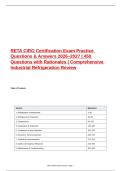
RETA CIRO Certification Exam Practice
Questions & Answers 2026–2027 | 450
Questions with Rationales | Comprehensive
Industrial Refrigeration Review
Table of Contents
Section Questions
1. Refrigeration Fundamentals 1–45
2. Refrigerants & Properties 46–90
3. Compressors 91–135
4. Evaporators & Expansion 136–180
5. Condensers & Heat Rejection 181–225
6. Receivers, Oil & Accessories 226–270
7. Controls & Instrumentation 271–315
8. Safety & Emergency Response 316–360
9. Maintenance & Troubleshooting 361–405
RETA CIRO Practice Exam • Page 1
, 10. Operations, Documentation & System Management 406–450
Study Instructions
• Read each question before reviewing the marked answer.
• Use the rationales to reinforce the underlying refrigeration principle, not just the answer letter.
• Pay special attention to pressure-temperature relationships, superheat/subcooling, compressor protection, safety, controls,
andtroubleshooting.
1. Refrigeration Fundamentals
1. What is the primary function of a refrigeration system in an industrial facility?
A. To increase humidity
B. To remove heat from a space or process
C. To produce steam
D. To burn fuel efficiently
Correct Answer: B. To remove heat from a space or process
Rationale: Industrial refrigeration systems remove heat from a controlled space or process to maintain the desired
operating temperature.
2. Which of the following is a common refrigerant used in industrial ammonia systems?
A. R-134a
B. Ammonia (NH3)
C. R-410A
D. Carbon dioxide (CO2)
Correct Answer: B. Ammonia (NH3)
Rationale: Ammonia (NH3) is a widely used refrigerant in large industrial refrigeration systems because of its
thermodynamic performance and established industrial use.
3. What does the term “suction pressure” refer to?
A. Pressure in the condenser
B. Pressure at the evaporator outlet going to the compressor
C. Pressure in the liquid line
D. Pressure of the refrigerant after expansion
Correct Answer: B. Pressure at the evaporator outlet going to the compressor
Rationale: Suction pressure is the low-side pressure at the compressor inlet and is closely related to evaporator
operating conditions.
4. What is the primary safety concern with ammonia refrigeration systems?
A. Corrosion
B. Toxicity and flammability
C. High operating cost
D. Ice formation
Correct Answer: B. Toxicity and flammability
Rationale: Ammonia presents a significant toxicity hazard and also has flammability considerations, so engineered
controls and emergency procedures are important.
RETA CIRO Practice Exam • Page 2
,5. What device is commonly used to control evaporator pressure in industrial systems?
A. Expansion valve
B. Condenser fan
C. Pressure relief valve
D. Sight glass
Correct Answer: A. Expansion valve
Rationale: An expansion valve meters refrigerant into the evaporator and influences evaporator feed and operating
conditions; pressure-control arrangements vary by system design.
6. Which of the following compressors is most commonly used in large ammonia refrigeration systems?
A. Scroll compressor
B. Centrifugal compressor
C. Reciprocating compressor
D. Rotary compressor
Correct Answer: C. Reciprocating compressor
Rationale: Reciprocating compressors are widely used in industrial ammonia refrigeration because of their reliability,
serviceability, and broad capacity range.
7. What is the purpose of an oil separator in a refrigeration system?
A. To remove water from the refrigerant
B. To remove oil from the refrigerant vapor returning to the compressor
C. To clean the condenser
D. To increase suction pressure
Correct Answer: B. To remove oil from the refrigerant vapor returning to the compressor
Rationale: An oil separator reduces the amount of compressor oil carried with discharge gas, helping promote proper oil
return and lubrication.
8. What is the typical function of a receiver in a refrigeration system?
A. Store liquid refrigerant
B. Increase evaporator temperature
C. Measure pressure
D. Reduce suction pressure
Correct Answer: A. Store liquid refrigerant
Rationale: A receiver acts as a reservoir for liquid refrigerant and can help provide a stable liquid supply to downstream
components.
9. Which instrument is used to measure the superheat of a refrigeration system?
A. Manometer
B. Thermometer and pressure gauge
C. Psychrometer
D. Hydrometer
Correct Answer: B. Thermometer and pressure gauge
Rationale: Superheat is determined by comparing measured vapor temperature with the refrigerant's saturation
temperature corresponding to the measured pressure.
10. What is the purpose of a liquid line sight glass?
RETA CIRO Practice Exam • Page 3
, A. Measure suction pressure
B. Observe refrigerant flow and detect moisture
C. Control evaporator temperature
D. Reduce discharge pressure
Correct Answer: B. Observe refrigerant flow and detect moisture
Rationale: A sight glass provides visual information about liquid-line condition; moisture indicators can also signal the
presence of excessive moisture.
11. During routine industrial refrigeration operation, an operator is evaluating Primary purpose of industrial
refrigeration. Which response is most appropriate?
A. increase humidity
B. produce steam
C. burn fuel efficiently
D. remove heat from a space or process
Correct Answer: D. remove heat from a space or process
Rationale: Industrial refrigeration transfers heat away from a controlled space or process to maintain the desired
temperature.
12. A technician is diagnosing a refrigeration system with emphasis on Primary purpose of industrial
refrigeration. Which conclusion is best supported?
A. produce steam
B. burn fuel efficiently
C. remove heat from a space or process
D. increase humidity
Correct Answer: C. remove heat from a space or process
Rationale: Industrial refrigeration transfers heat away from a controlled space or process to maintain the desired
temperature.
13. During routine industrial refrigeration operation, an operator is evaluating Evaporator function. Which
response is most appropriate?
A. absorb heat from the refrigerated space or process
B. reject heat to ambient air
C. compress vapor
D. store oil
Correct Answer: A. absorb heat from the refrigerated space or process
Rationale: The evaporator is the low-side heat exchanger where refrigerant absorbs heat.
14. A technician is diagnosing a refrigeration system with emphasis on Evaporator function. Which
conclusion is best supported?
A. reject heat to ambient air
B. compress vapor
C. store oil
D. absorb heat from the refrigerated space or process
Correct Answer: D. absorb heat from the refrigerated space or process
Rationale: The evaporator is the low-side heat exchanger where refrigerant absorbs heat.
RETA CIRO Practice Exam • Page 4
Questions & Answers 2026–2027 | 450
Questions with Rationales | Comprehensive
Industrial Refrigeration Review
Table of Contents
Section Questions
1. Refrigeration Fundamentals 1–45
2. Refrigerants & Properties 46–90
3. Compressors 91–135
4. Evaporators & Expansion 136–180
5. Condensers & Heat Rejection 181–225
6. Receivers, Oil & Accessories 226–270
7. Controls & Instrumentation 271–315
8. Safety & Emergency Response 316–360
9. Maintenance & Troubleshooting 361–405
RETA CIRO Practice Exam • Page 1
, 10. Operations, Documentation & System Management 406–450
Study Instructions
• Read each question before reviewing the marked answer.
• Use the rationales to reinforce the underlying refrigeration principle, not just the answer letter.
• Pay special attention to pressure-temperature relationships, superheat/subcooling, compressor protection, safety, controls,
andtroubleshooting.
1. Refrigeration Fundamentals
1. What is the primary function of a refrigeration system in an industrial facility?
A. To increase humidity
B. To remove heat from a space or process
C. To produce steam
D. To burn fuel efficiently
Correct Answer: B. To remove heat from a space or process
Rationale: Industrial refrigeration systems remove heat from a controlled space or process to maintain the desired
operating temperature.
2. Which of the following is a common refrigerant used in industrial ammonia systems?
A. R-134a
B. Ammonia (NH3)
C. R-410A
D. Carbon dioxide (CO2)
Correct Answer: B. Ammonia (NH3)
Rationale: Ammonia (NH3) is a widely used refrigerant in large industrial refrigeration systems because of its
thermodynamic performance and established industrial use.
3. What does the term “suction pressure” refer to?
A. Pressure in the condenser
B. Pressure at the evaporator outlet going to the compressor
C. Pressure in the liquid line
D. Pressure of the refrigerant after expansion
Correct Answer: B. Pressure at the evaporator outlet going to the compressor
Rationale: Suction pressure is the low-side pressure at the compressor inlet and is closely related to evaporator
operating conditions.
4. What is the primary safety concern with ammonia refrigeration systems?
A. Corrosion
B. Toxicity and flammability
C. High operating cost
D. Ice formation
Correct Answer: B. Toxicity and flammability
Rationale: Ammonia presents a significant toxicity hazard and also has flammability considerations, so engineered
controls and emergency procedures are important.
RETA CIRO Practice Exam • Page 2
,5. What device is commonly used to control evaporator pressure in industrial systems?
A. Expansion valve
B. Condenser fan
C. Pressure relief valve
D. Sight glass
Correct Answer: A. Expansion valve
Rationale: An expansion valve meters refrigerant into the evaporator and influences evaporator feed and operating
conditions; pressure-control arrangements vary by system design.
6. Which of the following compressors is most commonly used in large ammonia refrigeration systems?
A. Scroll compressor
B. Centrifugal compressor
C. Reciprocating compressor
D. Rotary compressor
Correct Answer: C. Reciprocating compressor
Rationale: Reciprocating compressors are widely used in industrial ammonia refrigeration because of their reliability,
serviceability, and broad capacity range.
7. What is the purpose of an oil separator in a refrigeration system?
A. To remove water from the refrigerant
B. To remove oil from the refrigerant vapor returning to the compressor
C. To clean the condenser
D. To increase suction pressure
Correct Answer: B. To remove oil from the refrigerant vapor returning to the compressor
Rationale: An oil separator reduces the amount of compressor oil carried with discharge gas, helping promote proper oil
return and lubrication.
8. What is the typical function of a receiver in a refrigeration system?
A. Store liquid refrigerant
B. Increase evaporator temperature
C. Measure pressure
D. Reduce suction pressure
Correct Answer: A. Store liquid refrigerant
Rationale: A receiver acts as a reservoir for liquid refrigerant and can help provide a stable liquid supply to downstream
components.
9. Which instrument is used to measure the superheat of a refrigeration system?
A. Manometer
B. Thermometer and pressure gauge
C. Psychrometer
D. Hydrometer
Correct Answer: B. Thermometer and pressure gauge
Rationale: Superheat is determined by comparing measured vapor temperature with the refrigerant's saturation
temperature corresponding to the measured pressure.
10. What is the purpose of a liquid line sight glass?
RETA CIRO Practice Exam • Page 3
, A. Measure suction pressure
B. Observe refrigerant flow and detect moisture
C. Control evaporator temperature
D. Reduce discharge pressure
Correct Answer: B. Observe refrigerant flow and detect moisture
Rationale: A sight glass provides visual information about liquid-line condition; moisture indicators can also signal the
presence of excessive moisture.
11. During routine industrial refrigeration operation, an operator is evaluating Primary purpose of industrial
refrigeration. Which response is most appropriate?
A. increase humidity
B. produce steam
C. burn fuel efficiently
D. remove heat from a space or process
Correct Answer: D. remove heat from a space or process
Rationale: Industrial refrigeration transfers heat away from a controlled space or process to maintain the desired
temperature.
12. A technician is diagnosing a refrigeration system with emphasis on Primary purpose of industrial
refrigeration. Which conclusion is best supported?
A. produce steam
B. burn fuel efficiently
C. remove heat from a space or process
D. increase humidity
Correct Answer: C. remove heat from a space or process
Rationale: Industrial refrigeration transfers heat away from a controlled space or process to maintain the desired
temperature.
13. During routine industrial refrigeration operation, an operator is evaluating Evaporator function. Which
response is most appropriate?
A. absorb heat from the refrigerated space or process
B. reject heat to ambient air
C. compress vapor
D. store oil
Correct Answer: A. absorb heat from the refrigerated space or process
Rationale: The evaporator is the low-side heat exchanger where refrigerant absorbs heat.
14. A technician is diagnosing a refrigeration system with emphasis on Evaporator function. Which
conclusion is best supported?
A. reject heat to ambient air
B. compress vapor
C. store oil
D. absorb heat from the refrigerated space or process
Correct Answer: D. absorb heat from the refrigerated space or process
Rationale: The evaporator is the low-side heat exchanger where refrigerant absorbs heat.
RETA CIRO Practice Exam • Page 4