

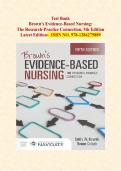
Test Bank
Brown's Evidence-Based Nursing:
The Research-Practice Connection, 5th Edition
Latest Edition- ISBN NO. 978-1284275889
,Test Bank for Brown's Evidence-Based Nursing: The
Research-Practice Connection, 5th Edition (Brand
New) 550 Comprehensive Multichoice Questions with
Answers and Detailed Rationales (All Chapters
inclusive)
Table of Contents
Question
Chapter Title
Numbers
1 The Research-Practice Connection 1-35
2 Research Evidence 36-65
3 Reading Research Articles 66-100
4 Qualitative Research 101-135
5 Quantitative Descriptive Research 136-170
6 Correlational Research 171-210
7 Experimental Research 211-250
8 Cohort Research 251-285
9 Systematic Reviews 286-320
10 Evidence-Based Clinical Practice Guidelines 321-355
11 Asking Clinical Questions 356-390
12 Searching for Research Evidence 391-425
, Question
Chapter Title
Numbers
13 Appraising Research Evidence 426-460
14 Appraising Recommendations of Clinical Practice Guidelines 461-490
Appraising Conclusions of Systematic Reviews with Narrative
15 491-515
Synthesis
16 Appraising Findings of Original Studies 516-535
17 Evidence-Based Practice Strategies 536-545
18 Evidence-Based Practice Participation 546-548
19 Point-of-Care Adaptations 549-550
, Chapter 1: The Research-Practice Connection
1. What is the primary purpose of evidence-based practice (EBP) in nursing?
A. To replace all traditional nursing practices with new ones
B. To integrate the best available research evidence with clinical expertise and
patient values
C. To eliminate the need for clinical judgment in patient care
D. To standardize all nursing care across all healthcare settings
Correct Answer: B
Rationale: Evidence-based practice is a multi-step approach to healthcare delivery
that requires the ability to assess, interpret, and integrate current research to apply
to day-to-day clinical problems. It integrates the best available research evidence
with clinical expertise and patient values and preferences. Option A is incorrect
because EBP does not aim to replace all traditional practices; rather, it builds upon
existing knowledge. Option C is incorrect because EBP actually enhances clinical
judgment rather than eliminating it. Option D is incorrect because EBP
acknowledges that patient care must be individualized.
DIF: Remembering | KEY: Evidence-Based Practice | MSC: Management of Care
| NOT: Chapter 1, The Research-Practice Connection
2. Which of the following best describes the "research-practice gap" in
nursing?
A. The difference between nursing research conducted in academic settings and
clinical settings
B. The time lag between the discovery of new evidence and its implementation in
clinical practice
C. The gap between nurses' educational preparation and their clinical competencies
D. The difference between qualitative and quantitative research methodologies
Correct Answer: B
Rationale: The research-practice gap refers to the delay or disconnect between the
generation of research evidence and its actual application in clinical practice
settings. This gap represents a significant challenge in healthcare, as patients may
Brown's Evidence-Based Nursing:
The Research-Practice Connection, 5th Edition
Latest Edition- ISBN NO. 978-1284275889
,Test Bank for Brown's Evidence-Based Nursing: The
Research-Practice Connection, 5th Edition (Brand
New) 550 Comprehensive Multichoice Questions with
Answers and Detailed Rationales (All Chapters
inclusive)
Table of Contents
Question
Chapter Title
Numbers
1 The Research-Practice Connection 1-35
2 Research Evidence 36-65
3 Reading Research Articles 66-100
4 Qualitative Research 101-135
5 Quantitative Descriptive Research 136-170
6 Correlational Research 171-210
7 Experimental Research 211-250
8 Cohort Research 251-285
9 Systematic Reviews 286-320
10 Evidence-Based Clinical Practice Guidelines 321-355
11 Asking Clinical Questions 356-390
12 Searching for Research Evidence 391-425
, Question
Chapter Title
Numbers
13 Appraising Research Evidence 426-460
14 Appraising Recommendations of Clinical Practice Guidelines 461-490
Appraising Conclusions of Systematic Reviews with Narrative
15 491-515
Synthesis
16 Appraising Findings of Original Studies 516-535
17 Evidence-Based Practice Strategies 536-545
18 Evidence-Based Practice Participation 546-548
19 Point-of-Care Adaptations 549-550
, Chapter 1: The Research-Practice Connection
1. What is the primary purpose of evidence-based practice (EBP) in nursing?
A. To replace all traditional nursing practices with new ones
B. To integrate the best available research evidence with clinical expertise and
patient values
C. To eliminate the need for clinical judgment in patient care
D. To standardize all nursing care across all healthcare settings
Correct Answer: B
Rationale: Evidence-based practice is a multi-step approach to healthcare delivery
that requires the ability to assess, interpret, and integrate current research to apply
to day-to-day clinical problems. It integrates the best available research evidence
with clinical expertise and patient values and preferences. Option A is incorrect
because EBP does not aim to replace all traditional practices; rather, it builds upon
existing knowledge. Option C is incorrect because EBP actually enhances clinical
judgment rather than eliminating it. Option D is incorrect because EBP
acknowledges that patient care must be individualized.
DIF: Remembering | KEY: Evidence-Based Practice | MSC: Management of Care
| NOT: Chapter 1, The Research-Practice Connection
2. Which of the following best describes the "research-practice gap" in
nursing?
A. The difference between nursing research conducted in academic settings and
clinical settings
B. The time lag between the discovery of new evidence and its implementation in
clinical practice
C. The gap between nurses' educational preparation and their clinical competencies
D. The difference between qualitative and quantitative research methodologies
Correct Answer: B
Rationale: The research-practice gap refers to the delay or disconnect between the
generation of research evidence and its actual application in clinical practice
settings. This gap represents a significant challenge in healthcare, as patients may


