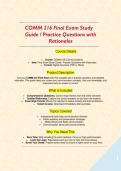
COMM 216 Final Exam Study
Guide / Practice Questions with
Rationales
Course Details
• Course: COMM 216 (Communications)
• Item: Final Exam Study Guide / Practice Questions with Rationales
• Format: Digital document (PDF or Word)
Product Description
Ace your COMM 216 Final Exam with this complete set of practice questions and detailed
rationales. This guide helps you review core communication concepts, test your knowledge, and
understand why an answer is correct.
What Is Included
• Comprehensive Questions: Covers major themes from the entire semester.
• Detailed Rationales: Explains the correct answers so you learn the material.
• Exam-Style Format: Mimics the real test to reduce anxiety and build confidence.
• Instant Access: Download immediately after purchase.
Topics Covered
• Interpersonal and mass communication theories
• Public speaking and presentation strategies
• Media effects and digital communication
• Communication ethics and cultural contexts
Why You Need This
• Save Time: Skip rereading the entire textbook. Focus on high-yield concepts.
• Learn the Logic: Rationales teach you how to think like the professor.
• Boost Your Grade: Practice active recall to secure a higher score on your final.
1
, 1. Integrity
The appropriateness of a corporation's behaviour and its adherence to moral guidelines
acceptable to society such as honesty, fairness, and justice.
•
• Rationale: Integrity functions as the foundational pillar of ethical business operations. It
bridges the gap between legal compliance and societal expectations by aligning corporate
behavior with deeper values of honesty and justice, which directly builds long-term
institutional reputation.
2. Ethics of Business
The rules, standards, codes, or principles that provide guidance for morally appropriate
behaviour in managerial decision making relating to the operation of the business enterprise's
and business' relationship with society.
•
• Rationale: Business ethics serve as the operational framework for decision-making.
Unlike personal morality, business ethics structurally institutionalize rules and codes
(such as corporate policies) to navigate complex commercial dilemmas and balance a
firm's responsibilities to external stakeholders.
3. Stakeholder
An individual, group, or organization who may affect, be affected by, or perceive itself to be
affected by a decision, activity, or outcome of a project.
•
• Rationale: The stakeholder concept shifts corporate focus away from a strict shareholder-
only view (maximizing profits) toward a broader ecosystem approach. This spectrum
includes employees, suppliers, customers, and local communities, all of whom hold an
explicit interest or risk in corporate actions.
2
Guide / Practice Questions with
Rationales
Course Details
• Course: COMM 216 (Communications)
• Item: Final Exam Study Guide / Practice Questions with Rationales
• Format: Digital document (PDF or Word)
Product Description
Ace your COMM 216 Final Exam with this complete set of practice questions and detailed
rationales. This guide helps you review core communication concepts, test your knowledge, and
understand why an answer is correct.
What Is Included
• Comprehensive Questions: Covers major themes from the entire semester.
• Detailed Rationales: Explains the correct answers so you learn the material.
• Exam-Style Format: Mimics the real test to reduce anxiety and build confidence.
• Instant Access: Download immediately after purchase.
Topics Covered
• Interpersonal and mass communication theories
• Public speaking and presentation strategies
• Media effects and digital communication
• Communication ethics and cultural contexts
Why You Need This
• Save Time: Skip rereading the entire textbook. Focus on high-yield concepts.
• Learn the Logic: Rationales teach you how to think like the professor.
• Boost Your Grade: Practice active recall to secure a higher score on your final.
1
, 1. Integrity
The appropriateness of a corporation's behaviour and its adherence to moral guidelines
acceptable to society such as honesty, fairness, and justice.
•
• Rationale: Integrity functions as the foundational pillar of ethical business operations. It
bridges the gap between legal compliance and societal expectations by aligning corporate
behavior with deeper values of honesty and justice, which directly builds long-term
institutional reputation.
2. Ethics of Business
The rules, standards, codes, or principles that provide guidance for morally appropriate
behaviour in managerial decision making relating to the operation of the business enterprise's
and business' relationship with society.
•
• Rationale: Business ethics serve as the operational framework for decision-making.
Unlike personal morality, business ethics structurally institutionalize rules and codes
(such as corporate policies) to navigate complex commercial dilemmas and balance a
firm's responsibilities to external stakeholders.
3. Stakeholder
An individual, group, or organization who may affect, be affected by, or perceive itself to be
affected by a decision, activity, or outcome of a project.
•
• Rationale: The stakeholder concept shifts corporate focus away from a strict shareholder-
only view (maximizing profits) toward a broader ecosystem approach. This spectrum
includes employees, suppliers, customers, and local communities, all of whom hold an
explicit interest or risk in corporate actions.
2