
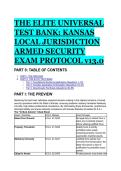
THE ELITE UNIVERSAL
TEST BANK: KANSAS
LOCAL JURISDICTION
ARMED SECURITY
EXAM PROTOCOL v13.0
PART 0: TABLE OF CONTENTS
1. PART I: THE PREVIEW
2. PART II: THE ELITE TEST BANK
○ Tier 1: Foundational Syntax & Application (Questions 1–18)
○ Tier 2: Complex Application & Simulation (Questions 19–37)
○ Tier 3: Grandmaster Synthesis (Questions 38–55)
PART I: THE PREVIEW
Mastering this test bank calibrates analytical decision-making to the highest echelons of armed
security operations within the State of Kansas, ensuring academic mastery translates flawlessly
into elite, high-stakes professional competence. By internalizing these frameworks, practitioners
eliminate liability and ensure absolute compliance with Kansas Statutes Annotated (K.S.A.).
The "Critical Axioms" Cheat Sheet
Axiom / Doctrine K.S.A. Statute Core Principle
Stand Your Ground K.S.A. 21-5230 No legal duty to retreat from a
place one is lawfully present
before utilizing justified force.
Property Threshold K.S.A. 21-5225 Deadly force is strictly
prohibited when solely
protecting property; human life
supersedes material assets.
Statutory Immunity K.S.A. 21-5231 Justified force grants true
immunity from prosecution; the
State must prove a lack of
justification by probable cause
pretrial.
Citizen's Arrest K.S.A. 22-2403 Private persons may arrest only
,Axiom / Doctrine K.S.A. Statute Core Principle
if a felony is committed or a
misdemeanor is actively
committed in their view.
Merchant's Privilege K.S.A. 21-5411 Suspected thieves may be
detained for a reasonable time
on the premises, provided there
is probable cause of wrongful
taking.
PART II: THE ELITE TEST BANK
Tier 1: Foundational Syntax & Application (Questions 1–18)
Q1: An applicant seeks a Kansas Armed Security Guard license. Based on the principles of the
Kansas Administrative Regulations and K.S.A. 75-7b, which statement regarding the applicant's
qualifications is the MOST ACCURATE?
A) The applicant must be at least 18 years of age and hold a valid Kansas driver's license. B)
The applicant must be at least 21 years of age, submit to a fingerprint background check, and
undergo state-certified training. C) The applicant may carry a firearm immediately upon passing
a psychological evaluation. D) The applicant must possess prior law enforcement experience to
qualify for armed status.
● Answer: B (The applicant must be at least 21 years of age, submit to a fingerprint
background check, and undergo state-certified training.)
● Distractor Analysis:
○ A is incorrect: Age 18 applies only to unarmed security; armed guards must be 21.
○ C is incorrect: Carrying a firearm requires completion of state-certified training and
official permit issuance.
○ D is incorrect: Prior law enforcement experience is not a statutory requirement for
armed licensure.
The Mentor's Analysis: Foundational licensing parameters establish the hard deck of the
profession. When verifying eligibility, the immediate priority is verifying the strict 21-year age
minimum and the absolute necessity of state-certified KLETC or KSCPOST aligned training. By
utilizing baseline statutes, the practitioner bypasses the common trap of confusing unarmed and
armed prerequisites. Professional/Academic Intuition: Never conflate unarmed (18+) and
armed (21+) statutory licensing requirements.
Q2: An armed guard unholsters their firearm and points it at an aggressive trespasser. Based on
the principles of K.S.A. 21-5221 (Definitions of Use of Force), which classification is the MOST
ACCURATE?
A) Unlawful aggravated assault. B) Use of deadly force. C) Use of non-deadly force. D) Criminal
restraint.
● Answer: C (Use of non-deadly force.)
● Distractor Analysis:
○ A is incorrect: If justified to terminate unlawful interference, displaying a weapon is
not an assault.
○ B is incorrect: K.S.A. 21-5221 explicitly defines displaying a weapon to create
apprehension as non-deadly force.
○ D is incorrect: The guard is demanding the trespasser leave, not restricting
, movement.
The Mentor's Analysis: The law distinguishes between the threat of deadly force and the
application of deadly force. When facing an escalating threat, the immediate priority is
understanding that presenting a firearm to create apprehension remains statutorily classified as
non-deadly force. By utilizing the threat of force exception, the analyst bypasses the common
trap of equating weapon display directly with deadly force application. Professional/Academic
Intuition: Displaying a firearm to deter an attack is legally classified as non-deadly force
under Kansas law.
Q3: A thief cuts a fence and steals a $5,000 generator. Based on the principles of K.S.A.
21-5225 (Defense of Property), which action is the MOST ACCURATE?
A) The officer may use deadly force because the value exceeds the felony theft threshold. B)
The officer may use deadly force to prevent the escape of a fleeing felon. C) The officer may
use reasonable non-deadly force to terminate the interference, but deadly force is strictly
prohibited. D) The officer must retreat and solely act as a witness.
● Answer: C (The officer may use reasonable non-deadly force to terminate the
interference, but deadly force is strictly prohibited.)
● Distractor Analysis:
○ A is incorrect: Monetary value never justifies deadly force.
○ B is incorrect: The fleeing felon rule permits deadly force only if the suspect poses a
threat of death or serious injury.
○ D is incorrect: Officers may use reasonable non-deadly force to protect property.
The Mentor's Analysis: Property defense is a highly tested liability trap. When facing property
theft, the immediate priority is recognizing that material goods do not equate to human life. By
utilizing proportional non-deadly force, the operator bypasses the common trap of escalating to
lethal measures for property preservation. Professional/Academic Intuition: Deadly force is
absolutely forbidden for the sole defense of property, regardless of its monetary value.
Q4: An armed guard is shoved to the ground by an unarmed assailant. Based on the principles
of K.S.A. 21-5230 (No Duty to Retreat), which conclusion is the MOST ACCURATE?
A) The guard must attempt to scramble away before deploying defensive force. B) The guard
has no duty to retreat and may use proportional force to defend themselves. C) The guard must
issue a verbal warning before utilizing any physical force. D) The guard may immediately shoot
the assailant due to the disparity in physical positioning.
● Answer: B (The guard has no duty to retreat and may use proportional force to defend
themselves.)
● Distractor Analysis:
○ A is incorrect: Kansas explicitly removes the legal obligation to retreat from a place
one is lawfully present.
○ C is incorrect: A verbal warning is tactically sound but not statutorily mandated prior
to defensive force.
○ D is incorrect: Being shoved does not automatically justify deadly force unless the
guard reasonably fears imminent death or great bodily harm.
The Mentor's Analysis: The removal of the retreat requirement fundamentally alters defensive
engagements. When facing a physical attack, the immediate priority is deploying proportional
force to neutralize the threat. By utilizing the Stand Your Ground doctrine, practitioners bypass
the common trap of believing they must attempt an unsafe withdrawal. Professional/Academic
Intuition: If lawfully present, there is zero duty to retreat before defending oneself with
proportional force.
Q5: A private security officer witnesses a suspect commit a misdemeanor vandalism offense
TEST BANK: KANSAS
LOCAL JURISDICTION
ARMED SECURITY
EXAM PROTOCOL v13.0
PART 0: TABLE OF CONTENTS
1. PART I: THE PREVIEW
2. PART II: THE ELITE TEST BANK
○ Tier 1: Foundational Syntax & Application (Questions 1–18)
○ Tier 2: Complex Application & Simulation (Questions 19–37)
○ Tier 3: Grandmaster Synthesis (Questions 38–55)
PART I: THE PREVIEW
Mastering this test bank calibrates analytical decision-making to the highest echelons of armed
security operations within the State of Kansas, ensuring academic mastery translates flawlessly
into elite, high-stakes professional competence. By internalizing these frameworks, practitioners
eliminate liability and ensure absolute compliance with Kansas Statutes Annotated (K.S.A.).
The "Critical Axioms" Cheat Sheet
Axiom / Doctrine K.S.A. Statute Core Principle
Stand Your Ground K.S.A. 21-5230 No legal duty to retreat from a
place one is lawfully present
before utilizing justified force.
Property Threshold K.S.A. 21-5225 Deadly force is strictly
prohibited when solely
protecting property; human life
supersedes material assets.
Statutory Immunity K.S.A. 21-5231 Justified force grants true
immunity from prosecution; the
State must prove a lack of
justification by probable cause
pretrial.
Citizen's Arrest K.S.A. 22-2403 Private persons may arrest only
,Axiom / Doctrine K.S.A. Statute Core Principle
if a felony is committed or a
misdemeanor is actively
committed in their view.
Merchant's Privilege K.S.A. 21-5411 Suspected thieves may be
detained for a reasonable time
on the premises, provided there
is probable cause of wrongful
taking.
PART II: THE ELITE TEST BANK
Tier 1: Foundational Syntax & Application (Questions 1–18)
Q1: An applicant seeks a Kansas Armed Security Guard license. Based on the principles of the
Kansas Administrative Regulations and K.S.A. 75-7b, which statement regarding the applicant's
qualifications is the MOST ACCURATE?
A) The applicant must be at least 18 years of age and hold a valid Kansas driver's license. B)
The applicant must be at least 21 years of age, submit to a fingerprint background check, and
undergo state-certified training. C) The applicant may carry a firearm immediately upon passing
a psychological evaluation. D) The applicant must possess prior law enforcement experience to
qualify for armed status.
● Answer: B (The applicant must be at least 21 years of age, submit to a fingerprint
background check, and undergo state-certified training.)
● Distractor Analysis:
○ A is incorrect: Age 18 applies only to unarmed security; armed guards must be 21.
○ C is incorrect: Carrying a firearm requires completion of state-certified training and
official permit issuance.
○ D is incorrect: Prior law enforcement experience is not a statutory requirement for
armed licensure.
The Mentor's Analysis: Foundational licensing parameters establish the hard deck of the
profession. When verifying eligibility, the immediate priority is verifying the strict 21-year age
minimum and the absolute necessity of state-certified KLETC or KSCPOST aligned training. By
utilizing baseline statutes, the practitioner bypasses the common trap of confusing unarmed and
armed prerequisites. Professional/Academic Intuition: Never conflate unarmed (18+) and
armed (21+) statutory licensing requirements.
Q2: An armed guard unholsters their firearm and points it at an aggressive trespasser. Based on
the principles of K.S.A. 21-5221 (Definitions of Use of Force), which classification is the MOST
ACCURATE?
A) Unlawful aggravated assault. B) Use of deadly force. C) Use of non-deadly force. D) Criminal
restraint.
● Answer: C (Use of non-deadly force.)
● Distractor Analysis:
○ A is incorrect: If justified to terminate unlawful interference, displaying a weapon is
not an assault.
○ B is incorrect: K.S.A. 21-5221 explicitly defines displaying a weapon to create
apprehension as non-deadly force.
○ D is incorrect: The guard is demanding the trespasser leave, not restricting
, movement.
The Mentor's Analysis: The law distinguishes between the threat of deadly force and the
application of deadly force. When facing an escalating threat, the immediate priority is
understanding that presenting a firearm to create apprehension remains statutorily classified as
non-deadly force. By utilizing the threat of force exception, the analyst bypasses the common
trap of equating weapon display directly with deadly force application. Professional/Academic
Intuition: Displaying a firearm to deter an attack is legally classified as non-deadly force
under Kansas law.
Q3: A thief cuts a fence and steals a $5,000 generator. Based on the principles of K.S.A.
21-5225 (Defense of Property), which action is the MOST ACCURATE?
A) The officer may use deadly force because the value exceeds the felony theft threshold. B)
The officer may use deadly force to prevent the escape of a fleeing felon. C) The officer may
use reasonable non-deadly force to terminate the interference, but deadly force is strictly
prohibited. D) The officer must retreat and solely act as a witness.
● Answer: C (The officer may use reasonable non-deadly force to terminate the
interference, but deadly force is strictly prohibited.)
● Distractor Analysis:
○ A is incorrect: Monetary value never justifies deadly force.
○ B is incorrect: The fleeing felon rule permits deadly force only if the suspect poses a
threat of death or serious injury.
○ D is incorrect: Officers may use reasonable non-deadly force to protect property.
The Mentor's Analysis: Property defense is a highly tested liability trap. When facing property
theft, the immediate priority is recognizing that material goods do not equate to human life. By
utilizing proportional non-deadly force, the operator bypasses the common trap of escalating to
lethal measures for property preservation. Professional/Academic Intuition: Deadly force is
absolutely forbidden for the sole defense of property, regardless of its monetary value.
Q4: An armed guard is shoved to the ground by an unarmed assailant. Based on the principles
of K.S.A. 21-5230 (No Duty to Retreat), which conclusion is the MOST ACCURATE?
A) The guard must attempt to scramble away before deploying defensive force. B) The guard
has no duty to retreat and may use proportional force to defend themselves. C) The guard must
issue a verbal warning before utilizing any physical force. D) The guard may immediately shoot
the assailant due to the disparity in physical positioning.
● Answer: B (The guard has no duty to retreat and may use proportional force to defend
themselves.)
● Distractor Analysis:
○ A is incorrect: Kansas explicitly removes the legal obligation to retreat from a place
one is lawfully present.
○ C is incorrect: A verbal warning is tactically sound but not statutorily mandated prior
to defensive force.
○ D is incorrect: Being shoved does not automatically justify deadly force unless the
guard reasonably fears imminent death or great bodily harm.
The Mentor's Analysis: The removal of the retreat requirement fundamentally alters defensive
engagements. When facing a physical attack, the immediate priority is deploying proportional
force to neutralize the threat. By utilizing the Stand Your Ground doctrine, practitioners bypass
the common trap of believing they must attempt an unsafe withdrawal. Professional/Academic
Intuition: If lawfully present, there is zero duty to retreat before defending oneself with
proportional force.
Q5: A private security officer witnesses a suspect commit a misdemeanor vandalism offense


