

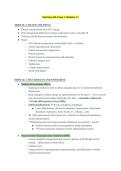
Med Surg III- Exam 1- Modules 1-2
MODULE 1: DEATH AND DYING
● Ethical considerations in an ICU setting
● Pain management differences/Unique medications used in critically ill
● Sedation and delirium assessment and treatment
● Death
○ S/S of patient progressing toward death (acute vs chronic)
○ Family education and interactions
○ Family inconsistency/aggression
○ Patient questions
○ Priority based on communication and education
○ Palliative/hospice care
○ Medications
○ Comfort interventions
○ Death with dignity
MODULE 2: METABOLISM AND ENDOCRINE
● Diabetic Ketoacidosis (DKA)
○ Inadequate insulin for cells to obtain adequate glucose for normal metabolism
○ Rapid onset
○ Body attempts to obtain energy by rapid breakdown of fat stores → liver converts
fatty acids into ketone bodies (which has low pH) → metabolic acidosis ph <
7.35 (this differentiates it from HHS)
○ Initial manifestations: Polyuria, polydipsia, polyphagia
■ Later: Dehydration, electrolyte imbalance, hypotension, tachycardia,
Kussmaul respirations, fruity breath, n/v, lethargy, coma
○ Tx: fluid replacement with isotonic NS, correction of electrolyte imbalances,
insulin administration
○ **Monitoring and correcting potassium imbalances are essential = priority
■ Osmotic diuresis makes pt susceptible to lethal arrhythmias
■ **Correct potassium imbalance before administering insulin!
● Hyperosmolar Hyperglycemic Syndrome (HHS)
○ serious metabolic derangement that occurs in patients with DM (ph will be
normal… differentiates it from DKA)
○ Gradual onset
○ Characterized by hyperglycemia, hyperosmolality, and dehydration without
significant ketoacidosis
, ■ Along with dehydration, most present with global neurological defects
○ Sufficient insulin to prevent rapid fat breakdown and ketone release, but not
enough insulin to prevent severe hyperglycemia
○ Dx: BG > 600+ mg/dL, serum osmolality of 320+ mOsm/kg, Bicarbonate >15
mEq/L, low ketonuria, absent to low ketonemia, ALOC
○ Tx: IV fluids (may alone be sufficient for tx) for dehydration and ALOC, airway
management, may additionally needIV insulin to correct hyperglycemia
● Hypothyroidism
○ ↓ T3, ↓ T4, ↑ TSH = primary
○ ↓ T3, ↓ T4, ↓ TSH = secondary or tertiary
○ If Hashimoto’s thyroiditis is suspected… evaluate antithyroid antibodies
○ **Pts with hypothyroidism who are receiving sedatives, hypotonics, or narcotics
require close observation bc their metabolism is slower
○ Manifestations: bradycardia, decreased RR, hypothermia, weight gain, elevated
serum cholesterol, increased sleeping, weakness and muscle aches, anorexia,
constipation, cold intolerance, decrease in libido
■ Think LOW and SLOW
○ Tx: replacing thyroid hormone and supportive measures
■ Levothyroxine is the most commonly prescribed med → take in the
morning (it’s a stimulant) on an empty stomach
○ Myxedema Coma: most severe type of hypothyroidism
■ ↓ T3, ↓ T4, ↑ TSH (look at T3 and T4 first!)
■ Characterized by hypoxia and carbon dioxide retention (secondary to
hypoventilation), fluid and electrolyte imbalances, hypothermia
● Also, bradycardia, hypotension, hypoglycemia, hyponatremia,
hypothermia
● Hyperthyroidism
○ ↑ T3, ↑ T4, ↓ TSH = primary (Grave’s)
○ ↑ T3, ↑ T4, ↑ TSH = secondary/ tertiary
○ Manifestations: elevated HR, thyroid bruit, heat intolerance, increased GI
activity, increased BM, increased appetite, weight loss, fatigue, nervousness,
insomnia, light to absent menses, hair loss, dysrhythmias
■ HYPERthyroidism… everything is HYPER
○ Propylthiouracil inhibits synthesis of thyroid hormone
○ Thyroid Storm: aka thyrotoxicosis, may develop with poorly managed
hyperthyroidism
■ Clinical manifestations: tachycardia, fever, systolic hypertension,
abdominal pain, tremors, changes in LOC
MODULE 1: DEATH AND DYING
● Ethical considerations in an ICU setting
● Pain management differences/Unique medications used in critically ill
● Sedation and delirium assessment and treatment
● Death
○ S/S of patient progressing toward death (acute vs chronic)
○ Family education and interactions
○ Family inconsistency/aggression
○ Patient questions
○ Priority based on communication and education
○ Palliative/hospice care
○ Medications
○ Comfort interventions
○ Death with dignity
MODULE 2: METABOLISM AND ENDOCRINE
● Diabetic Ketoacidosis (DKA)
○ Inadequate insulin for cells to obtain adequate glucose for normal metabolism
○ Rapid onset
○ Body attempts to obtain energy by rapid breakdown of fat stores → liver converts
fatty acids into ketone bodies (which has low pH) → metabolic acidosis ph <
7.35 (this differentiates it from HHS)
○ Initial manifestations: Polyuria, polydipsia, polyphagia
■ Later: Dehydration, electrolyte imbalance, hypotension, tachycardia,
Kussmaul respirations, fruity breath, n/v, lethargy, coma
○ Tx: fluid replacement with isotonic NS, correction of electrolyte imbalances,
insulin administration
○ **Monitoring and correcting potassium imbalances are essential = priority
■ Osmotic diuresis makes pt susceptible to lethal arrhythmias
■ **Correct potassium imbalance before administering insulin!
● Hyperosmolar Hyperglycemic Syndrome (HHS)
○ serious metabolic derangement that occurs in patients with DM (ph will be
normal… differentiates it from DKA)
○ Gradual onset
○ Characterized by hyperglycemia, hyperosmolality, and dehydration without
significant ketoacidosis
, ■ Along with dehydration, most present with global neurological defects
○ Sufficient insulin to prevent rapid fat breakdown and ketone release, but not
enough insulin to prevent severe hyperglycemia
○ Dx: BG > 600+ mg/dL, serum osmolality of 320+ mOsm/kg, Bicarbonate >15
mEq/L, low ketonuria, absent to low ketonemia, ALOC
○ Tx: IV fluids (may alone be sufficient for tx) for dehydration and ALOC, airway
management, may additionally needIV insulin to correct hyperglycemia
● Hypothyroidism
○ ↓ T3, ↓ T4, ↑ TSH = primary
○ ↓ T3, ↓ T4, ↓ TSH = secondary or tertiary
○ If Hashimoto’s thyroiditis is suspected… evaluate antithyroid antibodies
○ **Pts with hypothyroidism who are receiving sedatives, hypotonics, or narcotics
require close observation bc their metabolism is slower
○ Manifestations: bradycardia, decreased RR, hypothermia, weight gain, elevated
serum cholesterol, increased sleeping, weakness and muscle aches, anorexia,
constipation, cold intolerance, decrease in libido
■ Think LOW and SLOW
○ Tx: replacing thyroid hormone and supportive measures
■ Levothyroxine is the most commonly prescribed med → take in the
morning (it’s a stimulant) on an empty stomach
○ Myxedema Coma: most severe type of hypothyroidism
■ ↓ T3, ↓ T4, ↑ TSH (look at T3 and T4 first!)
■ Characterized by hypoxia and carbon dioxide retention (secondary to
hypoventilation), fluid and electrolyte imbalances, hypothermia
● Also, bradycardia, hypotension, hypoglycemia, hyponatremia,
hypothermia
● Hyperthyroidism
○ ↑ T3, ↑ T4, ↓ TSH = primary (Grave’s)
○ ↑ T3, ↑ T4, ↑ TSH = secondary/ tertiary
○ Manifestations: elevated HR, thyroid bruit, heat intolerance, increased GI
activity, increased BM, increased appetite, weight loss, fatigue, nervousness,
insomnia, light to absent menses, hair loss, dysrhythmias
■ HYPERthyroidism… everything is HYPER
○ Propylthiouracil inhibits synthesis of thyroid hormone
○ Thyroid Storm: aka thyrotoxicosis, may develop with poorly managed
hyperthyroidism
■ Clinical manifestations: tachycardia, fever, systolic hypertension,
abdominal pain, tremors, changes in LOC


