

NUR 445 -EXAM 2
Week 6
Module 4: Complex & Emergent Renal, Gl, Hepatic Disorders
B . . .
Management of Care for Complex Clients Experiencing Rena]
Dysfunction
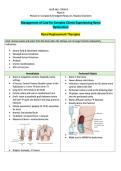
Renal Replacement Therapies
Goal: remove waste and water from the body when the kidneys can no longer function adequately
Indications:
Severe fluid & Electrolyte imbalances
Elevated Serum Creatinine
Elevated Serum Potassium
Acidosis
Uremic manifestations
GFR <10 mL/min
Hemodialysis Peritoneal Dialysis
e Done in outpatient centers, hospitals, home Done in the home
settings Fewer dietary restrictions
e |V Access: Central Venous Double-Lumen in the Indication: respond poorly to HD, desire more
Subclavian or IJ vein 2 short term TX control, elders with DM
e Long Term: AV Fistula or AV Graft Peritoneal cavity is used as the dialyzing layer
e Fistula: artery and vein in nondominant arm Fill phase: room-temp sterile dialysate fluid is
e Graft: insert a prosthetic graft between artery into the peritoneal cavity
and vein = quick use doesn’t last long, prone to Water diffusion control =2 dextrose
infection Gravity drains the fluid out
e Fistula assessment: palpate for thrill, auscultate fi’t'j?;ysate
for bruit
e Normal: low-pitched bruit , e
e Turbulent: increased force = stenosis |
e Absence of bruit = nonfunctional site Diffusion and
filtration across
oo returming to oationt the membrane
e L Catheter of the peritoneal
\ cavity
Artery.
Vein Catheter
‘ sure to WARM to body-temp
dialyzif(:a?h::z
Arterg?:fa[nous Artefriisci\gla:ous Central venous double lumen catheter
e Dialysis: 3x/week, 3-5 hours
, NUR 445 - EXAM 2
Week 6
Module 4: Complex & Emergent Renal, Gl, Hepatic Disorders
Blood is removed from the body and pumped
through a dialyzer. Dialysis fluid is pumped in
opposite direction of blood to remove waste.
Venous
pressure
Air trap and
air detector
— Clean blood
Arterial
Used
dialysateffiltrate monitor
Inflow
pressure
monitor
blood for
cleaning
e P4— Blood pump
Heparin pump
(to prevent clotting)
Complications HD Complications PD
Hypotension = rapid removal of fluid Contraindications:
(lightheaded, seizure, vision changes, chest o Abdominal surgeries
pain) O Abdominal hernias
O Obesity
A. TX: decrease fluid rate of removal
O Back problems
B. Replace with NS
O COPD
Muscle Cramps, N/V, malaise Complications:
A. NS Bolus o Contamination from bacteria
Bleeding o Peritonitis:
Uk Ww
Infection " Cloudy peritoneal efflueret
Dementia = due to aluminum " |ncreased WBC
= TX: Antibiotics
Dialysis disequilibrium syndrome: rapid changes
o
o Catheter infections: redness,
in the EXC Fluid
tenderness, drainage
A. Cerebral edema: N/V, restlessness, o Abdominal pain = change position to
confusion, headaches, twitching, help
seizures o Hyperglycemia and triglyceride: dietary
B. TX:Slow/decrease, hypertonic saline, and insulin administration
albumin, mannitol (Draw fluid from the o Respiratory 2 pneumonia/atelectasis:
brain cell) deep breathe, turn and reposition,
elevate HOB
Continuous Renal Replacement Therapy (CRRT)
, NUR 445 - EXAM 2
Week 6
Module 4: Complex & Emergent Renal, Gl, Hepatic Disorders
Indicated: acutely ill patients with AKI or severe fluid overload
Vascular Access: double lumen in combination with arterial line.
- Removal is slow and continuous
- Blood from patient flows through a hemofilter, which removes waste and solutes
- Replacement fluid may be infused into the port before to prevent clots in the filter
- Anticoagulation must be used to prevent clotting during CRRT
- Heparin: bolus at the beginning of TX
Replacement
fluid
Qent
n
, |Convectio
across
~ || pressure
patient
Replacement
fluid
Late-stage Renal Disorders
Acute Kidney Injury
Pathophysiology Clinical Manifestations
e Rapid, acute disease Volume overload
e Rapid azotemia (nitrogenous waste) Edema
e Uremia SOB
e Oliguria: decreased urine to 400 mL/day Pulmonary edema
Heart failure
JVD
Increased K, BUN/Creat, Phos
Decreased calcium, sodium, pH = metabolic
acidosis
Week 6
Module 4: Complex & Emergent Renal, Gl, Hepatic Disorders
B . . .
Management of Care for Complex Clients Experiencing Rena]
Dysfunction
Renal Replacement Therapies
Goal: remove waste and water from the body when the kidneys can no longer function adequately
Indications:
Severe fluid & Electrolyte imbalances
Elevated Serum Creatinine
Elevated Serum Potassium
Acidosis
Uremic manifestations
GFR <10 mL/min
Hemodialysis Peritoneal Dialysis
e Done in outpatient centers, hospitals, home Done in the home
settings Fewer dietary restrictions
e |V Access: Central Venous Double-Lumen in the Indication: respond poorly to HD, desire more
Subclavian or IJ vein 2 short term TX control, elders with DM
e Long Term: AV Fistula or AV Graft Peritoneal cavity is used as the dialyzing layer
e Fistula: artery and vein in nondominant arm Fill phase: room-temp sterile dialysate fluid is
e Graft: insert a prosthetic graft between artery into the peritoneal cavity
and vein = quick use doesn’t last long, prone to Water diffusion control =2 dextrose
infection Gravity drains the fluid out
e Fistula assessment: palpate for thrill, auscultate fi’t'j?;ysate
for bruit
e Normal: low-pitched bruit , e
e Turbulent: increased force = stenosis |
e Absence of bruit = nonfunctional site Diffusion and
filtration across
oo returming to oationt the membrane
e L Catheter of the peritoneal
\ cavity
Artery.
Vein Catheter
‘ sure to WARM to body-temp
dialyzif(:a?h::z
Arterg?:fa[nous Artefriisci\gla:ous Central venous double lumen catheter
e Dialysis: 3x/week, 3-5 hours
, NUR 445 - EXAM 2
Week 6
Module 4: Complex & Emergent Renal, Gl, Hepatic Disorders
Blood is removed from the body and pumped
through a dialyzer. Dialysis fluid is pumped in
opposite direction of blood to remove waste.
Venous
pressure
Air trap and
air detector
— Clean blood
Arterial
Used
dialysateffiltrate monitor
Inflow
pressure
monitor
blood for
cleaning
e P4— Blood pump
Heparin pump
(to prevent clotting)
Complications HD Complications PD
Hypotension = rapid removal of fluid Contraindications:
(lightheaded, seizure, vision changes, chest o Abdominal surgeries
pain) O Abdominal hernias
O Obesity
A. TX: decrease fluid rate of removal
O Back problems
B. Replace with NS
O COPD
Muscle Cramps, N/V, malaise Complications:
A. NS Bolus o Contamination from bacteria
Bleeding o Peritonitis:
Uk Ww
Infection " Cloudy peritoneal efflueret
Dementia = due to aluminum " |ncreased WBC
= TX: Antibiotics
Dialysis disequilibrium syndrome: rapid changes
o
o Catheter infections: redness,
in the EXC Fluid
tenderness, drainage
A. Cerebral edema: N/V, restlessness, o Abdominal pain = change position to
confusion, headaches, twitching, help
seizures o Hyperglycemia and triglyceride: dietary
B. TX:Slow/decrease, hypertonic saline, and insulin administration
albumin, mannitol (Draw fluid from the o Respiratory 2 pneumonia/atelectasis:
brain cell) deep breathe, turn and reposition,
elevate HOB
Continuous Renal Replacement Therapy (CRRT)
, NUR 445 - EXAM 2
Week 6
Module 4: Complex & Emergent Renal, Gl, Hepatic Disorders
Indicated: acutely ill patients with AKI or severe fluid overload
Vascular Access: double lumen in combination with arterial line.
- Removal is slow and continuous
- Blood from patient flows through a hemofilter, which removes waste and solutes
- Replacement fluid may be infused into the port before to prevent clots in the filter
- Anticoagulation must be used to prevent clotting during CRRT
- Heparin: bolus at the beginning of TX
Replacement
fluid
Qent
n
, |Convectio
across
~ || pressure
patient
Replacement
fluid
Late-stage Renal Disorders
Acute Kidney Injury
Pathophysiology Clinical Manifestations
e Rapid, acute disease Volume overload
e Rapid azotemia (nitrogenous waste) Edema
e Uremia SOB
e Oliguria: decreased urine to 400 mL/day Pulmonary edema
Heart failure
JVD
Increased K, BUN/Creat, Phos
Decreased calcium, sodium, pH = metabolic
acidosis


