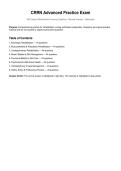
CRRN Advanced Practice Exam
350 Original Rehabilitation Nursing Questions • Marked Answers • Rationales
Purpose: Comprehensive practice for rehabilitation nursing certification preparation. Questions are original practice
material and are not recalled or copied examination questions.
Table of Contents
1. Neurologic Rehabilitation — 44 questions
2. Musculoskeletal & Amputation Rehabilitation — 44 questions
3. Cardiopulmonary Rehabilitation — 44 questions
4. Bowel, Bladder & Skin Management — 44 questions
5. Functional Mobility & Self-Care — 44 questions
6. Psychosocial & Behavioral Health — 44 questions
7. Interdisciplinary & Case Management — 43 questions
8. Safety, Ethics & Professional Practice — 43 questions
Answer format: The correct answer is highlighted in light blue. The rationale is highlighted in pale yellow.
,Question 1 — Neurologic Rehabilitation
A rehabilitation nurse is caring for a patient with stroke. Which intervention is the priority?
A. Assess the patient's current functional status and immediate safety needs.
B. Avoid all activity until discharge.
C. Provide education only after discharge.
D. Delegate the assessment to an unlicensed staff member.
Correct Answer: A
Rationale: The priority is a focused assessment of function and safety so the rehabilitation plan can be individualized and risks
addressed promptly.
Question 2 — Musculoskeletal & Amputation Rehabilitation
Which finding in a patient undergoing rehabilitation for amputation requires the nurse's most immediate
follow-up?
A. A request to practice a familiar self-care task.
B. A desire to learn about community resources.
C. Mild fatigue after scheduled therapy.
D. A new or worsening change from the patient's established baseline.
Correct Answer: D
Rationale: A new or worsening deviation from baseline may signal an acute complication and should be assessed before routine
rehabilitation activities continue.
Question 3 — Cardiopulmonary Rehabilitation
The best rehabilitation goal for a patient with heart failure is:
A. A goal based only on the diagnosis.
B. An identical goal for every patient with the condition.
C. A measurable goal that maximizes safe independence in a meaningful activity.
D. Complete dependence on staff for all activities.
Correct Answer: C
Rationale: Rehabilitation goals should be individualized, functional, measurable, and directed toward the greatest safe level of
independence.
,Question 4 — Bowel, Bladder & Skin Management
Which teaching approach is most appropriate when educating a patient with neurogenic bladder?
A. Delay teaching until the patient leaves rehabilitation.
B. Use demonstration and return demonstration, then reinforce learning.
C. Give a long written handout without discussion.
D. Teach only the family and exclude the patient.
Correct Answer: B
Rationale: Demonstration and return demonstration allow the nurse to verify understanding and skill performance while reinforcing
patient participation.
Question 5 — Functional Mobility & Self-Care
A patient with transfers wants to increase independence. Which nursing action best supports this goal?
A. Allow the patient to perform the portions of the task they can safely complete.
B. Perform the entire task to save time.
C. Discourage adaptive equipment.
D. Require assistance even when it is unnecessary.
Correct Answer: A
Rationale: Rehabilitation nursing promotes safe independence by supporting what the patient can do while providing assistance
only where needed.
Question 6 — Psychosocial & Behavioral Health
A rehabilitation nurse is caring for a patient with adjustment. Which intervention is the priority?
A. Avoid all activity until discharge.
B. Provide education only after discharge.
C. Delegate the assessment to an unlicensed staff member.
D. Assess the patient's current functional status and immediate safety needs.
Correct Answer: D
Rationale: The priority is a focused assessment of function and safety so the rehabilitation plan can be individualized and risks
addressed promptly.
, Question 7 — Interdisciplinary & Case Management
Which finding in a patient undergoing rehabilitation for team communication requires the nurse's most
immediate follow-up?
A. A desire to learn about community resources.
B. Mild fatigue after scheduled therapy.
C. A new or worsening change from the patient's established baseline.
D. A request to practice a familiar self-care task.
Correct Answer: C
Rationale: A new or worsening deviation from baseline may signal an acute complication and should be assessed before routine
rehabilitation activities continue.
Question 8 — Safety, Ethics & Professional Practice
The best rehabilitation goal for a patient with informed consent is:
A. An identical goal for every patient with the condition.
B. A measurable goal that maximizes safe independence in a meaningful activity.
C. Complete dependence on staff for all activities.
D. A goal based only on the diagnosis.
Correct Answer: B
Rationale: Rehabilitation goals should be individualized, functional, measurable, and directed toward the greatest safe level of
independence.
Question 9 — Neurologic Rehabilitation
Which teaching approach is most appropriate when educating a patient with traumatic brain injury?
A. Use demonstration and return demonstration, then reinforce learning.
B. Give a long written handout without discussion.
C. Teach only the family and exclude the patient.
D. Delay teaching until the patient leaves rehabilitation.
Correct Answer: A
Rationale: Demonstration and return demonstration allow the nurse to verify understanding and skill performance while reinforcing
patient participation.
350 Original Rehabilitation Nursing Questions • Marked Answers • Rationales
Purpose: Comprehensive practice for rehabilitation nursing certification preparation. Questions are original practice
material and are not recalled or copied examination questions.
Table of Contents
1. Neurologic Rehabilitation — 44 questions
2. Musculoskeletal & Amputation Rehabilitation — 44 questions
3. Cardiopulmonary Rehabilitation — 44 questions
4. Bowel, Bladder & Skin Management — 44 questions
5. Functional Mobility & Self-Care — 44 questions
6. Psychosocial & Behavioral Health — 44 questions
7. Interdisciplinary & Case Management — 43 questions
8. Safety, Ethics & Professional Practice — 43 questions
Answer format: The correct answer is highlighted in light blue. The rationale is highlighted in pale yellow.
,Question 1 — Neurologic Rehabilitation
A rehabilitation nurse is caring for a patient with stroke. Which intervention is the priority?
A. Assess the patient's current functional status and immediate safety needs.
B. Avoid all activity until discharge.
C. Provide education only after discharge.
D. Delegate the assessment to an unlicensed staff member.
Correct Answer: A
Rationale: The priority is a focused assessment of function and safety so the rehabilitation plan can be individualized and risks
addressed promptly.
Question 2 — Musculoskeletal & Amputation Rehabilitation
Which finding in a patient undergoing rehabilitation for amputation requires the nurse's most immediate
follow-up?
A. A request to practice a familiar self-care task.
B. A desire to learn about community resources.
C. Mild fatigue after scheduled therapy.
D. A new or worsening change from the patient's established baseline.
Correct Answer: D
Rationale: A new or worsening deviation from baseline may signal an acute complication and should be assessed before routine
rehabilitation activities continue.
Question 3 — Cardiopulmonary Rehabilitation
The best rehabilitation goal for a patient with heart failure is:
A. A goal based only on the diagnosis.
B. An identical goal for every patient with the condition.
C. A measurable goal that maximizes safe independence in a meaningful activity.
D. Complete dependence on staff for all activities.
Correct Answer: C
Rationale: Rehabilitation goals should be individualized, functional, measurable, and directed toward the greatest safe level of
independence.
,Question 4 — Bowel, Bladder & Skin Management
Which teaching approach is most appropriate when educating a patient with neurogenic bladder?
A. Delay teaching until the patient leaves rehabilitation.
B. Use demonstration and return demonstration, then reinforce learning.
C. Give a long written handout without discussion.
D. Teach only the family and exclude the patient.
Correct Answer: B
Rationale: Demonstration and return demonstration allow the nurse to verify understanding and skill performance while reinforcing
patient participation.
Question 5 — Functional Mobility & Self-Care
A patient with transfers wants to increase independence. Which nursing action best supports this goal?
A. Allow the patient to perform the portions of the task they can safely complete.
B. Perform the entire task to save time.
C. Discourage adaptive equipment.
D. Require assistance even when it is unnecessary.
Correct Answer: A
Rationale: Rehabilitation nursing promotes safe independence by supporting what the patient can do while providing assistance
only where needed.
Question 6 — Psychosocial & Behavioral Health
A rehabilitation nurse is caring for a patient with adjustment. Which intervention is the priority?
A. Avoid all activity until discharge.
B. Provide education only after discharge.
C. Delegate the assessment to an unlicensed staff member.
D. Assess the patient's current functional status and immediate safety needs.
Correct Answer: D
Rationale: The priority is a focused assessment of function and safety so the rehabilitation plan can be individualized and risks
addressed promptly.
, Question 7 — Interdisciplinary & Case Management
Which finding in a patient undergoing rehabilitation for team communication requires the nurse's most
immediate follow-up?
A. A desire to learn about community resources.
B. Mild fatigue after scheduled therapy.
C. A new or worsening change from the patient's established baseline.
D. A request to practice a familiar self-care task.
Correct Answer: C
Rationale: A new or worsening deviation from baseline may signal an acute complication and should be assessed before routine
rehabilitation activities continue.
Question 8 — Safety, Ethics & Professional Practice
The best rehabilitation goal for a patient with informed consent is:
A. An identical goal for every patient with the condition.
B. A measurable goal that maximizes safe independence in a meaningful activity.
C. Complete dependence on staff for all activities.
D. A goal based only on the diagnosis.
Correct Answer: B
Rationale: Rehabilitation goals should be individualized, functional, measurable, and directed toward the greatest safe level of
independence.
Question 9 — Neurologic Rehabilitation
Which teaching approach is most appropriate when educating a patient with traumatic brain injury?
A. Use demonstration and return demonstration, then reinforce learning.
B. Give a long written handout without discussion.
C. Teach only the family and exclude the patient.
D. Delay teaching until the patient leaves rehabilitation.
Correct Answer: A
Rationale: Demonstration and return demonstration allow the nurse to verify understanding and skill performance while reinforcing
patient participation.